Impact Factor




Theranostics 2026; 16(15):8546-8558. doi:10.7150/thno.131438 This issue Cite
Review
Frailty and [177Lu]Lu-PSMA-617 therapy: tools and strategies for older men with metastatic castration-resistant prostate cancer
Matteo Bauckneht1,2  , Nicolò Borsellino3, Giuseppe Ferdinando Colloca4, Lucia Fratino5, Daniele Santini6
1. Department of Health Sciences (DISSAL), University of Genova, Genova, Italy.
2. AOM-IRCCS Ospedale Policlinico San Martino, Genova, Italy.
3. Medical Oncology Unit, Ospedale Buccheri La Ferla Fatebenefratelli, Palermo, Italy.
4. Department of Geriatrics, Orthopaedics and Rheumatology, Fondazione A Gemelli IRCCS, Rome, Italy.
5. Medical Oncology Unit, IRCCS Centro Di Riferimento Oncologico di Aviano, Aviano, Italy.
6. Department of Sciences and Medical-surgical Biotechnologies, UOC Oncologia, Policlinico Umberto 1, La Sapienza Università di Roma, Rome, Italy.
Received 2026-1-14; Accepted 2026-5-29; Published 2026-7-29
Abstract
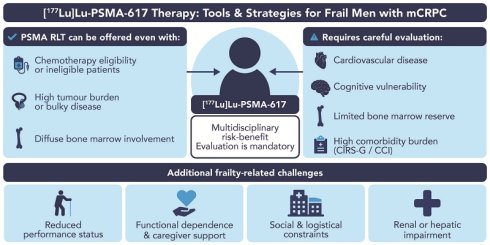
The prognosis of metastatic castration-resistant prostate cancer is dismal. [177Lu]Lutetium-prostate-specific membrane antigen (PSMA)-617 ([177Lu]Lu-PSMA-617) is the new standard of care for PSMA-positive mCRPC previously treated with ARPI and taxane-based chemotherapy. The efficacy and safety of [177Lu]Lu-PSMA-617 have been confirmed by phase 2 (TheraP [NCT03392428]) and phase 3 (VISION study [NCT02511664] and PSMAfore trial [NCT04689828]) clinical trials. A substantial proportion of patients with mCRPC are older adults; however, chronological age alone should not be considered a contraindication to [177Lu]Lu-PSMA-617 therapy. Instead, therapeutic decisions must be guided by a comprehensive evaluation of life expectancy, comorbidities, and frailty. Here we review the effectiveness and safety data for [177Lu]Lu-PSMA-617, present tools for the geriatric and frailty assessments in clinical practice and discuss its utility and therapeutic indications in patients with different types of frailty.
Introduction
Prostate cancer is an age-associated malignancy, with most diagnoses occurring in men older than 60 years. While many patients initially present with localised or castration-sensitive disease, a substantial proportion eventually develop metastatic castration-resistant prostate cancer (mCRPC), a condition associated with poor prognosis and limited long-term survival [1].
Several systemic therapies for mCRPC have demonstrated survival benefit, including taxane-based chemotherapy, androgen receptor pathway inhibitors (ARPIs), and poly(ADP-ribose) polymerase (PARP) inhibitors in selected molecular subgroups [2]. However, in real-world clinical practice, a large proportion of patients with mCRPC are older, frail, and affected by multiple comorbidities [3-6]. Because of this, treatment decisions are frequently limited by reduced physiological reserve, polypharmacy, impaired bone marrow function, and increased susceptibility to toxicity. As a result, standard systemic therapies are often poorly tolerated, leading to dose reductions, early discontinuation, or exclusion from treatment [7, 8].
In parallel, the role of geriatric oncology has shifted from selecting “fit” older adults for intensive treatments to enabling broader access to effective therapies through individualised, evidence-based decision-making. Comprehensive Geriatric Assessment (CGA) is no longer used primarily to exclude patients at high risk of toxicity, but rather to guide treatment adaptation and optimisation. This paradigm shift is particularly relevant in mCRPC, where frailty is highly prevalent and represents a central determinant of therapeutic sequencing [9-13]. The goal today is to enable older adults, including those with degrees of frailty, to access life prolonging therapies through tailored, evidence-based decision making.
In this context, the limitations of conventional systemic therapies in frail patients highlight the need for alternative strategies. Prostate-specific membrane antigen (PSMA)-targeted radioligand therapy, particularly with [177Lu]Lu-PSMA-617, has emerged as an effective treatment option for PSMA-positive mCRPC [14, 15]. By integrating molecular imaging for patient selection with targeted radionuclide delivery, this theranostic approach enables biologically driven, tumour-directed treatment. Although initially positioned after ARPIs and taxane-based chemotherapy, evolving regulatory approvals and accumulating clinical experience are progressively integrating radioligand therapy earlier in the treatment pathway, including in patients for whom chemotherapy is unsuitable [16-18].
Radioligand therapy should therefore not be regarded merely as a last-line option with uncertain feasibility in frail patients, but rather as a biologically rational and clinically meaningful strategy in a population where standard systemic treatments are frequently limited by toxicity. In this setting, the key issue is not whether radioligand therapy can be used in frail patients, but how to optimise patient selection and management to maximise benefit while minimising risk. Advanced age, impaired bone marrow reserve, baseline cytopenias, renal dysfunction, impaired nutritional status, and cumulative toxicity from prior treatments may increase vulnerability to treatment-related adverse events. Frailty should thus be considered not as a reason for exclusion, but as a factor requiring structured assessment, multidisciplinary evaluation, and individualised risk–benefit analysis [19].
Given the high prevalence of frailty in men with mCRPC [3-5] and the expanding role of PSMA-targeted theranostics, a critical appraisal of effectiveness, safety, and patient selection in this complex population is warranted. In this review, we examine the available evidence on [177Lu]Lu-PSMA-617 in frail patients, discuss tools for frailty assessment, and explore how radioligand therapy can be safely and appropriately integrated into therapeutic decision-making in mCRPC.
[177Lu]Lu-PSMA-617
Efficacy/effectiveness
Lutetium-177 radioisotope, the active moiety of the drug, is linked to a small-molecule high-affinity PSMA-specific ligand. PSMA is a transmembrane protein highly expressed in prostate cancer, including the metastatic castration-resistant disease and its expression is lower in normal tissue than in tumour cells [14, 15]. Once bound to PSMA-expressing cancer cells, the beta-emission of lutetium-177 induces DNA damage leading to cell death. [177Lu]Lu-PSMA-617 emits also a small fraction of gamma rays, which favours scintigraphic detection useful for post-treatment imaging [14].
The efficacy of the drug was first shown by the phase 3 VISION study (NCT02511664), in which [177Lu]Lu-PSMA-617 added to the standard of care prolonged radiographic progression-free survival (rPFS) and overall survival (OS) in patients with advanced PSMA-positive mCRPC [20]. The magnitude of prostate-specific antigen (PSA) response was associated with clinical and patient-reported outcome improvements [21]. Moreover, [177Lu]Lu-PSMA-617 plus standard of care delayed time to worsening of health-related quality of life and time to skeletal events compared to the control arm [22]. The phase 2 TheraP (NCT03392428) trials showed that, compared with cabazitaxel, [177Lu]Lu-PSMA-617 elicited a better response measured as lowering of the PSA levels [23]. Also, in a real-world setting, [177Lu]Lu-PSMA-617 provided significantly longer duration of PFS and OS [24] and of OS and time-to-treatment-failure as well as rates of at least 50% and 90% improvement of PSA levels versus baseline [25] than cabazitaxel. In addition, the PSMAfore trial (NCT04689828) showed that patients treated with [177Lu]Lu-PSMA-617 had twice longer median rPSF than those in whom ARPI was changed [26].
There is a growing body of evidence that confirms the effectiveness of [177Lu]Lu-PSMA-617 in the real-world setting [24, 27-32] and the results from a small series of 18 patients indicated that rechallenge with [177Lu]Lu-PSMA-617 radioligand therapy in mCRPC can be effective and safe [33]. A meta-analysis of clinical trial results confirmed that the treatment with [177Lu]Lu-PSMA-617 favourably impacts the radiographic and biochemical control of mCRPC [34].
Safety
In the VISION trial, both all and grade ≥ 3 adverse events were more common in the [177Lu]Lu-PSMA-617 plus standard of care arm than in the control arm (52.7% versus 38.0%). Amongst adverse events of grade ≥ 3, haematological toxicity, namely anaemia (12.9% versus 4.9%), thrombocytopaenia (7.9% versus 1.0%), lymphopenia (7.8% versus 0.5%), was more common in the [177Lu]Lu-PSMA-617 plus standard of care arm [20]. The mean haemoglobin and creatinine concentrations and platelet counts remained stable over time [22].
The VISION dosimetry substudy quantified absorbed doses of [177Lu]Lu-PSMA-617 in the kidneys and other organs showing that renal cumulative dose was below the established limit, whilst cumulative absorbed doses in at-risk organs over multiple cycles could be predicted from the first cycle data [35]. In fact, according to a systematic review, tumour tissue receives 3-6 times greater absorbed dose than the at-risk organs [36].
The any-grade treatment-emergent adverse events (TEAE) frequency was similar across all cycles of [177Lu]Lu-PSMA-617 treatment. No additional safety concerns were reported for patients who received >4 cycles. The exposure-adjusted safety analysis revealed that the overall TEAE incidence was similar between arms, but distinct trends for different TEAE types were noted and the incidence of events associated with [177Lu]Lu-PSMA-617 remained higher in the [177Lu]Lu-PSMA-617 arm. Longer exposure to [177Lu]Lu-PSMA-617 plus standard of care was not associated with a higher toxicity risk, and the extended time for safety observation could account for the higher TEAE incidence in comparison to standard of care alone. The findings support a favourable benefit-risk profile for 6 cycles of [177Lu]Lu-PSMA-617 in this setting and the use of up to 6 cycles of [177Lu]Lu-PSMA-617 in patients who are clinically benefiting from and tolerating this therapy [37]. For patients with metastatic prostate cancer no longer responding to hormone therapy, an increase in the number of cycles of treatment with [177Lu]Lu-PSMA-617 from 4 to 6 had no additional adverse side effects [37].
Regarding the risk of developing secondary tumours, a low incidence (5/381; 1.3%) of treatment-induced myeloid neoplasms was described after a median of 33.6 months from the commencement of [177Lu]Lu-PSMA-617 in patients who also underwent chemotherapy [38]. A recent postmarketing safety monitoring study detected new adverse events (loss of libido, hydronephrosis, tachycardia, tumour lysis syndrome and tumour flare). These events were identified during a disproportionality analysis of the FDA Adverse Events Reporting System’s database and do not necessarily imply a causal relation to [177Lu]Lu-PSMA-617 [39].
These findings highlight the need for meticulous patient selection and management to optimise therapeutic benefits while mitigating risks.
Frailty
Definition and prevalence
The term “frailty” refers to a state of aging-related vulnerability due to physiological reserve and function decline. Such decline results in poor response to acute stressors increasing the likelihood of adverse events [40, 41]. Several definitions of frailty have been proposed. Frailty can be conceptualised as the result of an accumulation of deficits such as diseases and disabilities that make an individual more vulnerable to health deterioration and increase the risk of complications and mortality [42, 43]. The most widely used model of physical frailty describes it as a biological syndrome characterised by extreme vulnerability to stressors (physical, psychological or environmental) and predisposition to adverse events such as falls, disability, hospitalisation and death. It reflects a loss of homeostatic capacity and reduced resilience of biological system to environmental stress [6]. According to Fried’s criteria, frailty can be defined as weight loss, exhaustion, low physical activity, slowness and weakness [40]. In geriatric oncology, an early definition of frailty was proposed by Balducci et al, and included the presence of one or more of the following conditions: 1) a geriatric syndrome and/or 2) a dependency in at last one activity of daily living (ADL) and/or 3) more than three comorbidities and /or 4) age ≥ 85 years [44].
Dimensions of frailty. Adapted from [48]
| Dimension | Description |
|---|---|
| Physical | • Frailty syndrome: set of signs and symptoms that define a health condition • Age-related accumulation of diseases and deficits |
| Cognitive | • Reduced cognitive reserve, can be reversible or not |
| Social | • Risk of losing/loss of resources needed to fulfil basic social needs, threat to/lack of self-management abilities to fulfil social needs • Low income, housing insecurity |
| Psychological | • Co-occurrence of frailty with low mood, apathy, depression, loneliness and cognitive deficits. |
The weighted prevalence of frailty in community-dwelling >65-year-olds is about 10% and increases with age up to > 25% in the > 85 group [45]. Given that > 80% of patients with prostate cancer receive their diagnosis at the age > 60 years, the problem of frailty is common in this patient category and impacts both the prognosis and therapy choices [19]. Frailty measured by the Frailty Index (FI), based on the deficit accumulation model, is directly associated with worse baseline quality of life and impaired physical function in patients with mCRPC, underscoring its relevance not only as a prognostic variable but also as a practical tool for patient stratification before treatment decisions [46]. This finding is consistent with data from the Italian real-world context: in the prospective Meet-URO 5-ADHERE study, a substantial proportion of patients with mCRPC presented with functional impairment on instrumental ADL assessment and G8 screening, confirming that frailty affects a clinically significant portion of this patient population already at the time of treatment planning [75].
Markers of frailty
Frailty is a multidimensional construct. It can be considered as an age-related, physical, clinical conditions, cognitive, psychological and social syndrome (Table 2) [47, 48]. Frailty is considered to be an expression of population aging [6] and physical frailty is a pre-disability, disability being a condition in which assistance with basic ADL is needed [49]. Low testosterone due to aging-related hypogonadism, as well as androgen deprivation therapy, a key of prostate cancer management, can cause sarcopenia, loss of bone mineral density, and increase the risk of falls and fatigue that contribute to frailty [3, 19].
Tools used for assessing frailty.
| Domain | Tools |
|---|---|
| Comprehensive health status | Geriatric 8 (G8), Clinical Frailty Score (CFS) |
| Comorbidities | Cumulative Illness Score Rating-Geriatrics (CISR-G) and Charlson Co-morbidity Index (CCI) |
| Nutritional status | BMI, longitudinal body weight measurements |
| Cognitive function | Mini-COG |
| Physical function | Performance status: Karnofsky score, ECOG score Activities of Daily Living (ADL) and Instrumental Activities of Daily Living (IADL) |
ECOG, Eastern Cooperative Oncology Group.
Sarcopenia has garnered significant interest in oncology research and it is increasingly evident that reduced muscle mass and function are clearly associated with adverse outcomes and should be included in the geriatric assessment of older patient with cancer. According to the updated EWGSOP2 consensus, sarcopenia is defined by both low muscle strength and low muscle quantity or quality, with physical performance further stratifying its severity. In oncological practice, assessment of muscle mass via computed tomography at the L3 vertebral level or dual-energy X-ray absorptiometry is increasingly integrated into clinical workflows as an objective, reproducible measure of sarcopenic status that goes beyond the limitations of BMI or weight-based nutritional screening alone [50]. In a secondary analysis of a prospective observational study in 110 men with mCRPC, baseline sarcopenia was a predictor of radiographic progression and overall mortality regardless of treatment type received [51]. Cognitive frailty is the result of physical frailty and mild cognitive impairment and can be reversible or potentially reversible. Subjectively, patients may complain of memory loss [52]. Psychological frailty has been defined as the co-occurrence of physical frailty with low mood, apathy, depression, loneliness, and cognitive deficits [48, 53]. Social frailty, including living alone, interaction with neighbours, and social participation, is a component of frailty that increases the incidence of adverse health outcomes [54].
There is a relationship between frailty and poverty. The often-substantial financial burden can result in financial toxicity, i.e., unintended financial consequences and distress brought about by cancer and its treatment [55]. Therefore, financial issues must be considered when discussing frailty [56]. In an analysis from almost 500 older adults with cancer entered into the Cancer and Aging Resilience Evaluation (CARE) registry at the University of Alabama, the unmet resource needs were associated with a 3.3-fold higher adjusted odds of frailty. In this population, transportation insecurity (i.e., problems with getting transportation to the doctor and missing doctor’s appointments due to transportation issues) encountered in 11.5% was the most prevalent unmet need. Another CARE study showed that living in a rural area was associated with reduced 1-year survival amongst frail older adults with newly diagnosed cancer [57]. Also, high prevalence and early onset of frailty was found in homeless individuals [58]. Socioeconomic frailty results in health inequalities [59]. In extreme situations, costs of healthcare may be so high that individuals delay or give up healthcare to pay for housing and food [60]. In a Swedish study, patients with the highest incomes had higher probability of curative treatment for intermediate and high-risk prostate cancer (OR 1.77 [1.61-1.95]) [61]. Finally, poverty increases social frailty of older individuals by disrupting their social activities, hindering building successful social relationships, and reducing quality of life [56].
Tools for measuring frailty
The primary goal of oncology treatment in frail patient includes symptom control, disease response or stability with acceptable toxicity coupled with the preservation of the quality of life.
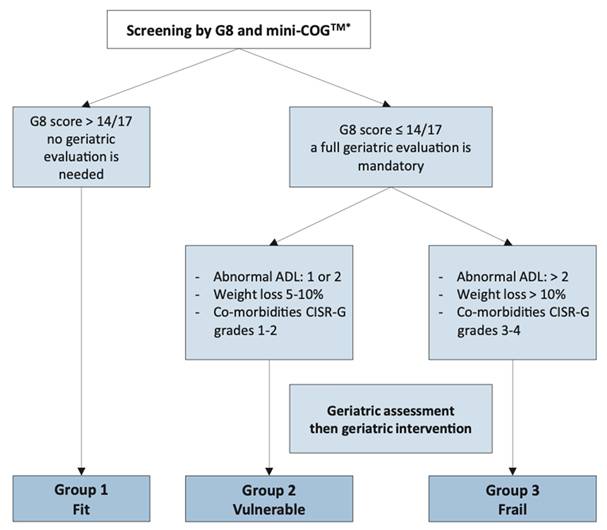
EAU guidelines recommend the assessment of life expectancy and health status in patients with prostate cancer as the drivers of therapeutic decision-making. Full geriatric is not recommended in all patients (Figure 1) [62].
Health status screening recommended by the SIOG guidelines and included in the 2025 EAU guidelines on prostate cancer. Reproduced from EAU Guidelines. Edn. presented at the EAU Annual Congress Madrid 2025. ISBN 978-94-92671-29-5 originally published by and used with permission from EAU Guidelines Office, Arnhem, The Netherlands. http://uroweb.org/guidelines/compilations-of-all-guidelines/. Mini-COGTM, Mini- COGTM cognitive test; ADLs, activities of daily living; CISR-G, cumulative illness rating score – geriatrics. *For Mini-COGTM, a cut-off points of ≤3/5 indicates a need to refer the patient for full evaluation of potential dementia.
1. Life expectancy. Life expectancy can be predicted from gait speed usually measured over the distance of 6 meters: for men aged 75 years, 10-year survival ranged from 19% to 87% for gait speeds < 0.4 m/s and ≥ 1.4 m/s, respectively [63].
2. Health status. In oncology practice, abbreviated screening tools are frequently used to reduce assessment time. Geriatric 8 (G8) and Clinical Frailty Score (CFS) are comprehensive health status assessment tools [64-66]. G8 discriminates between fit, vulnerable and frail patient based on the assessment of eight items: declining food intake, weight loss in 3 months, mobility, neuropsychological problems, BMI, polypharmacy (> 3 prescription drugs/day), self-comparison to same-age individuals, and age [66]. The panel of the International Society of Geriatric Oncology (SIOG) proposed an operational flowchart, later incorporated into the EAU 2025 prostate cancer guidelines, for oncologists to incorporate geriatric screening using G8 and mini-COG™ into their standard clinical workflow (Figure 1). Patients with the G8 score ≤ 14 should undergo full comprehensive geriatric assessment (CGA) described below [62]. In a Japanese study, 70% of patients with metastatic prostate cancer had G8 score < 14. The OS was significantly worse in patients with G8 ≤ 12 or > 12 and castration-resistant metastatic disease [67].
EAU guidelines list also the CFS tool, a nine-point scale (the higher the score the more pronounced frailty) less used in patients with cancer [41].
3. CGA. CGA is a multidimensional, often multidisciplinary, diagnostic process to assess functional status, comorbidities, cognition and emotional status, nutritional status, polypharmacy, and geriatric syndromes (fall risk, delirium, urinary incontinence, dentition, visual, or hearing impairments) [65]. In patients with metastatic prostate cancer, CGA scores are lower than in patients without metastasis [4]. The following tools can be used for a full CGA (Table 3):
Patient selection and suitability considerations for [177Lu]Lu-PSMA-617 radioligand therapy.
| Indications |
|---|
| EU: adults with progressive PSMA-positive metastatic castration-resistant prostate cancer previously treated with ≥1 ARPI and ≥1 taxane-based chemotherapy in combination with ADT ± AR pathway inhibition [101] |
| US: adults with PSMA-positive metastatic castration-resistant prostate cancer who have been treated with ARPI and taxane-based chemotherapy and adults with PSMA-positive metastatic castration-resistant prostate cancer previously treated with ARPI in whom the delay of taxane-based chemotherapy is considered appropriate [16, 17] |
| Clinical scenarios in which treatment may be considered (supported by available evidence and consensus statements): |
| • Patients unsuitable for taxane-based chemotherapy but with PSMA-positive disease [100] • High tumour burden or bulky disease [100] • Diffuse bone marrow disease or PSMA PET “superscan” pattern (with careful monitoring) [88, 91] |
| Clinical scenarios requiring individualised multidisciplinary risk–benefit discussion (expert-based considerations; not absolute contraindications):* |
| • Reduced performance status (ECOG PS ≥2) • Significant baseline cytopenias or limited bone marrow reserve • Mild-to-moderate cognitive impairment • High comorbidity burden (e.g., elevated CIRS-G or CCI score) • Functional decline (ADL/IADL impairment) • Severe renal insufficiency • Severe hepatic dysfunction • Severe cardiopathy with risk of haemodynamic instability • Active uncontrolled infection • Limited social support or logistical barriers |
* The clinical considerations listed here reflect expert-based multidisciplinary experience and should not be interpreted as formal contraindications. Frailty-related dimensions (functional, cognitive, social and comorbidity burden) should guide treatment adaptation, monitoring intensity and supportive care planning rather than automatic exclusion from radioligand therapy.
ADT, androgen deprivation therapy; ADL, activities of daily living; ARPI, androgen receptor pathway inhibitor; CCI, Charlson Comorbidity Index; CGA, comprehensive geriatric assessment; CIRS-G, chronic illness rating scale-geriatric; ECOG, Eastern Cooperative Oncology Group; IADL, instrumental activities of daily living; PSMA, prostate-specific membrane antigen.
a. Cumulative Illness Score Rating-Geriatrics (CIRS-G) and Charlson Comorbidity Index (CCI) are used to assess the burden of comorbidities [68, 69]. The CIRS-G is a valid indicator of health status in the frail population, which performs well to predict longitudinal outcomes [69].
b. Body mass index or longitudinal monitoring of patient’s weight to assess nutritional status. By measuring weight for 3 months, malnutrition can be determined (good nutritional status: < 5% weight loss; risk of malnutrition: 5–10% weight loss; severe malnutrition: > 10% weight loss) [70].
c. Three-word recall and clock drawing (mini-COG™) are the tools used for cognitive function assessment [71]. Mini-COG™ is a quick test to screen for cognitive impairments. Patients with scores ≤ 3/5 need full cognitive assessment and may be incapable of decision making [62].
d. Physical fitness is often evaluated using Karnofsky score and European Cooperative Oncology Group (ECOG) score. Karnofsky status is a 100-point scale that measures patient’s ability to perform various task. Increasing impairment results in lower scores [72]. The ECOG performance score ranges from 0 (fully active) to 5 (dead) [73].
e. Patient’s independence assessment includes ADL. The index of ADL was developed to assess treatment results and prognosis in the elderly and chronically ill. Grades of the ADL evaluate the overall performance in bathing, dressing, going to toilet, transferring, continence, and feeding. The activities requiring higher cognition are assessed using instrumental ADL (IADL) score [74]. In the population of patients with mCRPC enrolled into the Meet-URO 5-ADHERE study, instrumental ADL and the G8 geriatric scales were found to be essential tools to identify frail and less auto-sufficient patients who are vulnerable [75].
[177Lu]Lu-PSMA-617 in frail and geriatric populations
The SIOG recommends that treatment in patients with prostate cancer should be based on patient’s health status evaluation and not on chronological age [76]. Real-world studies show that age > 75 years, and even > 90 years, alone is not a contraindication for being treated with [177Lu]Lu-PSMA-617, as older patients had benefits when treated with this agent [77-83]. The safety of [177Lu]Lu-PSMA-617 was confirmed in a real-life study of 37 patients > 75 years of age, meaning that advanced age in itself is not a contraindication for receiving this treatment modality [78]. In fact, [177Lu]Lu-PSMA-617 treatment equally effectively controlled cancer and was safe in the elderly (> 75 years of age) and frail population [80], in two studies conducted on populations with a median age of 82 (range 75-92 and 80-92 years) at the start of the treatment [77, 79] and in a case series of three nonagenarians [82]. Tauber et al showed clinical benefit with rare high-grade adverse events in a cohort of 80 octogenarians, especially those who were chemotherapy-naïve [79], whilst Bastian et al demonstrated that [177Lu]Lu-PSMA-617 in patients over 85 years (range 85-96 years), resulted in clinical and safety outcomes similar to those obtained in younger patients [81]. This was further confirmed by a retrospective analysis of data from 102 patients with mCRPC in a single centre in Germany, which showed similar OS in patients < 80 and ≥ 80 with a comparable safety profile [83]. Charron et al suggested that [177Lu]Lu-PSMA-617 could be a promising treatment option for medically-fragile nonagenarians with as the therapy elicited strong clinical and radiographic responses including significant PSA reductions. Its favourable safety profile and minimal toxicities further support its use in these medically-vulnerable patients [82]. However, larger studies are needed to enable a more comprehensive analysis and establish the statistical significance of these finding.
Regarding frailty, a real-world multivariate analysis by Wenzel et al demonstrated that [177Lu]Lu-PSMA-617 was equally effective in frail patients (ECOG status ≥ 1) and in patients with ECOG status 0 despite worse PFS and OS in the frail population [80]. Notably, the same analysis identified concomitant cardiovascular disease as an independent predictor of shorter PFS and OS [80]. In addition, recent data from a cohort of 18 patients with poor performance status (ECOG 3) also showed that PSMA-targeted radioligand therapy is feasible in this patient category. In this cohort, 50% of patients achieved partial response or stable disease and severe adverse events (haematological toxicity) occurred in three patients [84].
At-risk organ-wise, despite haematological toxicity, the safety of [177Lu]Lu-PSMA-617 was confirmed in a cohort of 17 patients with preexisting moderate-to-severe thrombocytopaenia. There were no severe bleeds due to thrombocytopaenia and almost 60% of patients remained stable or showed improvement in severity of thrombocytopenia graded on Common Terminology Criteria of Adverse Events (CTCAE v5.0) severity score [85]. One of the most frequent cause of reduced bone marrow reserve is diffuse bone marrow involvement. A multicentre retrospective study showed that the safety profile of [177Lu]Lu-PSMA-617 was acceptable in a study of 43 patients with diffuse bone marrow involvement, as grade ≥3 anaemia, thrombocytopaenia and neutropoenia were observed in 22%, 25% and 8% of patients, respectively [86]. This datum was confirmed by Groener et al who showed that the cumulative treatment activity and absorbed whole-body dose did not correlate with new onset of grade ≥ 3 haematotoxicity in patients with diffuse bone marrow involvement [87].
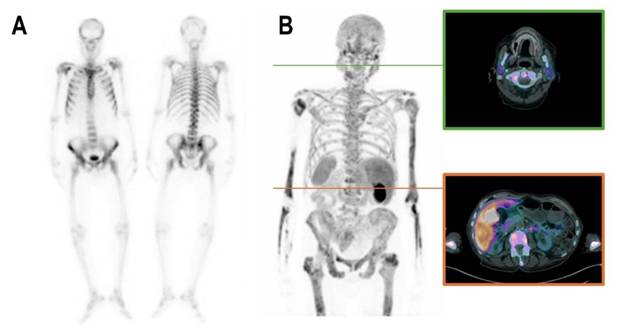
Patients with diffuse marrow disease represent a unique challenge regarding radioligand therapy [88]. Whilst not part of the VISION trial, a retrospective review of 43 patients from four institutions suggests that treating patients with diffuse marrow disease may be safe [86]. SNMMI Consensus Statement on appropriate patient selection and use of [177Lu]Lu-PSMA-617 therapy noted that it is not well defined how to translate diffuse marrow disease on bone scan to PSMA PET. Overall, the committee agreed that patients with diffuse marrow disease are candidates for PSMA radioligand therapy [88]. In nuclear medicine, the term “superscan” historically described patients with extremely high-volume bone metastases as visualised on bone scans (Figure 2 A). More recently, the concept has been extended to PSMA PET imaging (Figure 2 B). So far, [177Lu]Lu-PSMA-617 has not been extensively studied in patients with “superscan” bone scans, as the presence of the classical “superscan” in baseline bone scintigraphy was an exclusion criterion in clinical trials, including the VISION study. However, the PSMA PET “superscan” pattern was not an exclusion criterion, and such patients remain eligible for treatment (for further explanation please see the legend of Figure 2). Notably, real-world data indicate that patients with “superscan” pattern on bone scans may still respond well to therapy [86, 89-91]. Altogether, these data suggest that while caution is warranted, treatment response appears to be independent of the number of bone metastases and total tumour burden. Therefore, PSMA-targeted radionuclide therapy can be considered safe even in patients with high disease volume.
Understanding the “superscan” appearance in nuclear medicine on two emblematic examples of “superscan” patients. The “superscan” appearance on a bone scan (A) is characterised by diffuse, intense, and relatively symmetrical osseous radiotracer uptake, often accompanied by faint or absent tracer activity in the urinary system and soft tissues. Renal uptake is typically lower than that of the adjacent ribs, and bone metastases may not appear as distinct foci of metabolically active lesions [104]. By contrast, the “superscan” pattern on PSMA PET imaging (B) is defined by diffusely increased PSMA uptake in PSMA-avid lesions, usually involving the entire skeleton, with minimal to no uptake in normal organs (salivary glands, intestine, spleen, and liver), as demonstrated in the hybrid PSMA PET/CT axial sections depicted on the right side of the panel. However, renal uptake was not suppressed in several cases described in the literature [105-108], and a consistent decrease in radiotracer uptake was not observed in all patients. Therefore, reduced renal uptake should not be considered a strict imaging criterion for the diagnosis of a PSMA PET “superscan”. Importantly, the presence of a “superscan” pattern on a bone scan does not necessarily imply a corresponding “superscan” pattern on PSMA PET imaging in the same patient.
Preexisting renal impairment was not associated with significantly poorer safety outcomes in real-world studies, although treatment led to declines in eGFR [92-94]. In the Bastian et al study, CTCAE severity score of renal impairment remained stable in ~60% of patients [92-94], whereas in the Rosar et al analysis, renal function improved in 10/22 (45.5%), remained unchanged in 11/22 (50%) and worsened in just one patient [94]. In the latter study, a statistically significant increase in cohort’s mean eGRF versus baseline was observed at the end-of-treatment (after a median of five cycles) and after 6 months of follow. Mean eGRF was still improved after 9 and 12 months of follow-up albeit the difference versus baseline was not statistically significant [94]. In a German retrospective analysis of 106 patients (mean age 73 years), an at-least-moderate (>15%) eGFR decline was observed in 45% of patients who received four or more cycles of [177Lu]Lu-PSMA-I&T at 12 months after treatment commencement. In 24% (25/106) of patients, a severe eGFR (≥30%) decline was seen. A higher number of risk factors (including arterial hypertension, age ≥ 65 years, diabetes mellitus, prior platinum-based chemotherapy) at baseline was associated with a greater eGFR decrease at 12 months [95]. A case report confirmed the safety and symptomatic improvements following treatment with [177Lu]Lu-PSMA-617 in a kidney transplant recipient [96]. The overall safety in patients with moderate and severe renal impairment is specifically being analysed in an ongoing trial (NCT06004661) [97].
Clinical experience and strategies to manage [177Lu]Lu-PSMA-617 therapy in frail patients
Multidisciplinary clinical experience in frail patients
The evolution of geriatric oncology has shifted the paradigm from binary “fit versus frail” classifications to a dynamic model of treatment adaptation based on biological age, functional reserve, and treatment-specific toxicity profiles [12, 76]. Although this conceptual framework is supported by geriatric oncology principles rather than radioligand therapy-specific prospective data, it is highly relevant in the context of theranostic approaches, the treatment burden and administration logistics of which differ substantially from conventional systemic approaches. Geriatric oncology coined the concepts of “elderly-friendly” pharmacological profiles and “adapted schedules”, supporting a personalised approach to treatment selection [76].
These following expert-driven insights are based on our multidisciplinary clinical experience with treating frail patients who have mCRPC. Our team, including medical oncologists, nuclear medicine specialists, and geriatricians, finds that frailty alone seldom leads to an automatic refusal of PSMA-targeted radioligand therapy. Instead of serving as an exclusion criterion, frailty typically guides adjustments to treatment plans and determines how closely patients are monitored.
Five frequently encountered clinical scenarios include:
1. Chemotherapy-ineligible patients with PSMA-positive disease
A substantial proportion of older patients with mCRPC are deemed unsuitable for taxane-based chemotherapy due to reduced performance status (ECOG 1–2), relevant cardiovascular comorbidities, prior intolerance to systemic therapies, or borderline bone marrow reserve. In these individuals, treatment decisions are often limited, not by tumour biology, but by host vulnerability. In our experience, patients with PSMA-positive disease who are chemotherapy-ineligible may still tolerate radioligand therapy with manageable haematological toxicity, particularly when careful baseline assessment and early laboratory monitoring are implemented. This observation is consistent with emerging real-world evidence suggesting feasibility of radioligand therapy in elderly and clinically vulnerable populations [77-82], although prospective data specifically addressing this subgroup remain limited. Compared with cytotoxic chemotherapy, the intermittent administration schedule and tumour-targeted radiation delivery may offer a more acceptable therapeutic burden in selected frail individuals.
2. Patients with cardiovascular disease
The finding of cardiovascular disease being an independent predictor of shorter PFS and OS in patients treated with [177Lu]Lu-PSMA-617 [80] has clinically relevant implications in this patient population. From a geriatric perspective, this observation is not unexpected: the burden of cardiovascular comorbidity is both highly prevalent and particularly difficult to quantify in patients aged over 75. As highlighted by current ESC guidelines, standard cardiovascular risk scores lose calibration in older adults and tend to underestimate true risk, especially in the presence of polypharmacy, frailty-related haemodynamic vulnerability, or subclinical organ dysfunction [98]. The coexistence of cardiovascular disease and mCRPC therefore warrants structured cardiac evaluation as an integral component of the pre-treatment multidisciplinary geriatric assessment, rather than being considered merely as a background comorbidity.
3. Patients with cognitive vulnerability and treatment adherence problems
Mild cognitive impairment, frequently encountered in older adults with advanced cancer, should not be considered a contraindication to radioligand therapy. There is currently no prospective evidence specifically addressing the impact of cognitive impairment on radioligand therapy outcomes; however, this consideration arises from practical differences in treatment delivery of various therapeutic options. A continuous oral ARPI therapy requires sustained daily adherence, appropriate drug management, and monitoring for long-term metabolic and cardiovascular toxicity, which may be challenging in patients with cognitive vulnerability, polypharmacy, or limited caregiver support. By contrast, radioligand therapy delivered at fixed intervals in a controlled hospital setting allows structured supervision, scheduled assessment, and multidisciplinary follow-up. In selected cases, this model may therefore be operationally easier to manage than chronic oral systemic therapy, provided that adequate social and caregiver support is available.
4. Patients with baseline cytopaenias or diffuse bone involvement
Frailty in mCRPC is frequently associated with reduced bone marrow reserve, either due to prior therapies or extensive bone metastases. While significant baseline cytopenias warrant caution, we do not systematically exclude patients solely on this basis. Available retrospective data suggest that radioligand therapy may be feasible even in patients with compromised marrow reserve or diffuse bone involvement [85-87], although an increased risk of haematological toxicity should be expected. In selected cases, we adopt intensified laboratory monitoring during the first treatment cycles, provide transfusion support, when necessary, and perform early reassessment after the first cycle before proceeding further. This risk-adapted approach allows individualised treatment rather than a priori exclusion, particularly in patients with symptomatic high-volume disease and limited alternative options.
5. Patients with functional dependence and the role of the caregiver
Functional status, particularly as measured by IADL, may influence treatment feasibility in different ways depending on the therapeutic modality. There is currently no direct evidence comparing the impact of functional dependence on outcomes across different mCRPC treatments; however, practical considerations related to treatment administration are relevant.
- Oral therapies: in the context of oral agents (e.g., ARPIs), the presence of an active caregiver may compensate for reduced patient autonomy, supporting adherence and safe treatment administration.
- Radioligand therapy: conversely, radioligand therapy involves specific radioprotection measures following administration, requiring patients to comply with hygiene and safety recommendations.
In this setting, functional independence may become relevant for safe outpatient management, although this should not be interpreted as an absolute exclusion criterion. These considerations are therefore primarily logistical rather than biological and should be evaluated on a case-by-case basis [99].
Table 3 summarises the patient selection and suitability considerations. Our clinical experience suggests that frailty assessment should guide treatment adaptation, monitoring strategies, and supportive care planning, rather than function as an automatic exclusion criterion. Importantly, for several of the scenarios discussed, high-quality prospective evidence is currently lacking, and these considerations should therefore be interpreted as expert-based clinical reasoning aimed at supporting, rather than replacing, evidence-based decision-making. Future prospective studies specifically addressing frail populations are warranted to better define these aspects.
To integrate these complexities, we propose a formalised four-step clinical pathway:
1. Staging the Ageing: A multidisciplinary evaluation involving oncologists, geriatricians, and specialised nursing staff. Initial screening (e.g., G8 scale) identifies candidates who require a full CGA.
2. Prehabilitation: Proactive intervention to address malnutrition, pain, social isolation, and comorbid conditions prior to treatment initiation.
3. Toxicity Minimisation: Selecting the "right treatment for the right patient" with a primary focus on preserving quality of life and ensuring treatment completion.
4. Rehabilitation and Simultaneous Care: Integrating supportive care early in the trajectory to manage the treatment journey and facilitate recovery.
Monitoring and toxicity-adapted management during [177Lu]Lu-PSMA-617 therapy
Monitoring during [177Lu]Lu-PSMA-617 therapy is based on standardised laboratory, clinical, and imaging assessments as recommended by current EANM/SNMMI procedural guidelines [100]. Laboratory tests should be obtained prior to each treatment cycle (within 5 days) and include full blood count, renal function (serum creatinine and estimated glomerular filtration rate), liver function parameters (AST, ALT, bilirubin, albumin, alkaline phosphatase), as well as disease-related markers such as PSA, LDH and CRP. During treatment, blood counts and renal function should be reassessed at least 2–3 weeks after each cycle (corresponding to the expected nadir) and again 4–6 weeks after completion of therapy. PSA should be monitored at each cycle and at follow-up, and interpreted according to PCWG3 criteria, considering the possibility of delayed response or PSA flare [100]. Imaging-based assessment is typically performed using PSMA-PET/CT, or alternatively PSMA-SPECT/scintigraphy combined with morphological imaging, at intervals of approximately 12 weeks or at the end of a treatment series [100]. Post-therapeutic scintigraphy may also be used to confirm biodistribution and provide an early qualitative assessment of treatment response. In addition, patient-reported outcomes, including fatigue, pain, and functional status, represent key elements in decisions regarding treatment continuation.
Data from the VISION trial indicate that the overall frequency of TEAEs remains relatively consistent across treatment cycles, without a clear cumulative increase in toxicity burden, although haematological toxicity typically occurs early, with nadirs observed during the first cycles [37]. Real-world evidence from expanded-access programs additionally demonstrates that this safety profile is applicable to more clinically vulnerable populations, with similar rates of grade ≥3 anaemia, thrombocytopenia, and neutropenia despite worse baseline characteristics [28, 39, 83, 86, 87].
Importantly, monitoring findings should directly guide treatment adaptation. According to regulatory guidance and clinical trial evidence, the occurrence and severity of adverse events determine the need for treatment interruption, dose reduction, or discontinuation [101]. Treatment should be withheld in the presence of clinically relevant toxicities, including haematological toxicity (e.g., grade ≥2 cytopenias), renal impairment, significant non-haematological adverse events (e.g., grade ≥3 fatigue or gastrointestinal toxicity), or clinical complications such as spinal cord compression or fractures in weight-bearing bones, until recovery to grade 1 or baseline. If treatment delay exceeds 4 weeks due to toxicity, permanent discontinuation is recommended.
Dose modification strategies are similarly toxicity driven. A single dose reduction of approximately 20% (to ~5.9 GBq) may be considered in selected cases, including severe xerostomia, gastrointestinal toxicity, clinically significant myelosuppression, or renal toxicity (e.g., marked increase in creatinine or decline in eGFR). Dose re-escalation is not recommended, and treatment should be discontinued if further dose reductions would be required [101]. In the VISION trial, dose reductions were required in a minority of patients (5.7%), most commonly due to haematological toxicity, including thrombocytopaenia and anaemia [20]. In a prospective Italian phase 2 study, [177Lu]Lu-PSMA-617 therapy at 5.5 GBq per cycle was safe and effective, and led to survival outcomes comparable to studies using 7.4 GBq with fewer severe toxicities supporting tailoring regimen intensity in patients at higher risk of toxicity [102].
Management of specific toxicities requires a risk-adapted approach [101]. Haematologic toxicity typically warrants treatment delay until recovery to grade 1 or baseline, with supportive care measures including transfusion or growth factors when indicated, and dose reduction in the case of grade ≥3 events. Renal toxicity requires treatment interruption until improvement, with dose reduction or discontinuation in cases of persistent or severe impairment. Non-haematological toxicities—including gastrointestinal symptoms, fatigue, and metabolic abnormalities—should prompt treatment delay until recovery to grade ≤2 or baseline. Severe hepatic toxicity (e.g., AST/ALT >5× upper limit of normal in the absence of liver metastases) represents an indication for treatment discontinuation [101].
While these principles apply to all patients, frailty may influence both the intensity of monitoring and the thresholds for intervention. In frail individuals, particularly those with reduced bone marrow reserve, diffuse bone involvement, renal impairment, or high comorbidity burden, closer surveillance is advisable, especially during early treatment cycles. This may include earlier interim laboratory assessments (e.g., within 10–14 days), more frequent reassessment in patients with borderline baseline values, and proactive planning of supportive care interventions. In these patients, treatment adaptation may be considered at lower toxicity thresholds compared with non-frail patients, particularly when cumulative clinical burden (e.g., fatigue, functional decline, or borderline cytopenias) is observed. Conversely, selected frail patients may still benefit from continuation of therapy under intensified monitoring and multidisciplinary supportive care. Integration of geriatric assessment domains (functional, cognitive, and social factors) may further support individualised decision-making.
Overall, monitoring during [177Lu]Lu-PSMA-617 therapy should be interpreted as a dynamic process integrating toxicity detection, treatment adaptation, and supportive care, with a tailored approach in frail patients aimed at maintaining treatment feasibility while minimising clinical risk.
Conclusions
In order, to maximise the outcomes, [¹⁷⁷Lu]Lu–PSMA-617 therapy must be offered to the appropriate patients meaning that careful patient selection is of utmost importance. Hence, prior to treatment initiation, patients must undergo a detailed assessment both to establish the eligibility and baseline key organ function for on-treatment comparisons. Equally important is treatment monitoring for early identification and management of adverse events. We propose a checklist that details the pre-, during, and post-treatment tests (Table 4).
Checklist for the management of [177Lu]Lu-PSMA-617 radioligand therapy in older men with castration-resistant metastatic prostate cancer.
| Prior to treatment commencement: |
|---|
| • Confirm PSMA expression • Assess disease extent • Assess life expectancy • Assess health status using G8 and “Mini-COG™ • Perform full comprehensive geriatric assessment in patients with G8 score 14/17 |
| When in treatment: |
| • Monitor haematological reserve (complete blood counts, absolute neutrophil count, platelet count), kidney (creatinine, calculated creatinine clearance) and liver (ALT, AST, ALP, amylase, lipase, total albumin and bilirubin) function • Withhold the dose until improvement to grade 1 or baseline if signs of toxicity including: o grade 2 myelosuppression o grade 2 creatinine increase o spinal cord compression o fractures in weight-bearing bones o grade ≥ 3 fatigue o grade ≥ 2 electrolyte or metabolic abnormalities o 2 non-haematological toxicity • Permanently discontinue if no improvement in toxicity in > 4 weeks • Reduce the dose by 20% in case of: o grade 3 dry mouth o grade ≥ 3 gastrointestinal toxicity o grade ≥ 3 myelosuppression o renal toxicity (> 40% increase in creatinine levels) • Favour the inpatient setting in patients who require close monitoring due to their health status or psychological and social support needs |
| After treatment: |
| • Assess haematological reserve and kidney function at 4-6 weeks after the end of the treatment |
In the future, the selection of the most suitable treatment for any given patient may be based on predictive circulating genomic markers. For example, in the TherP trial, patients with ATM gene mutations had favourable outcomes with [¹⁷⁷Lu]Lu–PSMA-617 therapy [103]. Our review of the literature shows that [177Lu]Lu-PSMA-617 is a valid therapeutic option in patients with mCRPC considered frail due to age and comorbidities.
Acknowledgements
The medical writing of this review was funded by Novartis Farma Spa and provided by Alicja M. Gruszka, MD PhD, an independent medical writer on behalf of Springer Healthcare Italia, Italy. Monica Tambalo, PhD, on behalf of Springer Healthcare Italy, provided editorial support in the creation of the graphical abstract. This article was developed in accordance with Good Publication Practice guidelines. The authors had full control of the contents and made the final decision on all aspects of this article.
Competing Interests
MB reports personal fees outside the present work for advisory roles, speaker engagements, and travel and accommodation expenses from Bayer, Johnson & Johnson, Novartis, Telix Pharmaceuticals, and Recordati. NB received grants of contracts from any entity from Pfizer; consulting fees from Bayer, Ipsen; payment or honoraria for lectures, presentations, speakers’ bureaus, manuscript writing, educational events from Novartis, Astellas, Astra Zeneca, Ipsen, MSD, Pfizer; support to attending meetings and/or travel from Astellas, Ipsen, Pfizer. GFC declares no competing interests. LF received honoraria for advisory boards from MSD, Ipsen, Astellas, Janssen, Bayer, Novartis. DS received honoraria for advisory boards from Sandoz, MSD, Astra Zeneca, Ipsen, Astellas, Janssen, Bayer, Novartis, Eisai, Daiiki-Sankyo.
References
1. Rebello RJ, Oing C, Knudsen KE, Loeb S, Johnson DC, Reiter RE. et al. Prostate cancer. Nat Rev Dis Primers. 2021;7:9
2. Parker C, Castro E, Fizazi K, Heidenreich A, Ost P, Procopio G. et al. Prostate cancer: ESMO Clinical Practice Guidelines for diagnosis, treatment and follow-up. Ann Oncol. 2020;31:1119-34
3. Bylow K, Mohile SG, Stadler WM, Dale W. Does androgen-deprivation therapy accelerate the development of frailty in older men with prostate cancer?: a conceptual review. Cancer. 2007;110:2604-13
4. Mafla-Espana MA, Torregrosa MD, Cauli O. Analysis of Frailty Syndrome in Men with Metastatic Prostate Cancer: A Scoping Review. J Pers Med. 2023 13
5. Meissner VH, Imhof K, Jahnen M, Lunger L, Dinkel A, Schiele S. et al. Frailty in Long-Term Prostate Cancer Survivors and Its Association With Quality of Life and Emotional Health. J Natl Compr Canc Netw. 2024 23
6. Clegg A, Young J, Iliffe S, Rikkert MO, Rockwood K. Frailty in elderly people. Lancet. 2013;381:752-62
7. Jha GG, Anand V, Soubra A, Konety BR. Challenges of managing elderly men with prostate cancer. Nat Rev Clin Oncol. 2014;11:354-64
8. Won HS, Sun S, Choi JY, An HJ, Ko YH. Factors associated with treatment interruption in elderly patients with cancer. Korean J Intern Med. 2019;34:156-64
9. Fratino L, Serraino D, Zagonel V. The impact of cancer on the physical function of the elderly and their utilization of health care. G.I.O. Ger (Gruppo Italiano Oncologia Geriatrica). Cancer. 1998;83:589-91
10. Monfardini S, Ferrucci L, Fratino L, del Lungo I, Serraino D, Zagonel V. Validation of a multidimensional evaluation scale for use in elderly cancer patients. Cancer. 1996;77:395-401
11. Repetto L, Fratino L, Audisio RA, Venturino A, Gianni W, Vercelli M. et al. Comprehensive geriatric assessment adds information to Eastern Cooperative Oncology Group performance status in elderly cancer patients: an Italian Group for Geriatric Oncology Study. J Clin Oncol. 2002;20:494-502
12. Repetto L, Venturino A, Fratino L, Serraino D, Troisi G, Gianni W. et al. Geriatric oncology: a clinical approach to the older patient with cancer. Eur J Cancer. 2003;39:870-80
13. Zagonel V, Fratino L, Sacco C, Babare R, Spazzapan S, Gattei V. et al. Reducing chemotherapy-associated toxicity in elderly cancer patients. Cancer Treat Rev. 1996;22:223-44
14. Bauckneht M, Ciccarese C, Laudicella R, Mosillo C, D'Amico F, Anghelone A. et al. Theranostics revolution in prostate cancer: Basics, clinical applications, open issues and future perspectives. Cancer Treat Rev. 2024;124:102698
15. Inderjeeth AJ, Iravani A, Subramaniam S, Conduit C, Sandhu S. Novel radionuclide therapy combinations in prostate cancer. Ther Adv Med Oncol. 2023;15:17588359231187202
16. FDA. FDA approves Pluvicto for metastatic castration-resistant prostate cancer. 2022.
17. FDA. FDA expands Pluvicto’s metastatic castration-resistant prostate cancer indication. 2025.
18. Ferretti S, Mercinelli C, Marandino L, Litterio G, Marchioni M, Schips L. Metastatic Castration-Resistant Prostate Cancer: Insights on Current Therapy and Promising Experimental Drugs. Res Rep Urol. 2023;15:243-59
19. Pathak N, Papadopoulos E, Kumar V, Alibhai S. Frailty in Older Adults with Prostate Cancer. Eur Urol Oncol. 2025;8:14-20
20. Sartor O, de Bono J, Chi KN, Fizazi K, Herrmann K, Rahbar K. et al. Lutetium-177-PSMA-617 for Metastatic Castration-Resistant Prostate Cancer. N Engl J Med. 2021;385:1091-103
21. Armstrong AJ, Sartor O, de Bono J, Chi K, Fizazi K, Krause BJ. et al. Association of Declining Prostate-specific Antigen Levels with Clinical Outcomes in Patients with Metastatic Castration-resistant Prostate Cancer Receiving [(177)Lu]Lu-PSMA-617 in the Phase 3 VISION Trial. Eur Urol. 2024;86:552-62
22. Fizazi K, Herrmann K, Krause BJ, Rahbar K, Chi KN, Morris MJ. et al. Health-related quality of life and pain outcomes with [(177)Lu]Lu-PSMA-617 plus standard of care versus standard of care in patients with metastatic castration-resistant prostate cancer (VISION): a multicentre, open-label, randomised, phase 3 trial. Lancet Oncol. 2023;24:597-610
23. Hofman MS, Emmett L, Sandhu S, Iravani A, Joshua AM, Goh JC. et al. [(177)Lu]Lu-PSMA-617 versus cabazitaxel in patients with metastatic castration-resistant prostate cancer (TheraP): a randomised, open-label, phase 2 trial. Lancet. 2021;397:797-804
24. Wenzel M, Koll F, Hoeh B, Humke C, Siech C, Mader N. et al. Real-World Comparison of Cabazitaxel Versus (177)Lu-PSMA Radiopharmaceutical Therapy in Metastatic Castration-Resistant Prostate Cancer. J Nucl Med. 2025;66:61-6
25. Mandel P, Groener D, Follacchio G, Urun Y, Bourlon MT, Sabet A. et al. (177)Lu-PSMA vs. cabazitaxel in patients with castration-resistant prostate cancer: Real-world efficacy and safety data from the ARON-3 study. Eur J Cancer. 2025;229:115789
26. Morris MJ, Castellano D, Herrmann K, de Bono JS, Shore ND, Chi KN. et al. (177)Lu-PSMA-617 versus a change of androgen receptor pathway inhibitor therapy for taxane-naive patients with progressive metastatic castration-resistant prostate cancer (PSMAfore): a phase 3, randomised, controlled trial. Lancet. 2024;404:1227-39
27. Almuradova E, Seyyar M, Arak H, Tamer F, Kefeli U, Koca S. et al. The real-world outcomes of Lutetium-177 PSMA-617 radioligand therapy in metastatic castration-resistant prostate cancer: Turkish Oncology Group multicenter study. Int J Cancer. 2024;154:692-700
28. Gafita A, Voter A, Shesadri S, Spitz A, Marshall CH, Rowe SP. et al. Initial Experience with [(177)Lu]Lu-PSMA-617 After Regulatory Approval for Metastatic Castration-Resistant Prostate Cancer: Efficacy, Safety, and Outcome Prediction. J Nucl Med. 2024;65:1724-30
29. Kafka M, Horninger A, di Santo G, Virgolini I, Neuwirt H, Unterrainer LM. et al. Real-world Outcomes and Predictive Biomarkers for (177)Lutetium Prostate-specific Membrane Antigen Ligand Treatment in Metastatic Castration-resistant Prostate Cancer: A European Association of Urology Young Academic Urologists Prostate Cancer Working Group Multi-institutional Observational Study. Eur Urol Oncol. 2024;7:421-9
30. Moradi Tuchayi A, Yadav S, Jiang F, Kim ST, Saelee RK, Morley A. et al. Real-World Experience with (177)Lu-PSMA-617 Radioligand Therapy After Food and Drug Administration Approval. J Nucl Med. 2024;65:735-9
31. Murthy V, Voter AF, Nguyen K, Allen-Auerbach M, Chen L, Caputo S. et al. Efficacy and Toxicity of [(177)Lu]Lu-PSMA-617 for Metastatic Castration-Resistant Prostate Cancer: Results from the U.S. Expanded-Access Program and Comparisons with Phase 3 VISION Data. J Nucl Med. 2024;65:1740-4
32. Satapathy S, Yadav MP, Ballal S, Sahoo RK, Bal C. [(177)Lu]Lu-PSMA-617 as first-line systemic therapy in patients with metastatic castration-resistant prostate cancer: a real-world study. Eur J Nucl Med Mol Imaging. 2024;51:2495-503
33. Santo G, Di Santo G, Sviridenko A, Bayerschmidt S, Wirth L, Scherbauer F. et al. Efficacy and safety of rechallenge with [(177)Lu]Lu-PSMA-I&T radioligand therapy in metastatic castration resistant prostate cancer. Eur J Nucl Med Mol Imaging. 2024;52:354-65
34. Ciccarese C, Bauckneht M, Zagaria L, Fornarini G, Beccia V, Lanfranchi F. et al. Defining the Position of [(177)Lu]Lu-PSMA Radioligand Therapy in the Treatment Landscape of Metastatic Castration-Resistant Prostate Cancer: A Meta-analysis of Clinical Trials. Target Oncol. 2025;20:103-12
35. Herrmann K, Rahbar K, Eiber M, Sparks R, Baca N, Krause BJ. et al. Renal and Multiorgan Safety of (177)Lu-PSMA-617 in Patients with Metastatic Castration-Resistant Prostate Cancer in the VISION Dosimetry Substudy. J Nucl Med. 2024;65:71-8
36. Nautiyal A, Jha AK, Mithun S, Rangarajan V. Dosimetry in Lu-177-PSMA-617 prostate-specific membrane antigen targeted radioligand therapy: a systematic review. Nucl Med Commun. 2022;43:369-77
37. Chi KN, Armstrong AJ, Krause BJ, Herrmann K, Rahbar K, de Bono JS. et al. Safety Analyses of the Phase 3 VISION Trial of [(177)Lu]Lu-PSMA-617 in Patients with Metastatic Castration-resistant Prostate Cancer. Eur Urol. 2024;85:382-91
38. Eifer M, Sutherland DEK, Goncalves I, Buteau JP, Au L, Azad AA. et al. Therapy-Related Myeloid Neoplasms After [(177)Lu]Lu-PSMA Therapy in Patients with Metastatic Castration-Resistant Prostate Cancer: A Case Series. J Nucl Med. 2025;66:579-84
39. Zhao Y, Wang N, Zhang Z, Zhao X. Postmarketing safety of [(177)Lu]Lu-PSMA-617 radioligand therapy for prostate cancer: a disproportionality analysis of the FDA adverse event reporting system. Expert Opin Drug Saf. 2025:1-9
40. Fried LP, Tangen CM, Walston J, Newman AB, Hirsch C, Gottdiener J. et al. Frailty in older adults: evidence for a phenotype. J Gerontol A Biol Sci Med Sci. 2001;56:M146-56
41. Rockwood K, Song X, MacKnight C, Bergman H, Hogan DB, McDowell I. et al. A global clinical measure of fitness and frailty in elderly people. CMAJ. 2005;173:489-95
42. Rockwood K, Mitnitski A. Frailty in relation to the accumulation of deficits. J Gerontol A Biol Sci Med Sci. 2007;62:722-7
43. Mitnitski AB, Mogilner AJ, Rockwood K. Accumulation of deficits as a proxy measure of aging. ScientificWorldJournal. 2001;1:323-36
44. Balducci L, Beghe C. The application of the principles of geriatrics to the management of the older person with cancer. Crit Rev Oncol Hematol. 2000;35:147-54
45. Collard RM, Boter H, Schoevers RA, Oude Voshaar RC. Prevalence of frailty in community-dwelling older persons: a systematic review. J Am Geriatr Soc. 2012;60:1487-92
46. Kim VS, Yang H, Timilshina N, Breunis H, Emmenegger U, Gregg R. et al. The role of frailty in modifying physical function and quality of life over time in older men with metastatic castration-resistant prostate cancer. J Geriatr Oncol. 2023;14:101417
47. Polidori MC, Ferrucci L. Frailty from conceptualization to action: the biopsychosocial model of frailty and resilience. Aging Clin Exp Res. 2023;35:725-7
48. Cohen CI, Benyaminov R, Rahman M, Ngu D, Reinhardt M. Frailty: A Multidimensional Biopsychosocial Syndrome. Med Clin North Am. 2023;107:183-97
49. Dent E, Morley JE, Cruz-Jentoft AJ, Woodhouse L, Rodriguez-Manas L, Fried LP. et al. Physical Frailty: ICFSR International Clinical Practice Guidelines for Identification and Management. J Nutr Health Aging. 2019;23:771-87
50. Colloca G, Di Capua B, Bellieni A, Cesari M, Marzetti E, Valentini V. et al. Muscoloskeletal aging, sarcopenia and cancer. J Geriatr Oncol. 2019;10:504-9
51. Papadopoulos E, Wong AKO, Law SHC, Zhang LZJ, Breunis H, Emmenegger U. et al. The impact of sarcopenia on clinical outcomes in men with metastatic castrate-resistant prostate cancer. PLoS One. 2023;18:e0286381
52. Kelaiditi E, Cesari M, Canevelli M, van Kan GA, Ousset PJ, Gillette-Guyonnet S. et al. Cognitive frailty: rational and definition from an (I.A.N.A./I.A.G.G.) international consensus group. J Nutr Health Aging. 2013;17:726-34
53. Brown PJ, Rutherford BR, Yaffe K, Tandler JM, Ray JL, Pott E. et al. The Depressed Frail Phenotype: The Clinical Manifestation of Increased Biological Aging. Am J Geriatr Psychiatry. 2016;24:1084-94
54. Yamada M, Arai H. Understanding social frailty. Arch Gerontol Geriatr. 2023;115:105123
55. Kadambi S, Wang Y, Job A, Khankan L, Yu T, Patel A. et al. Financial Toxicity in Older Adults With Cancer and Their Caregivers. JCO Oncol Pract. 2025;21:92-9
56. Hayajneh AA, Rababa M. The Association of Frailty with Poverty in Older Adults: A Systematic Review. Dement Geriatr Cogn Disord. 2021;50:407-13
57. Fowler ME, Kenzik KM, Al-Obaidi M, Harmon C, Giri S, Arora S. et al. Rural-urban disparities in mortality and geriatric assessment among older adults with cancer: The cancer & aging resilience evaluation (CARE) registry. J Geriatr Oncol. 2023;14:101505
58. Speck C, Amberg I, Deichmann A, Keil L, Pauer M, Kolbe C. et al. Frailty of Homeless People. Dtsch Arztebl Int. 2023;120:677-8
59. Wang J, Hulme C. Frailty and socioeconomic status: a systematic review. J Public Health Res. 2021 10
60. Thornton M, Bowers K. Poverty in Older Adulthood: A Health and Social Crisis. The Online Journal of Issues in Nursing. 2024;29:1-12
61. Tomic K, Ventimiglia E, Robinson D, Haggstrom C, Lambe M, Stattin P. Socioeconomic status and diagnosis, treatment, and mortality in men with prostate cancer. Nationwide population-based study. Int J Cancer. 2018;142:2478-84
62. Cornford P, Tilki D, van der Bergh RCN, Eberli D, De Meerleer G, De Santis M. et al. EAU - EANM - ESTRO - ESUR - ISUP - SIOG Guidelines on Prostate Cancer. EAU Guidelines Website. 2025
63. Studenski S, Perera S, Patel K, Rosano C, Faulkner K, Inzitari M. et al. Gait speed and survival in older adults. JAMA. 2011;305:50-8
64. Rockwood K, Theou O. Using the Clinical Frailty Scale in Allocating Scarce Health Care Resources. Can Geriatr J. 2020;23:210-5
65. Rubenstein LZ, Wieland D. Comprehensive geriatric assessment. Annu Rev Gerontol Geriatr. 1989;9:145-92
66. Bellera CA, Rainfray M, Mathoulin-Pelissier S, Mertens C, Delva F, Fonck M. et al. Screening older cancer patients: first evaluation of the G-8 geriatric screening tool. Ann Oncol. 2012;23:2166-72
67. Momota M, Hatakeyama S, Soma O, Tanaka T, Hamano I, Fujita N. et al. Geriatric 8 screening of frailty in patients with prostate cancer. Int J Urol. 2020;27:642-8
68. Charlson ME, Pompei P, Ales KL, MacKenzie CR. A new method of classifying prognostic comorbidity in longitudinal studies: development and validation. J Chronic Dis. 1987;40:373-83
69. Parmelee PA, Thuras PD, Katz IR, Lawton MP. Validation of the Cumulative Illness Rating Scale in a geriatric residential population. J Am Geriatr Soc. 1995;43:130-7
70. Blanc-Bisson C, Fonck M, Rainfray M, Soubeyran P, Bourdel-Marchasson I. Undernutrition in elderly patients with cancer: target for diagnosis and intervention. Crit Rev Oncol Hematol. 2008;67:243-54
71. Borson S, Scanlan J, Brush M, Vitaliano P, Dokmak A. The mini-cog: a cognitive 'vital signs' measure for dementia screening in multi-lingual elderly. Int J Geriatr Psychiatry. 2000;15:1021-7
72. Karnofsky D, Burchenal J. Evaluation of chemotherpeutic agents. NY, Columbia University, New York. 1949 19
73. Oken MM, Creech RH, Tormey DC, Horton J, Davis TE, McFadden ET. et al. Toxicity and response criteria of the Eastern Cooperative Oncology Group. Am J Clin Oncol. 1982;5:649-55
74. Katz S, Ford AB, Moskowitz RW, Jackson BA, Jaffe MW. Studies of Illness in the Aged. The Index of Adl: A Standardized Measure of Biological and Psychosocial Function. JAMA. 1963;185:914-9
75. Fratino L, Polesel J, Giunta EF, Maruzzo M, Buti S, Hassan MA. et al. Instrumental activities of daily living in older patients with metastatic prostate cancer: results from the meet-URO network ADHERE prospective study. Sci Rep. 2024;14:4949
76. Boyle HJ, Alibhai S, Decoster L, Efstathiou E, Fizazi K, Mottet N. et al. Updated recommendations of the International Society of Geriatric Oncology on prostate cancer management in older patients. Eur J Cancer. 2019;116:116-36
77. Leibowitz R, Davidson T, Gadot M, Aharon M, Malki A, Levartovsky M. et al. A Retrospective Analysis of the Safety and Activity of Lutetium-177-Prostate-Specific Membrane Antigen Radionuclide Treatment in Older Patients with Metastatic Castration-Resistant Prostate Cancer. Oncologist. 2020;25:787-92
78. Sahin E, Elboga U, Cimen U, Okuyan M, Cayirli YB. (177)Lu-PSMA-617 Radioligand Treatment in Elderly Patients with Metastatic Castration-resistant Prostate Cancer: Therapeutic Efficacy and Safety Assessment. Curr Radiopharm. 2024;17:356-63
79. Tauber R, Knorr K, Retz M, Rauscher I, Grigorascu S, Hansen K. et al. Safety and Efficacy of [(177)Lu]-PSMA-I&T Radioligand Therapy in Octogenarians with Metastatic Castration-Resistant Prostate Cancer: Report on 80 Patients over the Age of 80 Years. J Nucl Med. 2023;64:1244-51
80. Wenzel M, Siech C, Garcia CC, Humke C, Groener D, Kriegmair M. et al. Cancer-control outcomes with [(177)Lu]Lu-PSMA Radioligand Therapy in elderly, frail or comorbid mCRPC patients. Theranostics. 2025;15:2672-9
81. Bastian MB, Worl B, Blickle A, Burgard C, Speicher T, Wessendorf J. et al. PSMA Radioligand Therapy in Advanced Age: Insights From an 85y+ mCRPC Patient Cohort. Clin Nucl Med. 2025;50:825-9
82. Charron J, Maupin K, Su C, Mancini B, Kulkarni H. Evaluating the Efficacy and Safety of Pluvicto in Chemotherapy-Ineligible Nonagenarians: A Descriptive Case Series. Cureus. 2025;17:e79119
83. Schweigert N, Strewinsky N, Kohler D, Lehnert W, Ekrutt J, Karimzadeh A. et al. Age-Related Outcomes of [(177)Lu]Lu-PSMA Radioligand Therapy in Metastatic Castration-Resistant Prostate Cancer: A Retrospective Analysis. Cancers (Basel). 2025 17
84. Bastian MB, Worl B, Blickle A, Burgard C, Speicher T, Bartholoma M. et al. Expanding the scope of PSMA-RLT: evaluating treatment in challenging mCRPC patients with poor performance status (ECOG 3). Eur J Nucl Med Mol Imaging. 2025
85. Bastian MB, Sieben M, Blickle A, Burgard C, Speicher T, Bartholoma M. et al. Safety of PSMA radioligand therapy in mCRPC patients with preexisting moderate to severe thrombocytopenia. Eur J Nucl Med Mol Imaging. 2025;52:1271-7
86. Gafita A, Fendler WP, Hui W, Sandhu S, Weber M, Esfandiari R. et al. Efficacy and Safety of (177)Lu-labeled Prostate-specific Membrane Antigen Radionuclide Treatment in Patients with Diffuse Bone Marrow Involvement: A Multicenter Retrospective Study. Eur Urol. 2020;78:148-54
87. Groener D, Baumgarten J, Haefele S, Happel C, Klimek K, Mader N. et al. Salvage Radioligand Therapy with Repeated Cycles of (177)Lu-PSMA-617 in Metastatic Castration-Resistant Prostate Cancer with Diffuse Bone Marrow Involvement. Cancers (Basel). 2021 13
88. Hope TA, Antonarakis ES, Bodei L, Calais J, Iravani A, Jacene H. et al. SNMMI Consensus Statement on Patient Selection and Appropriate Use of (177)Lu-PSMA-617 Radionuclide Therapy. J Nucl Med. 2023;64:1417-23
89. Ahmadzadehfar H, Matern R, Baum RP, Seifert R, Kessel K, Bogemann M. et al. The impact of the extent of the bone involvement on overall survival and toxicity in mCRPC patients receiving [(177)Lu]Lu-PSMA-617: a WARMTH multicentre study. Eur J Nucl Med Mol Imaging. 2021;48:4067-76
90. Calderon Tobar MN, Yilmaz F, Perktas L. Superscan in First Posttherapeutic 177 Lu-PSMA Scan. Clin Nucl Med. 2025;50:e248-e9
91. Shamshirgaran A, Sahafi P, Samadi MH, Saeed M, Mohammadzadeh Kosari H, Erfani S. et al. Efficacy and safety of Lutetium-177 ((177)Lu)-PSMA-617 in metastatic Castration-Resistant prostate cancer patients with superscan pattern: A retrospective cohort study. Ann Nucl Med. 2026;40:298-309
92. Bastian MB, Sieben M, Burgard C, Blickle A, Speicher T, Bartholoma M. et al. Outcome and Renal Safety of PSMA-Targeted Radioligand Therapy in mCRPC Patients With Preexisting Impaired Renal Function. Clin Nucl Med. 2025;50:165-71
93. Topal E, Kovan B, Iribas A, Kuyumcu S, Basaran M, Malcok Demirtas A. et al. Impact of extended [(177)Lu] Lu-PSMA-617 therapy on absorbed kidney dose and CKD-EPI values: how long can therapy be safely continued? Eur J Nucl Med Mol Imaging. 2025
94. Rosar F, Kochems N, Bartholoma M, Maus S, Stemler T, Linxweiler J. et al. Renal Safety of [(177)Lu]Lu-PSMA-617 Radioligand Therapy in Patients with Compromised Baseline Kidney Function. Cancers (Basel). 2021 13
95. Steinhelfer L, Lunger L, Cala L, Pfob CH, Lapa C, Hartrampf PE. et al. Long-Term Nephrotoxicity of (177)Lu-PSMA Radioligand Therapy. J Nucl Med. 2024;65:79-84
96. Mahdi RA, Aggarwal P, Kumar S, Sood A, Paul D, Mittal BR. Excellent Response to Full-Dose 177 Lu-PSMA-617 RLT in Metastatic Castration-Resistant Prostate Cancer With Transplant Kidney: A Step Ahead. Clin Nucl Med. 2023;48:e470-e1
97. ClinicalTrial.gov. Study of Lutetium (177Lu) Vipivotide Tetraxetan in mCRPC Participants With Moderately and Severely Impaired and With Normal Renal Function. 2024.
98. Visseren FLJ, Mach F, Smulders YM, Carballo D, Koskinas KC, Back M. et al. 2021 ESC Guidelines on cardiovascular disease prevention in clinical practice. Eur Heart J. 2021;42:3227-337
99. Zagni F, Vetrone L, Farolfi A, Vadala M, Rizzini EL, Golemi A. et al. Feasibility of (177)Lu-PSMA Administration as Outpatient Procedure for Prostate Cancer. J Nucl Med. 2024;65:1848-9
100. Kratochwil C, Fendler WP, Eiber M, Hofman MS, Emmett L, Calais J. et al. Joint EANM/SNMMI procedure guideline for the use of (177)Lu-labeled PSMA-targeted radioligand-therapy ((177)Lu-PSMA-RLT). Eur J Nucl Med Mol Imaging. 2023;50:2830-45
101. European Medicines Agency. Pluvicto - Summary of Product characteristics. 2022.
102. Marini I, Giunta EF, Nicolini S, Grassi I, Foca F, Sarnelli A. et al. Efficacy, toxicity, and clinical outcomes of 177Lu-PSMA-617 radioligand therapy at 5.5 GBq per cycle in patients with advanced castration-resistant prostate cancer: a prospective, single arm, phase II study. Eur J Nucl Med Mol Imaging. 2026;53:3023-33
103. Kwan EM, Ng SWS, Tolmeijer SH, Emmett L, Sandhu S, Buteau JP. et al. Lutetium-177-PSMA-617 or cabazitaxel in metastatic prostate cancer: circulating tumor DNA analysis of the randomized phase 2 TheraP trial. Nat Med. 2025;31:2722-36
104. Osmond JD 3rd, Pendergrass HP, Potsaid MS. Accuracy of 99mTC-diphosphonate bone scans and roentgenograms in the detection of prostate, breast and lung carcinoma metastases. Am J Roentgenol Radium Ther Nucl Med. 1975;125:972-77
105. Agarwal KK, Tripathi M, Kumar R, Bal C. Metastatic superscan in prostate carcinoma on gallium-68-prostate-specific membrane antigen positron emission tomography/computed tomography scan. Indian J Nucl Med. 2016;31:150-1
106. Galindo Cortes DF, Mejia Efeer H, Caro Perdomo S, Hernandez Hidalgo N. Superscan on (68)Ga PSMA PET/CT in patients with metastatic prostate carcinoma: A case series. Arch Clin Cases. 2023;10:164-70
107. Koc ZP, Ozcan PP, Ercolak V, Reyhan M. Superscan Appearance of (68)Ga PSMA PET/CT in a Patient with Refractory Prostate Cancer. Mol Imaging Radionucl Ther. 2022;31:60-2
108. Sahoo MK, Shah S. Super Scan in 68Ga-PSMA Ligand PET/CT in Prostate Cancer-Diagnostic Criteria and Its Significance. J Nucl Med Radiol Radiat Ther. 2018;3:010
Author contact
Corresponding author: Matteo Bauckneht, MD, PhD, AOM-IRCCS Ospedale Policlinico San Martino, Largo R. Benzi, 10, 16132, Genova, Italia, matteo.baucknehtit.