Impact Factor




Theranostics 2027; 17(1):99-131. doi:10.7150/thno.141624 This issue Cite
Review
Piezoelectric hydrogels empowering closed-loop smart medicine: from self-powered sensing to autonomous therapy
Zhiqun Bai1*, Ge Wang1,2*, Yining Liu1,2*, Tong He1,2, Jiayuan Zhang3, Yuqi Wen1,2, Zhiyang Wang1,2, Zhiguang Chen1 
1. Department of Ultrasound, The First Hospital of China Medical University, China.
2. Department of Second Clinical Medicine, China Medical University, China.
3. Department of Mathematics, The University of Manchester, UK.
*Co-first authors: Ge Wang, Yining Liu and Zhiqun Bai contributed equally to the conception and design of this study.
Received 2026-7-28; Accepted 2026-9-25; Published 2027-1-1
Abstract
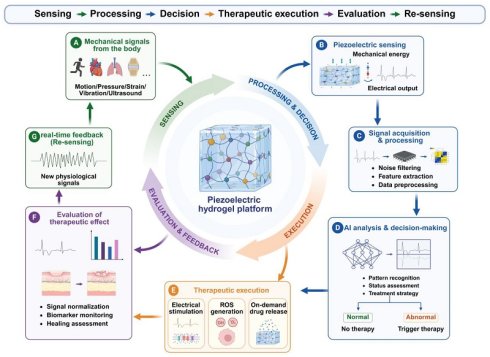
Closed-loop medicine is characterized not by a specific smart material, but by the integration of sensing and treatment processes. A complete feedback-controlled loop encompasses the acquisition, processing, and therapeutic intervention of physiological signals, as well as the evaluation of the response. For this purpose, piezoelectric hydrogels are promising because they can convert periodic biomechanical movements into electrical signals for self-powered sensing and, in some designs, localized actuation. We review the design, integration, and balance of materials, sensing, and therapeutic and self-powered actuation mechanisms, while distinguishing the self-powered transduction from true closed-loop control. Reported applications include the control of seizures, management of diabetes, and the therapeutic care of chronic wounds, with some representative studies reporting drug accumulation reductions of three orders of magnitude and achievement of greater than 95% closure of wounds. Although these results are promising, intrinsic challenges remain, such as the lack of feedback assurance, piezoelectric hydrogels’ long-term stability during implantation, immunocompatibility, and large-scale manufacturing, and standardized assessments. Programmable hydrogel networks combined with artificial intelligence may enable more autonomous therapeutic decisions in the future. For these reasons, we classify these piezoelectric hydrogel platforms as open-loop, semi-closed-loop, or fully autonomous systems based on the degree of integration of the sensing, processing, and decision-making, as well as the therapeutic intervention and feedback systems. This systems-level perspective may provide some insights into the potential of piezoelectric hydrogels for closed-loop medicine systems.
Keywords: piezoelectric hydrogels, closed-loop smart medicine, self-powered systems, piezoelectric sensors, self-treatment
1. Introduction
Advancements in smart medicine are primarily centered around reducing the delay between detecting a physiological abnormality and delivering an intervention. In the future, we envision a scenario in which emerging pathological states are treated promptly and in line with changing clinical requirements. Currently, electronic medical devices achieve this infrequently due to large battery packs, wired connections, and user-mediated decisions that interfere with mobility and create time delays. Closed-loop smart medicine attempts to mitigate this problem by organizing sensing, processing, and actuation as a control cycle that is always in operation [1]. Within this cycle, the timing of treatment delivery is improved and unnecessary exposure is reduced.
In this regard, piezoelectric hydrogels hold great potential. They combine soft, hydrated polymer networks with mechanoelectrical transduction. While piezoelectric ceramics are rigid, hydrogels have tissue-like compliance and offer a significant hydration capacity. The electromechanical function is supplied by the piezoelectric fillers or polymer domains. An interface that combines tissue with a device may be enhanced by mixed ionic-electronic conduction. Another key aspect of these hydrogels is that mechanical input creates an electrical signal without the need for external circuitry bias. This means that the motion of the heart, contraction of muscles, breathing, and even the movement of joints can be used as a source of physiological energy [2,3]. Ultrasound-driven systems fall outside of this category, as the energy needed to create sound is provided externally. Furthermore, removing a battery from a transducer does not give energy autonomy to an entire device, as the components needed to amplify, communicate, compute, store, and even activate a therapy still require an external power source [3-5].
Recent studies show advances in materials and systems [2,3]. Polyacrylonitrile/polyvinylidene fluoride (PAN/PVDF) double network structures exhibit piezoelectric coefficients of ~ 40 pC/N, while maintaining skin-like moduli and stretchability up to ~250% strain [6,7]. Self-polarized cellulose/poly (vinylidene fluoride-co-trifluoroethylene) (P(VDF-TrFE)) hydrogels reached 75.1% β-phase without poling, and demonstrated a sensitivity and detection limit of 11.1 mV kPa⁻¹ and 0.8 kPa, respectively [8]. Biological studies show wound closure of > 95% in infected wound models [9], improvement of regeneration in critical-sized calvarial defects [10], and ultrasound-activated chondrogenic differentiation with intracellular Ca²⁺ signaling [11]. There are beginning to be more examples of systems integration. A hydrogel microneedle system was able to provide real-time electrophysiological monitoring and voltage-controlled drug delivery, enabling the first example of a closed-loop seizure control system, and reducing the required drug dose by three orders of magnitude [12]. A ‘smart’ wound bandage has also been clinically tested in participants aged 18-95 years [13].
These improvements should not obscure the fact that there is still a translational gap [14-16]. Most durability studies continue to span only hours to days, leaving long-term piezoelectric stability subjected to repeated physiological loading undefined. Closed-loop algorithms which learn, adapt, and do therapeutic modifications in a repeated patient-specific manner remain infrequent, and as a result, current prototypes are a significant distance from fully autonomous clinical systems [1,14]. For implantable devices, degradation kinetics may still not satisfy the therapeutic function period. Large-animal and human validation is limited [16], and standardized protocols are still lacking for cross-study result comparability or to bring devices into certifications. These limitations justify the perspective taken in this review. Instead of considering the performance of materials or sensors to be the final goal, we view the field of closed-loop integration in the following order: the materials themselves to combine piezoelectric performance with a balance of compliance and biocompatibility, followed by self-powered sensors, therapies, and actuators, and finally the systems, structures, and algorithms that interpose sensing to intervention [15]. The objective is to address what has been accomplished and what remains to be done in the creation of autonomous, adaptable systems based on piezoelectric hydrogels.
2. Hydrogel design principles and piezoelectric engineering
Closed-loop systems make unique and extensive demands on the functionality of piezoelectric hydrogels. The hydrogels must be able to facilitate mechanoelectrical conversion and be compliant for tissue interfacing, and for more sophisticated systems, it may be required to perform sensing and therapeutic actuation. The challenges of transferring the piezoelectric characteristics that are present in rigid ceramics or crystalline polymers to a soft, water-rich network go beyond simply incorporating a piezoelectric phase [2,15]. The following sections elucidate the origin of the electromechanical response and relate them to the design and processing strategies necessary to derive optimal biomedical functionality.
2.1. Mechanisms of piezoelectricity in hydrogel systems
In this work, we discuss hydrated polymer networks that interface with a mechanoelectrical mechanism and produce electrical signals, under the term of "piezoelectric hydrogel-based mechanoelectrical systems". Within this larger classification, three categories must be differentiated. These are intrinsically piezoelectric hydrogels, piezoionic hydrogels, and hybrids/assemblies that exhibit a combination of piezoelectricity and other mechanisms such as triboelectricity. Intrinsic piezoelectricity arises from the alignment of non-centrosymmetric crystals or molecular dipoles in a polar structure. Piezoionic hydrogels, in contrast, create electrical signals by stressing and subsequently redistributing the mobile ions in the system, and piezoelectric-triboelectric hybrids create a piezoelectric polarization that is supplemented by contact electrification of the interfaces [17-21].
PVDF and copolymers exhibit piezoelectric behavior through the polarization of oriented C-F dipole molecular bonds in the polar β-phase. Among all the polymorphs of PVDF, this phase adopts the all-trans planar zigzag conformation and is believed to possess the highest spontaneous polarization. There are challenges in either preserving or developing polar organization in PVDF when combined with water-rich hydrogels. Structural constraints can limit the motion of polymer chains, while water can increase mobility. Modifying the synthesis method of the gel can optimize the balance of plasticization and structural constraints, and has previously produced β-phase contents in excess of 75% [8].
Another method that can be employed is using inorganic fillers, such as Barium Titanate (BaTiO3), Zinc Oxide (ZnO), or Potassium Sodium Niobate (KNN). Fillers produce electrical polarization through distortion of their lattice as a result of mechanical deformation. Because of this, they all exhibit intrinsic piezoelectric properties. However, their effectiveness in gel composites is dependent on multiple factors, including the dispersion of the filler, the interaction between the filler and the matrix, interfacial polarization, and the pathways for conductivity. Therefore, it is unknown whether the inclusion of a highly piezoelectric filler would have an overall negative or positive effect on the piezoelectric response of the composite [19].
Another physical route is what we refer to as piezoionic transduction. In this case, deformation leads to gradients that result in mobile ion redistribution in the hydrated networks. Migration of ionic species creates a voltage or current [18,19]. This mechanism does not require a non-centrosymmetric crystalline phase; therefore, piezoionic behavior can be observed in amorphous hydrogels as well [19,22]. Recent works have reported piezoionic coefficients reaching 27.9 μC N⁻¹ [19] due to strain-driven ion transport amplification within multi-gradient designs.
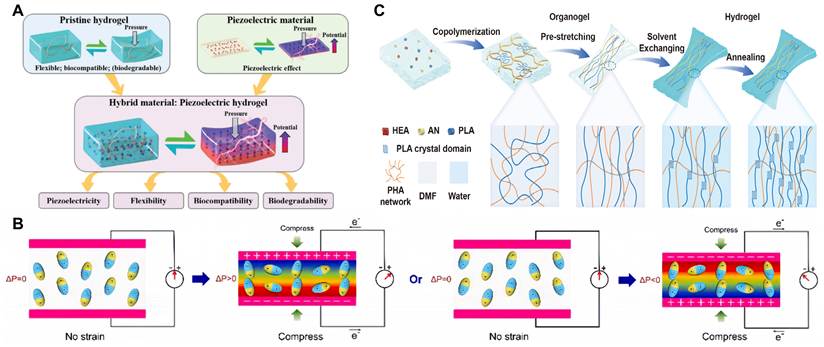
Hydrogels can merge several of these mechanisms while maintaining a compliant, biocompatible interface [2,3] (Figure 1A). The natural presence of water within the hydrogel facilitates ionic transport and mixed electronic–ionic signaling, which are favorable to biological systems for mechanoelectrical coupling [18]. Thus, both the output and response time are influenced by the composition of the hydrogel, as well as the dominant transduction pathway, the structural architecture, and the hydration level. For mechanistic or molecular-design comparisons, we refer to select non-hydrogel piezoelectric systems (e.g., molecularly assembled peptides). We do not classify these systems as piezoelectric hydrogels.
Mechanisms, design principles and representative preparation routes of piezoelectric hydrogels. (A) Integration of a compliant hydrogel matrix with piezoelectric components, combining piezoelectricity with flexibility, biocompatibility, and potential biodegradability. Reproduced with permission from Ref. [2]. Copyright 2024 Wiley-VCH GmbH. (B) Molecular-level mechanism of classical piezoelectric transduction, showing deformation-induced polarization of oriented molecular dipoles and the resulting electrical potential. Adapted with permission from Ref. [6]. Copyright 2022 Elsevier Ltd. (C) Representative preparation route for a piezoelectric poly(lactic acid) double-network hydrogel using the PHASE strategy, which integrates copolymerization, prestretching, solvent exchange, and annealing. Reproduced with permission from Ref. [22]. Copyright 2025 Wiley-VCH GmbH.
We focus on mechanism-based rather than component-based classification. A system is considered a hybrid if piezoelectricity noticeably contributes to either signal generation or energy conversion, combined with another phenomenon. Systems dominated by ionic, triboelectric, or other mechanisms are classified as related mechanoelectrical systems. Thus, we do not consider them intrinsically piezoelectric hydrogels.
These transduction modes provide the mechanistic basis for designing piezoelectric hydrogel systems. Representative material systems and their key properties and biomedical applications are summarized in Table 1.
Comparison of major mechanoelectrical transduction modes in hydrogel systems
| Category | Transduction mechanism | Required device architecture | Temporal response | Output form / unit | Major limitations | References |
|---|---|---|---|---|---|---|
| Intrinsic piezoelectric hydrogels | Deformation-induced polarization of non-centrosymmetric crystals or oriented dipoles. | Piezoelectric hydrogel coupled with electrodes. | Fast; typically milliseconds. | Voltage (V, mV); current (A, nA); charge (C); sensitivity. | Strongly affected by dipole/crystal orientation, hydration, and device configuration. | [18-20] |
| Piezoionic hydrogels | Deformation-induced redistribution of mobile ions in hydrated networks. | Ionically conductive hydrogel with ionic/electrode interfaces. | Milliseconds to seconds; generally slower than piezoelectric response. | Ionic potential/voltage (V, mV); current (A, nA); piezoionic coefficient. | Slower response; dependent on ion mobility, hydration, and diffusion. | [19,20] |
| Hybrid mechanoelectrical systems | Coupling of piezoelectricity with other mechanoelectrical mechanisms, such as triboelectricity. | Integrated or multilayer architecture combining multiple transduction components. | Mechanism and architecture-dependent. | Voltage (V); current (A); charge (C); sensitivity. | Complex architecture and difficult separation of contributions from different mechanisms. | [18,21,22] |
2.2. Material design principles and preparation strategies
We distinguish between design principles and the processing steps used to realize them. When we talk about design principles, we mean the selection of materials and the structural organization of the materials. On the other hand, we look at preparation methods including solvent exchange, prestretching, annealing, and crosslinking, among others. A preparation method further integrates multiple methods in a specific sequence to achieve the desired structure and function of the material.
With this approach to the engineering of piezoelectric hydrogels, we are able to identify three interrelated levels, which include the choice of material for the transduction, the design of molecular or interfacial structure, and device assembly. With the use of solution casting, solvent exchange methods, annealing, and chemical crosslinking, the phase of the polymer is manipulated, the formation of the network is completed, and the polymer is hydrated. It must be noted that recent methods and approaches assign more significance to the order and the control of the position of the network in the material, and employ the use of molecular assembly or the controlled design of the networks to orient the dipoles and to control the interfacial interactions.
Due to the large difference in elasticity and stiffness between polymer, hydrogel, and piezoelectric phases, the engineering challenge defies solution in terms of filler selection; rather, it lies in efficient stress transfer from polymer and hydrogel matrix to piezoelectric phase. Barium titanate and zinc oxide piezoelectric ceramics are widely used piezoelectric ceramic fillers [17,18,23,24]. Intrinsic piezoelectricity of nanoparticles can be suppressed by aggregation, interfacial mechanical mismatch, and confinement in a soft network. Surface engineering provides a solution to the interfacial mechanical mismatch. Polydopamine-coated BaTiO3 particles improve a positive change in the dispersion and adhesion in the polymer matrix [17], Surface modification of ZnO-based nanocomposites, such as PEG coating, can further enhance colloidal stability and biocompatibility in therapeutic applications [25]. Equally important, however, is the volume of the fillers used. Below 1 wt% filler volume, particles are insufficient to create the necessary stress-transfer pathways, and at over 10 wt% filler volume, stress concentration and particle aggregation cause the material to become brittle. As a result, the optimal range of filler volume percent is typically between 1 and 10 wt% in these systems [19].
Piezoelectric Synthetic Polymers. PVDF and its copolymer P(VDF-TrFE) represent the most promising synthetic piezoelectric polymers for use with hydrogels [6-8] (Figure 1B). Their characteristics of flexibility and processability, as well as their lack of a separate inorganic phase, make them ideal candidates. The primary design obstacle is how to best maximize the β-phase while maintaining hydrogel matrix compliance and stability. While solvent exchange has been shown to induce β-phase crystallization [8], the PHASE method incorporates β-phase crystallization, followed by prestretch and a defined, controlled annealing sequence. The incorporation of hydrogels by this method achieved a tensile strength of 6.27 MPa and a fracture energy of 46.27 kJ m-2 [22] (Figure 1C). In a related approach, PAN chains were used to stabilize the β-phase of PVDF through dipole–dipole interactions, resulting in an apparent skin-like modulus and piezoelectric coefficients in the range of 32 pC N-1 [6,7].
Naturally derived "biopiezoelectric" molecules. Biologically derived intrinsic piezoelectric materials include silk fibroin collagen and cellulose [24,26-28]. Their key advantages include biocompatibility and the ability to alter the electromechanical properties at the molecular level. In one of the silk-fibroin systems, the introduction of triblock structures led to the self-organization of silk fibroin β-sheet crystals and a 2.8-fold increase in the piezoelectric property of ZnO/Silk Fibroin composites [24]. “Hydrogel Cellulose Nanocrystals” (HCCN) combine a hydrogel matrix with cellulose nanocrystals and provide a source of polar crystalline domains. Nanocrystals of cellulose inclusion in the matrix were shown to improve charge transport within the matrix by 18.8-fold under heterojunction formation [26]. An assembly of phenylalanine-centered tripeptides, composed of the hydrophobic amino acid phenylalanine, formed stable crystals and displayed an effective piezoelectric modulus of 24.0 pC N-¹, the highest piezoelectric value reported for peptides in an aqueous environment [27].
Structural and directional control. For active phases, controlling their orientation and distribution is crucial for determining how stress is transferred and the direction of the output [22,28-31]. There are several ways to impose this order: prestretching, electric-field poling, directional freezing, and magnetic-field-assisted assembly. Electric field processing is limited in highly hydrated networks due to electrolysis, which limits the strength of the field and the time of exposure [30]. Directional freezing creates anisotropic pores and guides the alignment of fillers, while magnetic fields can accommodate anisotropic fillers [28,31]. Flexible–rigid double networks provide another means: interfacial interactions can create a self-generated field and yield self-polarized structures without external poling [8].
2.3 Key functional properties of piezoelectric hydrogels for biomedical applications
Their utility goes beyond electrical output. Their utility in biomedicine comes from the combination of their hydrated, deformable networks and their internal ability to convert stress into electric fields. Depending on the design, one construct may serve as a passive scaffold, a sensor, or an active biointerface. Electromechanical conversion, mechanical adaptability, biointerface compatibility, and operational stability are the four key properties for this purpose.
Electromechanical conversion capability. The first challenge is the reliable conversion of deformation of biological tissue, body motion, and mechanical excitation applied from outside the body to an electrical response. This challenge can be addressed using techniques such as piezoelectric polarization, piezoionic transport, and mechano-electrical coupling. In piezoelectric hydrogels, deformation induces polarization of aligned dipoles or non-centrosymmetric crystals. PVDF-based materials are widely used because the polar β-phase provides a strong and relatively stable response [6-8]. When using ceramic fillers such as BaTiO3 and ZnO, they will change the polarization of the lattice of these materials, and the final output of these materials will be influenced by the dispersion and interfacial coupling of the filler materials [17-19]. Piezoionic materials, on the other hand, rely on the strain-induced movement of ions and remain a viable option for designing interfaces that are highly hydrated and soft, where crystalline polarization is not needed. Piezoelectric–triboelectric hybrids broaden the output that is available [17,21].
Mechanical adaptability. Softness is not a secondary property in these systems. With the piezoelectric ceramic materials, they have a much greater stiffness than biological tissues and allow minimal deformation, whereas hydrogels can be adjusted to have high water contents and a stiffness that is similar to biological tissues. The improved stiffness matching is critical to the maintenance of repeatability of contact, which is vital to the function of body-worn sensors, implants, and devices of a mechanical nature used for therapy. Networks having PVDF and other flexible organic piezoelectric hydrogels have stabilized their electrical response under large deformations [6-8]. The ability to retain a materials response under large deformations is of critical importance for the long-term function of the materials, as is the elasticity and resistance to fatigue. Networks and improved polymer-polymer interactions of flexible and rigid nature can result in materials that can redistribute stress and improve their ability to withstand repeated mechanical loadings while still maintaining their functional responsiveness [8,22,29].
Biointerface compatibility. Hydrogels have a water-rich, three-dimensional, flexible architecture, much like the extracellular matrix, and can foster cell interaction and facilitate tissue integration. However, in the case of biomaterials, compatibility should be defined beyond just biocompatibility and should include cytocompatibility, adhesion, immune response, and degradation. For example, collagen, cellulose, silk fibroin, and peptides can be considered naturally occurring piezoelectric materials and can be of great interest to researchers and engineers, as their biocompatibility and biodegradability are inherent. In silk fibroin systems, the molecular structures of piezoelectric materials can be improved without affecting the biocompatibility [24,26-28]. Hydrogels can act as piezoelectric matrices and thus, the electrical signals and active cues can influence the microenvironment of the tissue and cellular structures. This coupling of biointerface and electrical functions gives piezoelectric hydrogels the ability to not only sense but also provide controlled regeneration of tissues [24,32,33].
Operational stability. For a hydrogel to be useful, it must retain structure, be hydrated, and retain its mechanoelectrical function after repeated deformation and thus, network integrity, fatigue resistance, interfacial stability, swelling, and long-term retention of electrical functions are interconnected. Organohydrogels that are tough and resistant to freeze demonstrate that a robust network is capable of permanently maintaining its mechanical and piezoelectric function [7]. Flexible-rigid double networks have improved stability by redistributing stress and retaining piezoelectric output, and swelling control along with stable interactions between the hydrogel matrix and functional components are equally necessary [8]. Dynamic physical crosslinking can confer self-healing and environmental stability, whereas anti-swelling architectures are designed to maintain the geometry of the hydrogel and the hydrogel's sensing capabilities in aqueous environments [22,30,31].
2.4. Structure-property relationships and key trade-offs
The four properties are highly interrelated. The active phase composition, network structure, interfacial interactions, and degree of hydration before and after use affect electrical, mechanical, and biological properties and performance trade-offs. Improvement in one aspect may worsen another. The relationships should be addressed explicitly in the design to enable trade-offs rather than optimizing one property at the expense of the others.
The main trade-offs encountered in the design of the system are those between electrical output, compliance, and stability vs. tissue compatibility [30,31,34,35]. Table 2 summarizes representative systems with electrical, mechanical, and environmental/functional data in the same manner as in the original studies [6-8,22,24,27,29].
Performance comparison of representative piezoelectric hydrogel systems.
| Material system | Material composition & piezoelectric phase | Preparation/principle | Piezoelectric properties | Electrical output | |||||
| PAN-based piezoelectric hydrogels | PAN/PVDF; P(AM-co-AN); dipolar interactions | Radical copolymerization/crosslinking; dipole interaction + PVDF phase stabilization | d₃₃ = 32–40 pC N⁻¹ | 40–60 mV; 1.34 mV kPa⁻¹; 0.2 V kPa⁻¹ | |||||
| Cellulose/P(VDF-TrFE) double-network hydrogel | Cellulose flexible network + P(VDF-TrFE) rigid network; β-phase | Double network; covalent/H-bond/dipolar interactions enable unpoled β-phase | β-phase = 75.1% | 11.1 mV kPa⁻¹; detection limit 0.8 kPa | |||||
| PLLA double-network hydrogel (PHASE) | HEA/AN double network + PLA | Pre-stretching → solvent exchange → annealing; orientation/crystallinity control | Pre-stretching-induced PLA β-phase | Frequency-domain sensing; sensitivity not uniformly reported | |||||
| ZnO/RSF piezoelectric hydrogel | RSF + ZnO nanoparticles; ZnO piezo-phase | Blending + HRP/H2O2 enzymatic crosslinking; ZnO polarization/RSF β-sheet synergy | Output increased 2.8-fold with ZnO | Vₒc ≈ 80 mV; Iₛc ≈ 32 nA (0.1 MPa) | |||||
| Tripeptide supramolecular piezoelectric system | Hydrophobic tripeptides; self-assembled crystals | Sequence design → purification → self-assembly/crystal growth; non-centrosymmetric packing | d₃₃,eff = 24.0 pC N⁻¹ | Vₒc = 2.57 V (50 N) | |||||
| PAM/BaTiO3 asymmetric composite hydrogel | PAM + BaTiO3 nanocubes; spatial asymmetry | Tune BTO content/position; enhanced mechanoelectric conversion/multimodal output | d₃₃ not reported | Multimodal output at 0.25–6 N, low frequency | |||||
| Material system | Mechanical & environmental performance | Experimental conditions | Function / biomedical application | Limitations | References | ||||
| PAN-based piezoelectric hydrogels | 0.51–3.15 MPa; ≤ 780% strain; ≤ 8.23 MJ m⁻³; -20 °C | Pressure/strain; 0.5–3 Hz; -20 °C; ≤ 5000 cycles | Self-powered sensing; pressure/pulse/speech/motion/gesture/HMI | Device/readout dependent; limited cross-system comparison | [7,8,30] | ||||
| Cellulose/P(VDF-TrFE) double-network hydrogel | Skin-like flexibility; stable | Low-pressure sensing | Self-powered sensing; health monitoring; robotic hand | Long-term in vivo efficacy unvalidated | [9] | ||||
| PLLA double-network hydrogel (PHASE) | 6.27 MPa; 46.27 kJ m⁻²; anti-swelling; -20 °C | Frequency response; -20 °C | Biodegradable sensing; HMI | Sensitivity data limited; long-term in vivo performance unvalidated | [25] a | ||||
| ZnO/RSF piezoelectric hydrogel | 1.7× strength; biodegradable; stable after 4-week PBS | 0.1 MPa; 100 cycles; 4-week PBS; bone repair | Self-powered stimulation/sensing; bone regeneration/vascularization | Zn²⁺ exposure; nanoparticle fate; long-term safety | [26] | ||||
| Tripeptide supramolecular piezoelectric system | Stable; thermally stable | 50 N; aqueous | Sequence-programmable; nanogeneration; bioelectronics | Not a hydrogel; stability/durability/translation unvalidated | [28] | ||||
| PAM/BaTiO₃ asymmetric composite hydrogel | Transparent; stretchable; > 8× electrode strain | 0.25–6 N; low frequency | Multimodal sensing; pressure/motion/curvature; wearable bioelectronics | Multimodal contributions complicate comparison | [18] | ||||
a Reference [22].Wei QY, Gao WC, Zhang TZ, Long LX, Zhao J, Pan LZ, et al. A "PHASE" Strategy for Preparing Flexible Piezoelectric Polylactic Acid Double Network Hydrogel Sensors. Adv Funct Mater. 2026 Apr;36(28):2525548. Which focused on mechanical and antifreezing properties and did not specifically report sensing sensitivity.
Cross-study comparisons are meaningful only when measurement conditions are considered. Interpretations vary based on mode of loading, sample geometry, hydration state, range of measured force/pressure, and frequency, and electrode design. The values of voltage, d33, and other parameters measured in response to stimuli should not be considered comparable assessments of performance in the biomedicine field [2,15].
An ideal evaluation distinguishes between the performance of the material, the device, and the tissue-interface. At the material level, the intrinsic electromechanical response can be described in terms of d33 or d31, polarization, crystallinity, and molecular orientation [36,37]. At the device level, characterization should include voltage, current, charge, sensitivity, detection limit, response and recovery time, and the stability of cycles, alongside the exerted force or pressure, deformation, frequency and hydration state, geometry, and electrode configuration [15,36,37]. For applications in the biomedical field, a third level is required: the effective electric-field strength or current density at the tissue interface [2,37]. This differentiation avoids confusion between intrinsic coefficients or unloaded output voltage and the true limits of device sensitivity or effectiveness of therapy.
Hybrid devices lead to further comparison challenges. This is because a single measured signal may stem from multiple transduction effects. An example of this is the asymmetric architectures of BaTiO3 and hydrogel where piezoelectric, triboelectric, and piezoresistive effects can be found. We should not directly compare such outputs to those of piezoelectric hydrogels that are single-mechanism.
One common negotiation is between electromechanical output and mechanical compliance [30,34]. Increased filler content results in greater charge generation, but also makes the network stiffer and less extensible. If filler loading is too low, the network maintains softness, but the charge generation could be unacceptably low and impractical. Some of these problems are addressed with the use of gradient distributions and anisotropic alignment, which can direct stress transfer pathways and mitigate the average stiffness increase. A limitation of ionic conductivity is that it must be optimized for charge collection while minimizing leakage and electrochemical side reactions. Although CNTs, MXene, and graphene have improved the charge transport in the networks, it becomes stiffer, and the biocompatibility may be compromised [29,38].
Swelling also shows the same interdependence. Physiological fluids can dilute the active phase and weaken the network, and modify the device–tissue interface. Crosslink density, hydrophobic domains, or double-network structures can address these alterations. For implantable applications, anti-swelling hydrogels with equilibrium swelling ratios less than 2% have been documented [31].
2.5. Tailoring piezoelectric hydrogels for closed-loop therapy
An all-purpose hydrogel composition to meet the electrical, mechanical, stability, and biocompatibility criteria for each specific application does not exist. Consequently, trade-offs are necessary in the chemistry of the materials and structure of the networks and devices in relation to the specific application at hand. For closed-loop therapy, electromechanical conversion, injectable delivery, dynamic tissue integration, controlled degradation, and long-term functionality are necessary, along with the material’s capacity to degrade and its functionality for the duration of treatment, are all essential considerations [34,35,38,39].
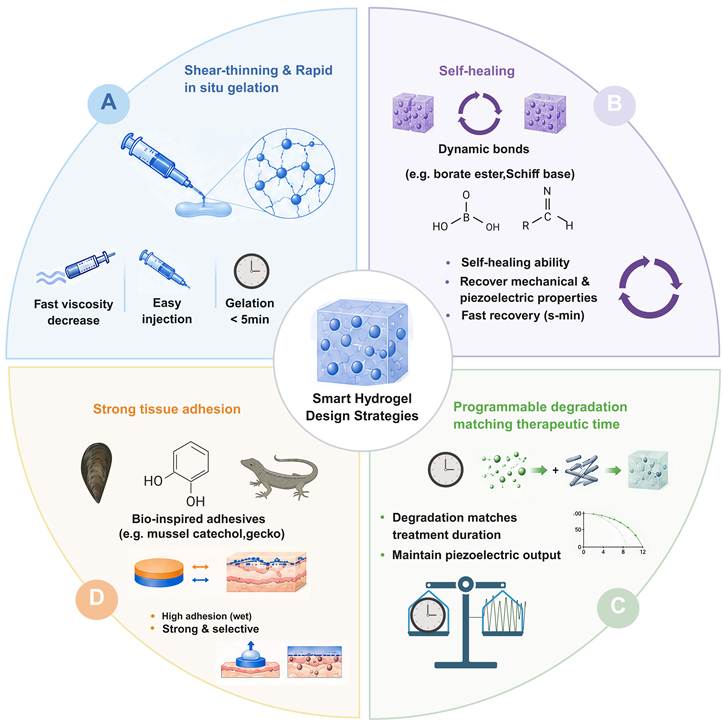
For deep-tissue delivery, injectable formulations which are shear-thinnable and rapidly gelling in situ are preferred. More recent injectable piezoelectric hydrogels have the capacity to rapidly gel in less than 5 minutes under physiological conditions and still retain a therapeutically relevant output [34,35]. Dynamic applications also face cumulative mechanical failure in dynamic applications such as musculoskeletal implants and wound dressings. There are piezoelectric ‘self-healing’ hydrogels which have dynamic covalent bonding such as boronate esters, schiff bases, or metal-ligand along with reversible hydrogen bonding [35].
Stable coupling of tissues is another requirement of a practical nature [38,39]. Some bioinspired designs using the foot of mussels and gecko microstructures have achieved adhesive strengths of up to 55.97 kPa on porcine skin, with preserved piezoelectric sensitivity [38]. Asymmetric interfaces are the quasi-Janus hydrogel designs, which have targeted tissue adhesion while minimizing adhesion with the adjacent structures [39].
It must be remembered that degradation cannot occur outside the therapeutic window [2,39]. PLLA, silk fibroin, and peptide-based piezoelectric materials are promising candidates for safe degradation during treatment [24,39]. However, mass loss must not precede loss of function. The degradation therefore must preserve piezoelectric activity for the duration of treatment and allow for clearance afterward. Composite systems can separate these schedules by utilizing a hydrogel matrix that has a piezoelectric phase with a longer degradation time [2,39]. These requirements are why closed-loop hydrogel design must combine electromechanical conversion with injectable gelation, self-healing, degradation control, and tissue adhesion (Figure 2).
Core design strategies for smart piezoelectric hydrogels in closed-loop healthcare. Four complementary strategies are highlighted: (A) shear-thinning and rapid in situ gelation, enabling minimally invasive injection, rapid stabilization under physiological conditions, and retention of piezoelectric functionality; (B) dynamic-bond-mediated self-healing, allowing rapid recovery of mechanical integrity and piezoelectric performance after repeated deformation; (C) programmable degradation synchronized with the therapeutic window, maintaining functional piezoelectric output during treatment and enabling subsequent biological clearance; and (D) bioinspired wet-tissue adhesion, ensuring stable and conformal coupling between the piezoelectric hydrogel and target tissues. Created in BioRender. Chen, Z. (2026) https://BioRender.com/sd4qq28.
3. Self-powered sensing modalities enabled by piezoelectric hydrogels
Piezoelectric hydrogel sensors offer more than voltage output; sensing is the first stage of any feedback loop. The sensors are attractive because the piezoelectric hydrogels can translate mechanical signals into sensing signals free of the electrical bias [2,3,40,41]. We do not consider sensing to be truly self-powered unless harvested energy also powers downstream readout, not just the transducer. Mechanical inputs can be provided by various forms of physiological motion [3,18]. The piezoelectric hydrogel’s material properties, which include piezoelectric coefficients of approximately 40 pC N⁻¹, skin-like moduli of less than 5 MPa, and fatigue and swelling resistance, allow the devices to adapt to tissues of the body and minimize the effects of mechanical mismatch. Transient events of the body are well complemented by the millisecond response time of the hydrogel. The following sections will first evaluate the transduction methods of piezoelectric, piezoionic, and triboelectric systems and then consider the sensing systems of the cardiovascular and musculoskeletal systems, as well as respiration [42-44].
These sensing systems represent the first layer of the information-acquisition process in the framework of therapeutic control. They provide a means of reducing reliance on standard external power sources by converting the mechanical function of a physiology into electrical data for processing and intervention [2-4,21,42-48]. While this capability is significant, it does not equate to closed-loop control. Wireless data readout, local data interpretation, and self-powered data transduction move this framework into the realm of semi-closed-loop or fully autonomous closed-loop systems once the data is utilized to determine or alter the subsequent therapeutic action. The remaining reliance on external computation, control, or manual interventions determines the extent of operational autonomy [1,12-15].
Ultrasound-powered systems showcase the importance of clearly stating the power source. Since the acoustic field is provided from the outside, it is technically inaccurate to say that piezoelectric hydrogels activated by ultrasound are harvesting the biomechanics of the body [11,32,33,39,49-51]. We therefore posit the following three energy configurations: systems powered by the body's physiological motion; externally powered piezoelectric systems activated by ultrasound; and systems in which the harvested energy is from the body's physiology, which is used to power the sensing or readout, while external energy is still required to provide therapy. This differentiation distinguishes piezoelectric signal generation at the transducer level from energy autonomy at the system level [3-5].
3.1. Transduction mechanisms and self-powered operation
3.1.1. Piezoelectric transduction
Classical piezoelectric sensors work on the principle of charge separation by deformation via the direct piezoelectric effect (see for example [2,8]). Changes in pressure, strain, or vibration can cause a hydrogel to polarize with an associated change in potential [6,7]. Since the output of a piezoelectric sensor relies on the magnitude and the rate of the loading, the same transducer can respond to both types of inputs: static and dynamic [18]. The primary output signal is generated without the need for any external electrical bias [18,19]. However, signal amplification, digitization, as well as signal transmission and processing, may still require external energy. The millisecond-scale response for rapid physiological changes, e.g. pulse waves and muscle twitches, whose time scale ranges from milliseconds to seconds [8,44].
3.1.2. Piezoionic transduction
Piezoionic hydrogels use stress-driven ionic migration as opposed to fixed dipole migration [18,19]. A strain gradient causes redistribution of cations and anions with different mobilities, generating an ionic current and potential that can be sensed [19]. The migration of ions is a slower process than the orientation of dipoles in a piezoelectric material. It is reported that the response time of piezoionic materials can range from milliseconds to several seconds [2,19]. The slower response is not a limitation, it can complement piezoelectric sensing for sustained or quasi-static forces [19,22]. This principle can be utilized by designing hydrogels of an asymmetric geometry which can have a gradient of both geometry and modulus with a gradient of charge; such designs can attain an effective d33 of 27.9 μC N⁻¹ under uniform compression [19,45].
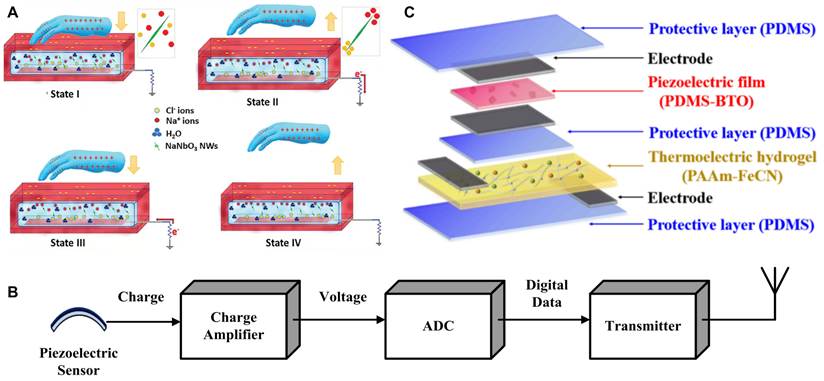
Triboelectric enhancement. The piezoelectric hydrogels used in triboelectric nanogenerators (TENGs) can function as electrodes (Figure 3A). Because these hydrogels can be used in contact with the separating layers of TENGs, they can function as both a piezoelectric component and an interface charge transfer layer [4,20] (Figure 3B). These TENGs, containing a piezoelectric hydrogel, can achieve outputs of over 840 V and 2.3 μC [20]. These outputs result from an improved charge density and transfer. These TENGs can combine both energy harvesting and sensing, where the TENGs can function as an energy production boost [21,40].
Representative mechanoelectrical transduction mechanisms, hybrid sensor architecture, and wireless signal acquisition. (A) Four-stage operating cycle of a NaNbO3-nanowire-embedded PVA hydrogel nanogenerator during hand contact and separation, involving contact electrification, ionic redistribution, interfacial polarization, and external electron flow. Reproduced with permission from Ref. [20]. Copyright 2024 Wiley-VCH GmbH. (B) Signal-conditioning and wireless-readout chain comprising charge amplification, analog-to-digital conversion, and wireless transmission. Adapted with permission from Ref. [4]. Copyright 2017 Institute of Electrical and Electronics Engineers. (C) Exploded-layer configuration of a hybrid piezoelectric–thermoelectric sensor integrating a PDMS–BaTiO3 piezoelectric layer, a PAAm–FeCN thermoelectric hydrogel, electrodes, and PDMS encapsulation layers. Adapted with permission from Ref. [48]. Copyright 2026 American Chemical Society.
Piezoelectric and triboelectric mechanisms differ in origin and response time. Piezoelectricity, from a polymer TENG, is a deformation-based process; ion-triboelectricity, from a polymer TENG, is a mechanism of interfacial charge transfer. TENG designs that incorporate both of these mechanisms are hybrid devices. For such devices, the choice of mechanism should correspond to the timescale of the physiological signal rather than the expected final output.
The claims of self-powered devices have to have limits, and one can define these limits at different levels and terms. At the lowest transducer level, the sensing mechanism is initiated via the mechanical actuation of the system, without requiring an electrical trigger. At the sensor level, the sensing signal is conditioned electronically, charged, and retained. At the node level, energy must also support communication and processing. The budget of system-level autonomy includes the actuation, the means of signal and information transmission, and the means to sustain the system. Only the self-powered systems that meet all of the described attributes of energy harvesting, energy storage, the control cycle, and the energy balance can truly be considered "fully self-powered" TENG systems [3,4].
3.2. Pressure strain and vibration sensing
Pressure sensors. Piezoelectric hydrogels for sensing compression have multiple applications [8,44,46]. For example, a self-polarized Cellulose/P(VDF-TrFE) double-network hydrogel achieved a sensitivity of 11.1 mV kPa⁻¹ with a 0.8 kPa detection limit and maintained skin-like flexibility [8]. With regard to [44], a solvent-exchanged PAAM/PVDF-TrFE double network exhibited a sensitivity of 2.76 mV·kPa⁻¹ from 1 to 280 kPa, 1.11 mV·kPa⁻¹ at higher pressures, and a response and recovery times from 43 to 52 ms. These demonstrate strong pressure-sensing capabilities. However, one should be cautious about concluding the entire device is fully energy-autonomous [46,47]. Although the transducer can generate a signal on its own without external bias, the other parts (e.g., conditioning electronics, data acquisition, storage, and wireless communication) still require energy [3,4,21]. Matrix mechanics influence and affect the sensitivity [30,31]. Within a device, a porous or micropatterned structure may produce a higher degree of pressure-related deformation, and embedding a CNT or MXene may provide a piezoresistive channel for static detection, which would already be complemented by the device’s dynamic piezoelectric response [29,38,46].
Strain sensors. For tensile deformation or strain, there is a different, but related, sensing mode [7,40,46]. Hydrogels that contain piezoelectric materials have been reported to reach a gauge factor of 43.1, which is based on the internal electronic transport pathways being altered within the polymer as dipoles of the polymer are moved [40,46]. Additionally, linear strain ranging 400% is applicable from jointly bending one’s fingers to bending one’s knees [7,38,40,46]. Environmental tolerance can also be engineered: glycerol- or dimethyl-sulfoxide-containing systems have retained strain-sensing function at temperatures as low as -80 °C [41,47].
The rapid response of many piezoelectric hydrogels makes them viable for use in vibration and sound applications. Response times below 10 ms enable sensing up to several hundred hertz, suitable for speech detection, communication underwater, monitoring operational faults, and sensing in the cardiac field [45,48] (Figure 3C). In terms of using piezoelectric hydrogels for implants, the hydrogel's acoustic impedance, similar to that of biological tissue, provides good acoustic matching through intervening tissue layers [42,45,48].
3.3. Physiological signal monitoring
Monitoring pulse and blood pressure. Arterial pulse sensing is a clear example of the physiological applications of these materials [43,44,47]. With sufficient waveform fidelity, hydrogel sensors can capture the P1 percussion wave, P2 tidal wave, and P3 diastolic wave useful for evaluation of the cardiovascular system [44]. Sensors deployed on the radial, carotid, or temporal arteries have demonstrated continuous monitoring of pulse, especially for the analysis of heart rate variability and estimation of blood pressure [43,44]. The high compliance of these materials maintains skin contact during motion, unlike rigid sensors. Hydrogel sensors have also been used for intraoperative arterial-pressure monitoring. A tissue-bonding hydrogel recorded pressure with a range of up to 8.3 V and was stable for more than 6000 cycles [43] (Figures 4A and 4B). That measurement is a device-level value and not the therapeutic value delivered to the adjacent tissue. In terms of stimulation and related interpretation, loaded output and electrical dose are more pertinent [3,43].
Physiological signal monitoring enabled by piezoelectric hydrogels. (A) Tissue-adhesive piezoelectric soft sensor mounted on the femoral artery for intraoperative acquisition and analysis of cardiovascular signals, including arterial blood pressure, heart rate, and respiratory rate. Adapted with permission from Ref. [43]. Copyright 2023 Wiley-VCH GmbH. (B) Calibration relationship between the sensor output voltage and arterial blood pressure. Adapted with permission from Ref. [43]. Copyright 2023 Wiley-VCH GmbH. (C) Voltage responses during finger and elbow bending at different joint angles. Adapted with permission from Ref. [7]. Copyright 2024 American Chemical Society. (D) Dual-modal throat patch integrating hydrogel-based surface electromyography electrodes with a PVDF vibration-sensing unit for simultaneous acquisition of speech-related sEMG and laryngeal vibration signals. Adapted with permission from Ref. [45]. Copyright 2025 American Chemical Society.
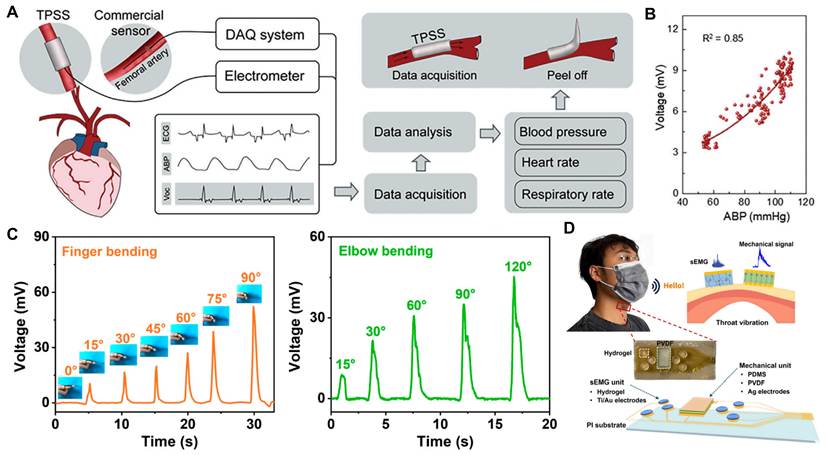
Motion and posture detection. Large joint and muscle movements are examples of mechanical stimuli [7,38,40,46]. When used in piezoelectric hydrogels, flexing the fingers, moving the wrist, extending the elbow, or flexing the knee generates signals that are detectable by the change in the speed and amplitude of the movement (Figure 4C). More subtle movements, such as facial movements, swallowing, and even blinking can also be detected by these interfaces. This expands the possible applications of these technologies to assistive technologies, and communication between humans and machines [38,46]. The integration of hydrogels into gloves, skin patches, and other types of fabrics allows them to be used in conjunction with wireless technologies. This enables movement to be monitored from a distance [46,47,52].
Current technologies, such as piezoelectric hydrogels embedded in insoles, are used to monitor gait [44]. These types of technologies can be used for rehabilitation monitoring, and for the assessment of falling risks. During the different phases of gait, such as heel strike and swing, piezoelectric sensors can capture different pressures and measure different characteristics of gait, such as cadence and stride length. These characteristics can then be used as input data for machine learning models. When using these features as inputs, researchers reported that the recognition accuracies of the models for the detection of different patterns of gait exceeded 90% [44,48].
Microvibration and acoustic sensing. Compared to other types of movements, respiratory movements are highly repetitive but also have lower amplitude. Piezoelectric hydrogels can capture chest wall displacement to measure tidal volume and respiratory rate [4,45,48]. These sensors can capture the movement of the chest and the diaphragm to monitor respiration in real time. Unlike other respiratory monitoring tools, these sensors do not use either nasal cannulas or chest straps. These sensors could also be used for long-term monitoring in sleep or home care, with ongoing effects to reduce power consumption [3,4].
Examples of laryngeal vibration measurement illustrate the utility of soft sensors at a smaller scale. Hydrogel-based devices are used to measure vocal-fold vibration in the larynx and can capture speech signals at a resolution sufficient to distinguish between phonemes and vocal tract movements [45,48]. The speech synthesizer using this capability has been implemented into the silent speech interface for environments with high levels of ambient noise and in users with speech disabilities [45] (Figure 4D). Pulse, breathing, walking, and joint sensing, along with laryngeal vibration measurement, illustrate the large spectrum of mechanical amplitudes and frequencies these soft, conformal interfaces can capture.
3.4. Multimodal and multichannel sensing
Hybrid sensing platforms. A single hydrogel device can be made to capture multiple physiological parameters [45,48,53]. Mechanical measurements of pressure, strain, and vibration can be detected alongside temperature through the use of the pyroelectric and thermoelectric effects, leading to the measurement of pH, ion concentration and other chemical signals [45,48]. Pyroelectric materials exhibit a polarization that occurs when there is a change in temperature. Furthermore, components that are ion-selective can also read electrolytes and metabolites in a potentiometric manner. The advantage of this methodology is not simply the inclusion of extra sensors, but the ability to obtain mechanical, thermal, and chemical information that correlates at the same interface [48].
Recent devices illustrate how these channels can be decoupled rather than co-located. Among the first examples is a class of devices that employs frequency-selective readout for temperature, strain, and pressure measurement. The same platform also employs the same class of materials with a Seebeck coefficient of 1.05 mV·K⁻¹, with crosstalk below 4% [48]. These examples of decoupled materials can monitor multiple physiological parameters without requiring entirely new materials [48,53,54].
Spatial mapping requires multiple sensing components, unlike single-transducer-based systems. Piezoelectric hydrogels can be arrayed via photolithography, screen printing, or 3D printing with element sizes down to 100 μm [8,46]. The arrays can reproduce the spatial location, intensity, and trajectory of the mechanical inputs, and are capable of tactile sensing, pressure mapping, object identification, contour mapping, and gesture sensing [8,29,44].
ML classifiers have achieved 84% accuracy in differentiating objects of similar shapes and sizes from sensor-array signals [44,48]. Deep Learning expands this to complex tactile and gesture patterns for prosthetics, robotics, and human-machine interaction [44,48,53].
3.5. Signal processing and wireless transmission
The raw output of a piezoelectric hydrogel is barely interpretable. This is because these sensors have high impedance and low amplitude, and therefore, the signal frequently needs to be boosted, conditioned, and digitized [4,55]. Low-power conditioning circuits powered by harvested piezoelectric energy can be self-powered if the harvested energy exceeds the load under specified conditions. Charge amplifiers are frequently used because they provide a low noise conversion of the sensor charge to a lower impedance voltage signal [4,55]. The signal is then filtered to remove motion artifacts and electromagnetic interference within the frequency of interest [55].
Positioning conditioning electronics adjacent to the hydrogel minimizes parasitic capacitance and ambient noise. Flexible printed circuit boards (PCBs) and stretchable interconnects retain the necessary proximity without compromising flexibility. Integrated circuits (ICs) designed for piezoelectric sensing feature power needs of less than 100 μW and can work without a battery if a sufficient amount of biomechanical energy is harvested. The key question is whether harvested energy meets the load for the given mechanical input and duty cycle.
A quantitative energy budget should therefore distinguish the energy harvested by the transducer from the energy required by the complete system. For a periodic physiological input, the harvested energy per cycle can be estimated as Eharvested = ∫ Pharvested(t) dt, and should be compared with the energy consumed by sensing, processing, communication, and actuation over the corresponding duty cycle.
For wireless data transmission, untethered sensing involves more than just the transducer and front-end electronics [4,5,13]. Near-field communication (NFC) enables battery-free, short-range readout by harvesting energy from the reader field, and has been integrated into skin-interfaced hydrogel systems [13]. While Bluetooth low energy (BLE) can cover a distance of approximately 100 m, its increased power consumption typically results in the need for a supercapacitor to be integrated as an intermediary power storage element. Thus, the choice of communication is part of the energy design, not an independent selection.
These downstream electronics must be accommodated in a realistic energy budget. Examples of implantable modules can consume less than 35 μW for analog-to-digital conversion and potentially consume 0.5–1.5 mW for ultrasonic communication and tens of milliwatts for stimulation or micro-actuation, depending on architecture and operation mode [56]. Compared to these loads, piezoelectric hydrogels are a feasible energy source for battery-free sensing or intermittent low-power functions; however, they are unlikely to sustain continuous communication, computation, or therapeutic actuation in most configurations. Therefore, claims of system-level self-powered operation are expected to provide details of harvested power or power density for a defined mechanical loading, along with downstream power consumption, duty cycle of operation, and storage considerations.
Wireless sensing with harvested energy has also been achieved using piezoelectric hydrogel sensing modules [4,57]. These systems reduce reliance on wired connections and external power, but the term "fully self-powered" must clearly state the modules of the system that are covered by the harvested energy budget and the operational duty cycles of those modules. The concepts of energy autonomy and therapeutic autonomy also need to be differentiated: A device can exist to serve its own purpose in sensing and communication, but actuation and control functions can be absent [1,12-15]. Communication bandwidths are typically in the order of a few kilobits per second, sufficient for most physiological signals but inadequate for high-bandwidth streaming.
Edge computing and intelligent signal processing. When signals are digital, part of their processing can be performed on the device, eliminating the need to send everything to the cloud for processing. This is particularly useful for edge AI, as it reduces data transmission and lowers latency [14,48]. Some low-power neural network accelerators have already been employed to classify certain physiological conditions and to identify potential threats locally. For the piezoelectric hydrogel sensors, machine learning (ML) has been used to identify atrial fibrillation, with a diagnostic accuracy of 91% [57], classify gait patterns [44], and identify stages of sleep [53]. With the addition of continual learning, these models can even be adapted to changes in user physiology over time [14]. The question of whether the resulting node is energy autonomous, however, still pertains to the cost of the inferences made and the amount of energy harvested.
4. Therapeutic systems based on piezoelectric hydrogels
In a closed-loop system, information regarding the status of a tissue is processed, and a therapeutic decision is made to drive an intervention. The piezoelectric effect can be used to convert mechanical energy from the body into therapeutic electrical signals. Thus, piezoelectric hydrogels can become active tissue intervention systems [32,52,58]. Traditional biomaterials serve as passive scaffolds and drug carriers. On the other hand, piezoelectric hydrogels have the potential to create dynamic bioelectrical signals and can be used to control cellular behavior by enhancing cell proliferation, directing cell differentiation, and regulating tissue healing and regeneration [33,52,59].
Piezoelectric hydrogels can facilitate physiological sensing as well as therapeutic intervention. The electrically charged signals that are generated when these hydrogels are mechanically deformed can be used to stimulate tissue [2,32,52]. Certain piezoelectric hydrogels can be used to couple the body’s mechanical activity to stimulate tissue through electrical signals or piezocatalysis [32,49,52,60]. In these systems, when the mechanical activity is endogenous, these can serve as self-powered therapeutic systems. On the other hand, therapies that are activated by ultrasound are externally powered [11,32,33,39,49-51]. The same material system can be used to both capture energy and activate a therapeutic intervention. In self-powered systems, the same material system can perform the function of a battery, which would reduce the size and the heat and replacement risks that are associated with having a battery implanted for long-term therapeutic use. This section examines electrophysiological techniques in cellular control and their potential to heal wounds, regenerate osteochondral tissues, repair nerves, and treat cancer [32,49,52,60].
From a system-level perspective, the therapeutic platforms discussed in this chapter provide the intervention layer of a closed-loop structure. By translating mechanical inputs, either physiological or externally applied, to localized electrical or chemical outputs, piezoelectric hydrogels facilitate the stimulation of tissues, piezocatalytic therapy, and the release of drugs in a stimulus-responsive manner [9,32,52,61,62]. Although these functions can eliminate the need for routine external stimulators or preprogrammed drug dosing, they do not, by themselves, create closed-loop control. The closed-loop operation calls for therapeutic outputs that are initiated and/or modified based on processed physiological data, followed by a feedback assessment to determine the next intervention. Thus, the systems described here include open-loop therapeutic modules that could be integrated into semi-closed-loop or fully autonomous closed-loop architectures [1,9,12,13]. The main therapeutic mechanisms are outlined below.
4.1. Mechanisms of piezoelectric therapy
Electrical stimulation of cells. The primary therapeutic mechanism, besides ROS generation and drug release, is local stimulation of cells and tissues [33,52,59]. The generation of a local electric field is possible by the mechanical deformation of piezoelectric hydrogels caused by either physiological movements or strain from tissues, without the need for an external electrical bias. When ultrasound is used, the therapy is externally driven and is not physiologically self-powered. Under the specific experimental conditions mentioned, the electrical outputs measured were in the range of millivolts to volts [33,52]. However, the voltage of the device measured in the laboratory is not a determinant of the electric stimulus of the cells in a living organism.
Due to multiple variables, including the configuration of the device, field intensity and duration, impedance, and characteristics of the tissue and hydrogels, in vivo stimulation can be quite complex. Because of these variables, studies that report stimulation characteristics are more useful if the associated field intensity is reported along with the stimulation duration and stimulation characteristics rather than the voltage.
Calcium signaling has recently become a central area of focus in studies investigating the mechanisms of piezoelectric stimulation [11,33,59,63]. Studies investigating the mechanisms of piezoelectric stimulation report that piezoelectric polymer hydrogels are able to modulate calcium signaling via mechanosensitive ion channels, including the Piezo and the calcium voltage-gated families, and also modulate downstream signaling pathways. These pathways include the Ca²⁺/calmodulin-dependent protein kinases, the PI3K/AKT pathway, and calcineurin [33,59,63]. Of these signaling pathways, calcium signaling and the Piezo channel are the most well supported. This is due to studies reporting the functional inhibition and genetic interference of the Piezo channels and a subsequent attenuation of the cellular response associated with piezoelectric stimulation in the field of neural regeneration [49,63]. In the field of bone regeneration, the calcium signaling pathway has been associated with an up-regulation of the RUNX2 transcription factor and enhancement of osteogenic differentiation of BMSCs [32,64]. Furthermore, interpretation should be cautious, as many studies rely on expression changes and phosphorylation rather than pathway-specific inhibitors, as many studies evaluate the flow of signaling in a pathway based on up-regulation of signaling and the assessment of protein phosphorylation and expression, as well as the up-regulation of osteogenic markers, rather than using specific inhibitors of the pathway. In the field of neuronal differentiation, studies have identified that calcium influx is correlated with the activation of CREB/CaMKII, which is associated with improved neuronal differentiation and enhanced CaMKII-directed axonal growth [49,63]. Considering the limited options for genetic or pharmacological inhibition of CREB/CaMKII, this pathway is considered supportive rather than fully established.
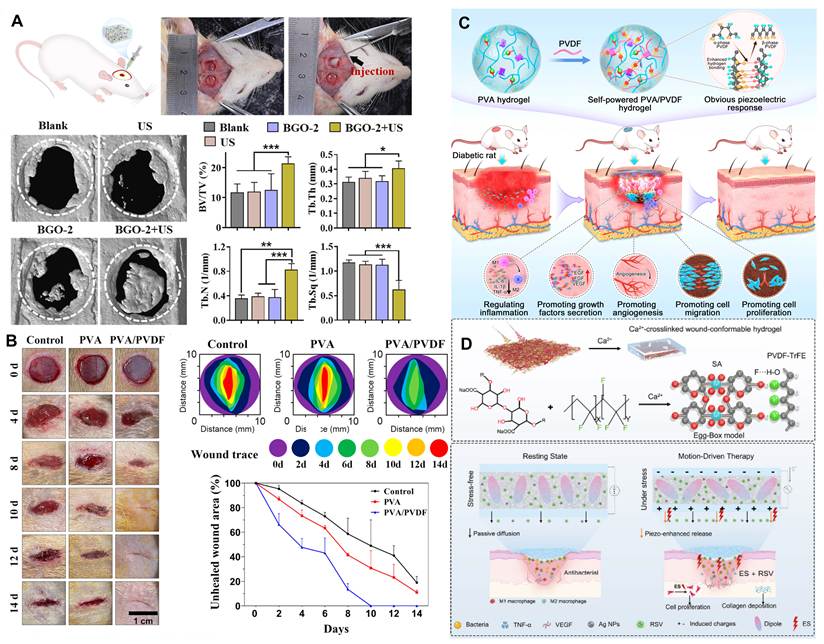
Immunomodulation is an indirect therapeutic effect, as piezoelectric stimulation can alter the tissue immune microenvironment. Macrophages, key regulators of inflammation, are particularly responsive to electrical signals. When piezoelectric hydrogels shift the macrophage response from the pro-inflammatory M1 to the pro-regenerative M2 phenotype, it helps to further diminish inflammation and improve tissue regeneration [60,65] (Figure 5A). This phenomenon is also linked to the activation of PI3K/AKT and the subsequent metabolic reprogramming, which encompasses elevation of amino acid biosynthesis and fatty acid oxidation [60,65].
Representative regenerative applications of piezoelectric hydrogels in bone and diabetic wound repair. (A) In vivo administration of the injectable BGO-2 hydrogel and ultrasound-assisted bone regeneration, together with representative micro-computed tomography images and quantitative analyses of bone volume fraction, trabecular thickness, trabecular number, and trabecular separation. Adapted with permission from Ref. [65]. Copyright 2024 The Authors. (B) Representative wound photographs, spatial wound traces, and time-dependent changes in the unhealed wound area in diabetic rats treated with the control, PVA hydrogel, or PVA/PVDF hydrogel. Adapted with permission from Ref. [52]. Copyright 2022 American Chemical Society. (C) Construction of a self-powered PVA/PVDF piezoelectric hydrogel and its proposed mechanisms for diabetic wound repair, including inflammation regulation, growth-factor secretion, angiogenesis, cell migration, and cell proliferation. Reproduced with permission from Ref. [52]. Copyright 2022 American Chemical Society. (D) Preparation of Ca2+-crosslinked SA/PVDF-TrFE piezoelectric hydrogel and its motion-triggered piezo-enhanced drug release and wound healing mechanism. Reproduced with permission from Ref. [61]. Copyright 2026 The Author(s).
It is important to distinguish piezoelectric stimulation, piezocatalysis, and the direct biological effects of ultrasound. Piezoelectric stimulation arises from mechanically induced electrical potentials, whereas piezocatalysis involves charge separation and subsequent redox reactions that generate reactive oxygen species (ROS). In ultrasound-activated systems, ultrasound itself may also produce direct acoustic and mechanical bioeffects. Therefore, biological outcomes should not be attributed exclusively to piezocatalysis without appropriate controls distinguishing ultrasound-only effects from those mediated by the piezoelectric hydrogel.
The creation of ROS. When piezoelectric materials are mechanically deformed, they exhibit piezocatalysis, resulting in the formation of ROS. This phenomenon occurs because an electric field, resulting from the deformation, provides sufficient energy to separate electrons from holes [17,32,50]. The separated electrons and holes can react with water and oxygen to produce ROS (hydroxyl radicals, superoxide anions, singlet oxygen) [17,50,66]. Biological impacts are reliant on the type of ROS, concentration, diffusion distance, and time. The studies described herein demonstrate that certain exposure regimes are associated with regenerative signals, while others are associated with an antibacterial response [17,32,51]. Context-dependent responses are especially important for the treatment of infected wounds [9,61,62].
The antibacterial response of piezoelectric hydrogels is the result of a certain piezoelectric effect and the level of mechanical stimulation [66-68]. In the studies reported, a bacterial clearance of more than 99% for both Gram-positive and Gram-negative bacteria was achieved through the use of ultrasound-activated systems. Some designs also increased oxidoreductase activity and promoted Fenton-like reactions, generating more ROS than the corresponding passive controls [17,50,69].
Drug Delivery Systems (DDS). Piezoelectric hydrogels allow the controlled release of drugs as a result of the changing structure and the drug-polymer interaction within the hydrogel caused by the application of an electric field. A piezoelectric field will change the extent of swelling of charged hydrogels, alter the electrostatic equilibrium of the drug and the polymer network, and change the conformation of the drug carrier [12,61]. These properties result in the ability to control, in a precise manner, the time and location of the drug delivery mechanism [9,12].
Electroresponsive drug carriers, which may be liposomes, nanoparticles, or conductive polymers, can be included in piezoelectric hydrogels to facilitate controlled release [61,70]. When an electrical stimulus is applied, carriers constructed of polypyrrole undergo a reduction and a volume contraction, which encourages the release of the therapeutic agent from the carrier [61]. This mechanism has been utilized to control the release of therapeutic agents, which include antibacterial agents, and also control the release of growth factors and immunomodulatory methods in response to the movement of the body or application of ultrasound [9,61].
4.2. Wound healing and skin regeneration
Mechanisms promoting wound healing. Four biological processes are facilitated by piezoelectric hydrogels: fibroblast activity, angiogenesis, collagen remodeling, and re-epithelialization, which makes piezoelectric hydrogels vital for wound healing [9,32,52,61,71]. Fibroblast activity, proliferation, and migration are stimulated by electrical signals and are necessary for granulation tissue formation [32,52] (Figure 5B and 5C). AKT and ERK1/2 pathways are activated in conjunction with angiogenesis, providing the wound with the necessary substrates and nourishment [32,71]. Collagen remodeling and deposition are additional mechanisms [32,61,72]. By stimulating collagen synthesis and fiber alignment, piezoelectric hydrogels reduce scarring and increase the mechanical integrity of the tissue [61,72]. Re-epithelialization of the wound and closure are due to the proliferation and migration of keratinocytes [9,32,62]. Application of piezoelectric hydrogels to diabetic models with chronic inflammation and poor angiogenesis resulted in over 95% wound closure within 10-14 days [9,61].
Management of infected wounds. Piezoelectric hydrogels are of great importance in treating infected wounds due to their combined properties of antibacterial activity and promotion of healing [9,61,62,66,68]. ROS generated by piezocatalysis play a role in eliminating bacterial pathogens and help to reduce the biofilms impeding healing [17,50,66]. In a coordinated system, electrical stimulation is used to aid tissue repair, which combines infection control and regeneration [9,61,71]. Infected diabetic wound models that were healed using piezoelectric hydrogels showed a 25.3% faster healing rate compared to the control group, and over 99% of the bacterial infection was eliminated [61,62,68] (Figure 5D). Combining photodynamic and piezoelectric effects enhances antibacterial activity [62,68]. Further, the incorporation of Ag+, Zn2+, and Cu2+ antibacterial metal ions in piezoelectric components provides antibacterial activity due to the release of ions [17,62,68].
The growing interest in piezoelectric polymers is largely due to their multifunctionality. Modulating the deposition of collagen, including the ratio of collagen I to collagen III and the amount of disorganized fibrous tissue, can reduce scarring [61,73]. Vascular maturation and restoration of hair follicles and skin appendages improve tissue perfusion and functional healing. Ideal healing and scar formation are a result of the alignment of collagen, which occurs when piezoelectric hydrogels provide stimuli to tissues during the remodeling stage of healing [61,62]. Regulating the healing process through endogenous mechanical stimuli can reduce external programming and allow future applications of piezoelectric polymers to treat wounds in homecare settings [9,52]. In a diabetic wound model, PVA/PVDF piezoelectric hydrogels improved healing through modulation of inflammation, angiogenesis, and growth factor secretion that stimulate cell proliferation and migration.
The potential for piezoelectric hydrogels to manage chronic wounds is clear. However, there are still considerable barriers to widespread use of piezoelectric hydrogels for healing in modern medicine. Currently, the most common piezoelectric-based wound dressings rely on externally applied ultrasound or mechanical stimuli to generate electric output. The therapeutic effects of such dressings tend to vary depending on the particular mode of stimulation, the architecture of the materials used in the design of the wound dressing, as well as the particular physiology of the patient.
As mentioned in several studies [15,16,70,71], a key challenge is to achieve stable, reliable, and reproducible piezoelectric output under diverse in vivo conditions. Available studies focus on antibacterial activity, angiogenesis, and tissue regeneration, but little attention has been given to the dynamic regulation of therapy in response to the evolving wound microenvironment [51,61,62,72]. The design and development of piezoelectric wound dressings should go beyond the multifunctional passive scaffolding approach and focus on the construction of smart wound management systems. Such systems should incorporate a biosensor, the ability to communicate wirelessly, and control the therapeutic process within a closed loop. The systems would be capable of monitoring the wound in real time, assessing the infection, inflammation, and repair of the tissue, and making modifications to the treatment as required [9,13,14].
4.3. Bone and cartilage tissue engineering
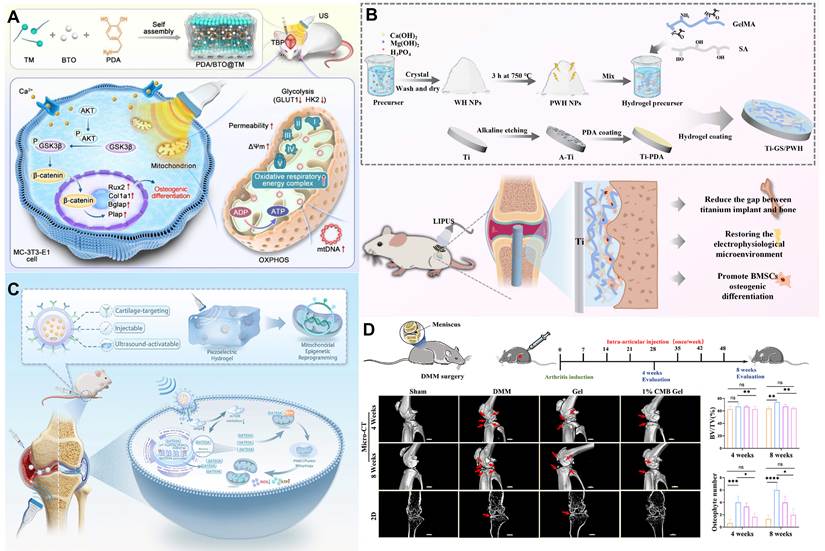
Osteogenic differentiation and bone regeneration. Ultrasound-activated piezoelectric stimulation promotes trabecular bone formation in bone defects, as shown with micro-CT images in Figure 5A. Bone is piezoelectric; mechanical loading of collagen fibers generates electrical signals. Due to this characteristic property of bone, piezoelectric biomaterials can replicate the native electrical microenvironment for bone homeostasis [10,32,64,74,75]. Hydrogels containing piezoelectric polymers promote osteogenic differentiation of BMSCs and activate the PI3K/AKT, Wnt/β-catenin, and AMPK pathways [32,64,75]. The activation of the PI3K/AKT pathway is responsible for the immunomodulatory effects described earlier. In critical-sized bone defect models, piezoelectric hydrogels have resulted in substantial bone regeneration [10,32,75,76] and improved the bone volume, mineral density, and the trabecular and architectural integrity of the bone compared to nonpiezoelectric-related hydrogels [10,32]. Piezoelectric hydrogels combined with low-intensity pulsed ultrasound (LIPUS) achieved nearly total healing of a bone defect within a few weeks. The hydrogels transmit LIPUS mechanical signals to generate piezoelectric potentials. The piezoelectric potential promotes osteogenesis while the scaffold support cell infiltration and vascularization [10,32,77]. Coupling piezoelectric hydrogels with osteogenic growth factors increases the capacity of these hydrogels to enhance bone regeneration [10,32,75] (Figure 6A). Additionally, piezoelectric stimulation is able to cause the sustained release of bone morphogenetic proteins and other osteoinductive factors creating a pro-regenerative microenvironment [75,76]. The bioactive ions of calcium, magnesium, and strontium provide chemical signals to assist the electrical stimulation [10,32,77] (Figure 6B).
Ultrasound-activated piezoelectric hydrogels for bone regeneration and osteoarthritis therapy. (A) Self-assembly of the TBP (PDA/BTO@TM) piezoelectric composite system and ultrasound-induced osteogenic differentiation through activation of the AKT/GSK3β/β-catenin pathway and enhancement of mitochondrial oxidative phosphorylation. Reproduced with permission from Ref. [32]. Copyright 2025 Elsevier B.V. (B) Schematic illustration of the fabrication procedure and in vivo osseointegration-promoting mechanism of piezoelectric hydrogel-modified titanium implants. Reproduced with permission from Ref. [77]. Copyright 2026 Wiley-VCH GmbH. (C) Design of an injectable, cartilage-targeting, and ultrasound-activatable piezoelectric hydrogel for osteoarthritis therapy through mitochondrial epigenetic reprogramming via the mTOR/GATD3A axis. Reproduced with permission from Ref. [33], Copyright 2026 The Author(s). (D) Experimental design of the destabilization of the medial meniscus model, intra-articular hydrogel administration, and micro-computed tomography evaluation of osteoarthritis progression and osteophyte formation. Adapted with permission from Ref. [33], Copyright 2026 The Author(s).
Chondrogenic differentiation and cartilage repair. Repairing osteochondral defects necessitates the growth of bone and cartilage in conjunction in one scaffold. Piezoelectric hydrogels designed for specific region differentiation within the scaffold (cartilage versus bone) feature site-specific chondrogenesis and osteogenesis. Spatial control of consolidated fillers with electrical signals across the scaffold enables synergistic tissue growth of cartilage and bone [58,60,74,78].
The piezoelectric stimulation induces chondrogenic differentiation of mesenchymal stem cells via the TGF-β/Smad and Ca²⁺/CaM/CaN pathways [11,33,59,79] (Figure 6C and 6D). In models of osteochondral defects, piezoelectric hydrogels provide a means of forming hyaline cartilage, type II collagen, and integration of the cartilage into the surrounding native cartilage [11,59,80]. Continuous electrical stimulation also helps to maintain the chondrocyte phenotype, a challenge in cartilage engineering [11,59,81].
Immunomodulation in bone healing. The immunomodulatory effect of piezoelectric stimuli on bone regeneration correlates with the specific control of the inflammatory phase of bone remodeling. The combination of piezoelectric stimuli and the modulation of the immune system promotes M2 macrophages and reduces osteoclast activity, improving bone regeneration [60,65].
Possible mechanisms of piezoelectric stimulation during bone healing may be associated with the cAMP-PKA-CREB pathway, through which some osteogenic genes may be induced [33,64], and the PI3K/AKT pathway, through which the survival and proliferation of cells are increased [64,65]. Piezoelectric stimulation may also enhance the activation of calcineurin, which is a calcium signaling pathway, and dephosphorylates NFAT. This activity may influence osteoclast regulation and bone remodeling [11,33]. Additionally, osteogenesis is enhanced through activated mitochondrial oxidative phosphorylation coupled with the AKT/GSK3β/β-catenin pathway. Furthermore, biomechanical stress can improve the quality of the osteoarthritic microenvironment through a mitochondrial reprogramming of innate immunity.
Although piezoelectric materials can mimic natural electrical signals to promote chondrogenesis and osteogenesis, several hurdles remain for their permanent integration in regenerative medicine. The majority of studies have focused on regenerative outcomes in bone defect or osteoarthritis models [74,79,80]. However, the evaluation of long-term mechanical properties of the composites, their behavior during degradation, and remodeling at the interface of complex body tissues have been reported rarely. Variations in material composition, polarization methods, and stimulation parameters make it difficult to establish standardized evaluation criteria linking piezoelectric output to biological outcomes [15,16,75]. Future efforts should focus on multifunctional systems that integrate immunomodulation, angiogenesis, and hierarchical tissue engineering [60,64].
4.4. Neural regeneration and neuromodulation
Peripheral nerve repair. In terms of neural regeneration, piezoelectric hydrogels can provide electrical cues and serve as a potential electrode-free substitute for traditional electrical stimulation [49,59,82,83]. In models of peripheral nerve injury, these hydrogels enhance Schwann-cell proliferation, migration, and myelination, thereby expediting axonal regeneration and functional recovery [59,82,83]. When piezoelectric nanofibers were used in nerve conduits, axonal regeneration in the cited studies occurred at levels similar to those seen with autografts in preclinical models; the same studies also noted improved myelination and motor recovery compared to the stated controls [59,82,84]. In Schwann cells and neurons, electrically stimulated piezoelectrics activate the PI3K/AKT and CREB/CaMKII pathways, which promote axonal growth and synaptogenesis [49,63]. Electrical stimulation increases the release of neurotrophic factors such as nerve growth factor and brain-derived neurotrophic factor, which creates a supportive environment for the survival and regeneration of neurons [59,63,83].
Therapeutic approaches to spinal cord injury. Addressing the structural complexities and limited regenerability of the central nervous system presents unique challenges to the development of piezoelectric hydrogel-based therapies for spinal cord injury (SCI). These hydrogels deliver electrical stimulation that supports the differentiation of neural stem cells, axonal regeneration, and the control of neuroinflammation [49,63,85]. In SCI rodent models, piezoelectric hydrogels have achieved significant functional recovery, including improved Basso-Beattie-Bresnahan (BBB) motor scores and decreased lesion volume. When combined with the transplantation of stem cells, these hydrogels have shown significant results [49,85]. These hydrogels provide a supportive matrix with a signaling mechanism that directs neurogenic differentiation and integration of the transplanted cells [49]. Neuroinflammation also contributes to improved outcomes via the transdifferentiation of M2 macrophages. Of interest is the use of ultrasound for the transduction of piezoelectric hydrogels in a cellular therapeutic approach to SCI [49,63,85]. The ultrasound permeates the deep spinal tissues and activates the hydrogel without the need for internal electrodes or external circuitry [49,85]. In SCI models, this approach further activates the Piezo1 channel, stimulating the CREB/CaMKII signaling cascade, facilitating neuronal differentiation, axonal regeneration and functional recovery [49,63,85].
The ability of piezoelectric hydrogels to promote functional recovery has been documented by several authors. These include direct neural regeneration, formation of neuromuscular junction (NMJ), and reinnervation of muscle. Advancements in electrical stimulation using these materials for neuromuscular junction formation indicate improvement in signal transmission from nerve fibers to muscle fibers. Active regenerative signals of these materials in volumetric muscle loss models demonstrated improved muscle function and force generation, along with myogenic differentiation and nerve regeneration [64,82]. Direct evidence related to piezoelectric hydrogels and the relevant comparison groups, however, must be outlined explicitly. Rehabilitation programs could be modified to design therapeutic stimulation, similar to purposeful patient movement [64]. Generated signals of piezoelectric hydrogels derived from the mechanical energy of movement may be sufficient for indicating stimulation for nerve regeneration, and can be characterized as "stimulating regeneration of movement" [49]. The piezoelectric hydrogels' applications in the nervous system can be organized into repair of peripheral nerves, rehabilitation of spinal cord injuries, and remodeling of neuromuscular junctions (Figure 7).
Piezoelectric hydrogels for neural regeneration and functional recovery. (A) Peripheral nerve repair: piezoelectric hydrogel nerve conduits provide endogenous electrical stimulation that promotes Schwann-cell proliferation and migration, axonal regrowth, remyelination, and motor-function recovery. (B) Spinal cord injury therapy: wirelessly ultrasound-activated piezoelectric hydrogels provide sustained local electrical stimulation, promote neural stem-cell differentiation and axonal regeneration, modulate inflammatory responses, and reduce lesion cavities. (C) Neuromuscular junction and functional recovery: piezoelectric stimulation facilitates neuromuscular junction maturation, muscle reinnervation, and restoration of contractile function, while converting patient activity into electrical stimulation to establish an activity-driven positive feedback loop between mechanical energy harvesting and tissue regeneration. Created in BioRender. Chen, Z. (2026) https://BioRender.com/9g83x6s.
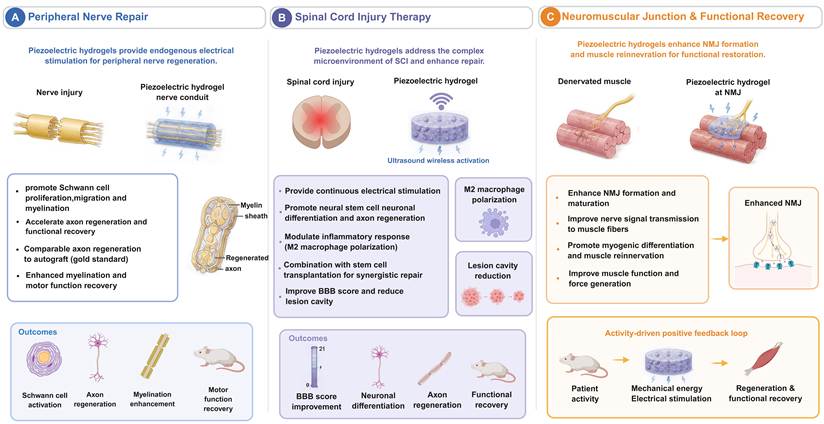
Utilizing piezoelectric hydrogels for neural tissue engineering is a possibility, considering the self-powered wireless features of the material, paired with the convenience of electroactive hydrogels and piezoelectric transduction, offering the option of artificial control of neural tissue. When compared to more classical electrodes, a greater degree of control is afforded for the amplitude and frequency of stimulation, as well as the spatial distribution of neural stimulation provided by implantable electrodes. In addition to the sensitivity control of the hydrogels, a mechanical input is required to elicit an electrical signal. Studies on neural regeneration are being tested on small animal models, and there is a need to address the stability of the device, the immune response of the host, and the recovery of functions in large animal models [49,82,85]. Incorporation of the acquisition of neural signals, artificial intelligence with algorithms, and methods of closed-loop control are the next steps for piezoelectric neural interfaces to leap from a passive stimulation method to more complex, adaptive, and intelligent systems, therefore more advanced therapeutic strategies could be applied [1,14,86].
4.5. Expanded applications of ROS-mediated piezoelectric therapy
Toward more targeted therapeutic outcomes, advanced piezoelectric hydrogels offer multiple treatment modalities using piezocatalytically synthesized ROS.
Piezocatalytic oncology. In cancer therapy, localized oxidative stress induces tumor cell apoptosis [50,65,87,88]. Ultrasound can be used as an external mechanical stimulus to activate piezoelectric materials and promote piezocatalytic ROS generation. However, ultrasound itself may also produce direct mechanical and other biological effects, which should be distinguished from piezocatalytic effects through appropriate controls. This technique can be used for targeted treatment of a tumor while minimizing the damage to the adjacent normal tissues. In the cited preclinical models based on osteosarcoma, tumor inhibition rates of more than 98% were reported [65,87,88], and more recent works are extending this technique to hydrogel systems [65] (Figure 8A). Combining piezocatalysis with other techniques like photothermal therapy produces synergistic antitumor effects. Some piezoelectric materials, such as BaTiO3 with polydopamine coating, can provide photothermal conversion and thus produce both heat and ROS in a simultaneous manner, which can enhance the cytotoxicity of tumor cells [65,88]. Additionally, the combination of piezoelectric therapy with immune checkpoint inhibitors has also been associated with enhanced antitumor immunity [87,89]. However, it is important to emphasize that the cited experimental models are the origin of the reported sustained responses.
Extended therapeutic applications of piezoelectric hydrogels in osteosarcoma, periodontitis, and intervertebral disc degeneration. (A) In vitro antitumor effects of the BGO-2 hydrogel under ultrasound and near-infrared irradiation, including relative cell viability and live/dead staining of Saos-2, UMR111, and 143B osteosarcoma cells under different treatment conditions. Adapted with permission from Ref. [65]. Copyright 2024 Elsevier B.V. (B) Preparation and intradiscal administration of the F127DA@α-TOH/NF-sPLLA piezoelectric composite hydrogel and ultrasound-assisted regulation of nucleus pulposus cell viability, inflammation, cellular metabolism, and extracellular-matrix homeostasis for intervertebral disc regeneration. Adapted with permission from Ref. [90]. Copyright 2025 Elsevier B.V. (C) Piezoelectric hydrogel-mediated rescue of impaired osteogenesis and periodontal regeneration through enhancement of mitochondrial bioenergetics and regulation of the inflammatory immune microenvironment. Reproduced with permission from Ref. [66]. Copyright 2024 Elsevier B.V. (D) Piezoelectric hydrogel upregulates the expression of M2-phenotype-related genes via the Integrin/CD44-mediated PI3K/Akt signaling pathway, while BEZ235 exerts an inhibitory blocking effect. Reproduced with permission from Ref. [60]. Copyright 2025 Military Medical Research.
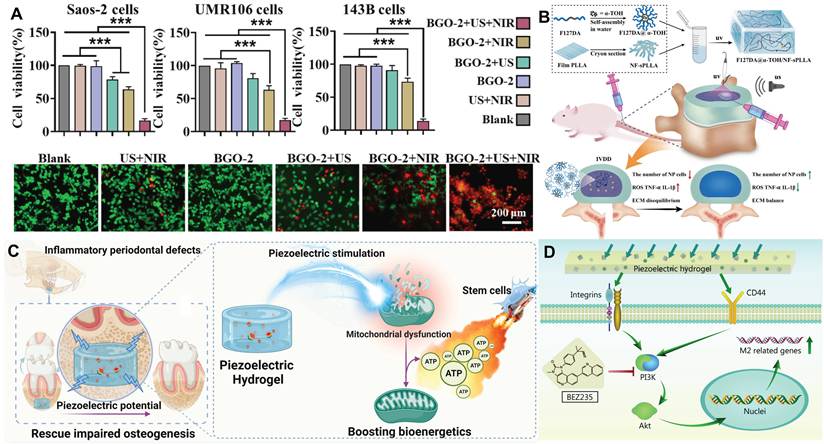
Intervertebral disc regeneration. Regenerative treatment of IVDD is challenging due to the avascular and confined disc microenvironment [50,90,91] (Figure 8B). Piezoelectric hydrogels are designed to target oxidative stress, mitochondrial dysfunction, and cellular senescence by electrical stimuli and controlled release of drugs. The AMPK-FOXO1a-mediated mitophagy pathway is a key mechanism [50,91]. Through the application of electrical stimulation, AMPK is activated, translocation of FOXO1a to the nucleus is triggered, and mitophagy-related genes are expressed. The process of mitophagy removes impaired mitochondria, decreases oxidative stress, and improves the energy metabolism of cells. In rat models of IVDD, piezoelectric hydrogels preserved disc height, decreased the expression of senescence markers, and postponed degeneration [50].
Immunomodulation and inflammatory diseases. The immunomodulatory functions of piezoelectric hydrogels make them applicable for the treatment of inflammatory diseases [60,65,66,92]. Piezoelectric hydrogels for periodontitis promote the polarization of M2 macrophages, decrease inflammatory bone loss, and facilitate the regeneration of alveolar bone [60,65,66] (Figure 8C). This immunomodulatory effect is mediated by the PI3K/AKT-mTORC1 signaling pathway in macrophages [60,65] (Figure 8D). The signaling response causes a shift in cellular metabolism to the anti-inflammatory state [60,65].
Piezoelectric hydrogels have been used for various purposes beyond traditional tissue repair, including the treatment of osteosarcoma, periodontal defect regeneration, and intervertebral disc degeneration. In these settings, they exert multifaceted therapeutic effects through ROS regulation, activation of mitochondrial bioenergetics, and immunometabolic remodeling.
Piezocatalytically produced ROS in experimental scenarios demonstrates antibacterial and antitumor effects. However, since excessive ROS may inflict damage on the adjacent healthy tissues, a balance must be achieved which allows sufficient ROS to be produced during the elimination of the target pathogens/tumors without crossing the toxicity threshold for healthy tissues. This balance depends on ROS species, their lifetime, the distance they diffuse, the tissue’s capacity to cope with ROS, and the ROS levels [51,69,87,89,93].
Determining this balance requires ROS quantification under physiologically relevant mechanical loading or ultrasound. The evaluation must go beyond confirming ROS production and include the species of ROS, their concentration, production distribution, and production kinetics. While fluorescence probes are the most common in current piezocatalytic studies, quantitative measurements must rely on other approaches, such as Electron Paramagnetic Resonance (EPR), genetically encoded redox biosensors, and oxidative damage biomarkers. Using these complementary methods, it will be possible to evaluate different piezocatalytic systems and stimulation protocols to a greater extent than is currently available [51,69,87,89,94,95].
The control and evaluation mechanisms at the biosafety level need to be developed to limit off-target ROS production. Directional implantation or injection of piezoelectric hydrogels, along with focused ultrasound activation, can be used to direct ROS production to specific areas. These technologies are in varying states of development [28,34,51,69,78,79,96]. All tissues differ in their response to oxidative stress; therefore, the threshold determination of peripheral nerves, blood, and endothelium, rather than relying solely on histological evaluation [94,97,98].
In the course of long treatments, complications arise from the fact that the body's antioxidant systems begin to manage ROS levels within the system. For example, glutathione, superoxide dismutase, and catalase can lead to redox homeostasis, but during repeated stimulation, the effectiveness of ROS can be lost. Chronic treatment should therefore consider adaptive optimization of ultrasound intensity, frequency, and timing based on local redox status to maintain efficacy while limiting cumulative oxidative damage. The control thus provided remains to be demonstrated [93,95].
5. Closed-loop architectures: integration of sensing and autonomous therapy
The autonomous functioning of a medical system is only achieved when advances in sensing and therapy are incorporated at the system level to form a sensing-processing-actuating-evaluating cycle. As explained in the previous sections, piezoelectric hydrogels provide multifunctional platforms for a self-powered system to sense and therapeutically intervene [2,9,52]. Closed-loop architectures connect monitoring, signal processing, and treatment without human intervention. [1,12,13]. This section will elaborate on system-level approaches to incorporate piezoelectric hydrogel sensors and actuators into self-therapeutic systems [1,14,55]. This will include the architectural frameworks, fundamentals of design, and strategies of control for closed-loop systems [1,12,55]. It will also provide a review of the in vivo studies to validate systems [9,13,99] and include the engineering constraints for clinical applications.
5.1 Definition, classification, and conceptual framework of closed-loop systems
5.1.1 Definition and basic components of closed-loop systems
Piezoelectric hydrogels have developed from being single-function materials to platforms that can sustain the sensing of physiological signals, the conversion of energy, and the regulation of therapy. However, these functions are usually documented in separate systems. Self-sufficient sensing or stimulus-responsive therapy does not form a closed-loop intelligent medical system. The essence of closed-loop medicine lies in the continuous collection of physiological data and the real-time modification of therapeutic responses to changing physiological conditions, not simply a material's capacity to elicit a therapeutic effect or to produce a signal.
From a systems-control standpoint, a closed-loop system observes biologic states and determines following therapeutic actions by means of signal processing and state recognition, decision making, therapeutic intervention, and feedback assessment. A closed-loop medical system comprises five interlinked steps: sensing, signal processing, decision making, therapeutic intervention (actuation), and feedback assessment. Novel closed-loop systems for drug delivery and intelligent health care systems are built on the same design principle of continuous control by integrating real-time sensing, computational decision making, therapeutic execution, and feedback regulation [1,14].
In systems of this kind based on PH, three attributes are assessed separately. Energy autonomy indicates the means by which a function is powered; operational autonomy refers to the degree of human or external control over decisions and actions; and closed-loop control involves the integration of measured feedback to adjust therapy. A self-powered piezoelectric hydrogel sensor that continuously generates physiological signals constitutes a sensing module, while a device that delivers electrical stimulation, drugs, or modulates and regulates tissue under preset conditions makes a therapeutic module. Both are essential elements of a closed-loop system, but the system is still incomplete without a feedback-driven decision-making and adaptive control system [1-3]. Feedback is assessed by a post-intervention, reassessing, and sensing routine that initiates the control cycle.
5.1.2 Classification of piezoelectric hydrogel - based medical systems according to closed-loop maturity
Piezoelectric hydrogels - based biomedical systems may be grouped into three classes (open-loop, semi-closed-loop, and fully autonomous closed-loop systems) based on the possession of a complete informational feedback pathway and the ability to make autonomous decisions and perform therapeutic interventions. The aim of this classification was to assess the control architecture, and not the mere existence of piezoelectricity and autonomy in the system.
(1) Open-loop systems. An open-loop system can perform one or more functions related to the acquisition of a signal or therapeutic output, but cannot change the therapy or output parameters on its own. An example of this kind of system is a self-powered sensing system. Piezoelectric hydrogels can convert mechanically induced strain, movement, or activity of a tissue into an electrical signal that can be used to monitor the movement, pressure, or other physiological conditions. However, these systems mainly capture data [3,7,8]. Likewise, open-loop interventions are therapeutic systems that primarily operate under ultrasound, mechanical, or electrical stimulation. Piezoelectric hydrogel-based systems, for instance, have enough therapeutic potential to aid in the regeneration of bone, the chondrogenesis process, and the healing of tissues and similar conditions; however, they remain open-loop systems as long as real-time physiological data is not used to adjust the therapy dynamically [10,11,24,35].
(2) Semi-closed-loop systems. These systems, to varying degrees, create a feedback connection to the information that has been sensed and the action that has been taken to provide a therapy. However, these systems still depend on an external computing platform, or rely on a human, or some other non-autonomous system, for the processing of the information, for making the critical decisions, or for changing the therapeutic parameters. For example, a monitoring system could continuously sense a physiological or tissue condition and send the real-time data to an external electronic system, where a clinician or an algorithm determines and adjusts the therapeutic response. Although this arrangement is more advanced than the self-powered sensing system, paired with a predefined therapy system, it is still far from offering a fully autonomous, end-to-end closed-loop control system. Several wireless smart wound-management systems that integrate the concepts of physiological sensing, external control, and on-demand therapy are examples of systems that can be at this stage of the development of closed-loop systems [9].
(3) Fully autonomous closed-loop systems. These systems can accomplish signal acquisition, processing, decision-making, intervention, and control with minimal external communication, leading to a modification of the system in response to changes in the patient’s state. Several hydrogel electronic devices can illustrate this framework. Qu et al. reported the first example of a real-time measurement of an electrophysiological signal with an activated voltage-controlled drug delivery system to recognize the state of a seizure and provide an instant intervention [12]. Additionally, an example of a skin-based wound dressing embedded with a sensing, control, and therapy system is also focused on the framework of closed-loop systems [13]. However, unless a piezoelectric component is included and documented, these examples cannot be classified as fully autonomous piezoelectric-hydrogels systems. Truly fully autonomous closed-loop systems based specifically on piezoelectric hydrogels remain limited. Future systems must be designed to incorporate the spectrum of materials, devices, computation, and control. Systems designed with sufficient energy to sustain sensing, processing, and therapeutic functions should be declared fully autonomous [1,12-16].
5.1.3 From self-powered sensing to autonomous therapeutic regulation: the role of piezoelectric hydrogels in closed-loop systems
Piezoelectric hydrogels do not have to carry out all functions of a closed-loop system. Instead, they can serve as a flexible, biocompatible substrate for information and energy transduction between sensing and therapeutic modalities of a closed-loop system. Section 3 describes the self-powered sensing of piezoelectric hydrogels, while Section 4 describes therapeutic control and regulation of assisted electrical stimulation, controlled drug delivery, and the regeneration of tissues. These establish a system-level closed loop only when the elements of a closed loop—signal processing, decision-making, therapeutic control, and evaluation of feedback—are integrated. Previous reviews have highlighted mechanical compliance, biocompatibility, and electromechanical transduction as the basis of piezoelectric hydrogels to self-powered bioelectronics integrated with therapeutic devices [2,3,15].
Section 3 presents the self-powered sensing modules of this framework. Piezoelectric hydrogels transform mechanical, physiological, or tissue-related stimuli into electrical signals, and thus, can gather data with minimal reliance on a continuous supply of external power. There are examples of flexible, self-powered, and wireless physiological monitoring piezoelectric hydrogels in the literature for pressure, strain, and human motion sensing [3,7,8,29,38,47]. However, continuous signal conditioning, readout, and communication might still require external energy. The output of such a system, in essence, serves as a signal to a closed-loop system, but does not represent a therapeutic decision. The sensing layer of the system obtains additional functionality by processing, interpreting, and converting the acquired signals into control commands to guide intervention actions [1,14].
The frameworks presented in Section 4 can be regarded as the intervention layer of a closed-loop system. They are concerned with providing electrical, mechanical, ultrasonic, or controlled drug delivery stimulation and tissue repair and regeneration. By transforming local mechanical stimuli into electrical signals or electric fields, piezoelectric hydrogels can engender therapeutic microenvironments for various tissues, including bone, cartilage, and neural tissues, as well as for other tissues and for wound healing [10,11,24,34,35,100]. If the system does not change the output based on the patient’s real-time physiological state, then the system is considered to be open-loop, even if the system provides therapy and changes the therapy based on collected feedback.
Piezoelectric hydrogels-enabled closed-loop smart medicine can thus be seen as an evolution from a mere material-level function to full system-level control. Piezoelectric hydrogels begin with self-powered sensing via mechanical-to-electrical transduction, followed by signal-processing modules that extract relevant features from the output, and decision-making modules that determine the intervention and the extent of the intervention based on the current state. The therapeutic module then applies the selected stimulation or drug delivery, and the feedback module reassesses the state. That information is then cycled to the next decision. The system is designed to function as an integrated control loop covering the main stages “sensing, processing, decision making, intervention and feedback” rather than just combining a sensor and a therapeutic unit [1,12-14].
These five functions should be combined as a unified system with specified capabilities in sensing, signal conditioning, data communication, energy control, and therapeutic actuation.
5.2 System architecture signal processing and control requirements
5.2.1 Architectural principles of closed-loop systems sensing-processing-actuation-feedback framework
From an architectural point of view, the five functional stages can be combined into four modules: sensing, processing, actuation, and feedback [1,12,13]. The sensing module, which is a piezoelectric hydrogel unit, transduces a physiological signal into an electrical one [3,8,44]. The processing module interprets the output, identifies which states are pathological, and determines the therapeutic response [14,101]. The actuation module is then responsible for delivering electrical impulses, drugs, or both [9,12]. The feedback loop is completed when the evaluation module determines the outcome of the actuation, modifies the actuation, and then reassesses the response [1,12,13].
This framework distinguishes between closed-loop systems and open-loop systems. Open-loop systems deliver pre-programmed therapies without regard for changing or current physiological states. Once an open-loop system is active, it continues its function as per its programmed setting. Conversely, closed-loop systems assess the therapeutic response and modify the therapy based on changes in physiological state [1,14]. It is, therefore, possible to administer therapy in a manner that is optimally needed, in the right quantity, and for the right duration. This kind of adjustment will enhance patient outcomes, minimize negative side effects, and reduce the quantity of therapeutic agents needed [1,15]. In the case of piezoelectric hydrogel systems, different configurations of a system may utilize the actuation and sensing responses of the piezoelectric materials in an integrated manner [2,3,15].
Three primary approaches to integration of piezoelectric hydrogel systems in the context of closed-loop systems have been presented. Monolithic integration involves placing both sensing and actuation functions in one hydrogel system, thereby allowing the same material to realize both the diagnostics and the therapy [12]. This approach results in a less complex system with improved compatibility of the system interfaces, but the integration of the sensing and actuation functions must be adequately addressed [1,12,55]. This configuration was used in an antiepileptic microneedle system by Qu et al. (2024) [12]. Each microneedle electrode performed both electrical sensing and controlled voltage-mediated drug release, and providing individual addresses allowed spatiotemporal control [12].
In modular integration, sensing and actuation are subdivided and separately realized functions in adjunct units, thereby offering the freedom to optimize the functions of sensing and actuation. The interfaces of the separate units must convey the needed signals, provide power to the system, and support mechanical functionality. This kind of integration is illustrated by smart wound dressings that incorporate separate temperature and humidity sensors alongside a drug-releasing hydrogel layer [9,13].
Hierarchical integration employs a CPU to manage several sensing and actuation modules and supports sophisticated decision-making and multi-modal therapy. While power constraints and data processing demand are significant, the architecture is useful in state-of-the-art implantable brain-machine interfaces and advanced control algorithms [55].
When deciding on an integration strategy, the tradeoff is between the complexity and reliability of the system [1,14]. Monolithic integration can reduce the complexity of the system, but can also limit certain functions of the system. On the other hand, modular integration can allow for the optimization of various system functions, but can also complicate the system as a result. The most appropriate tradeoff for all considerations is hierarchical integration, as it provides the most system functions at the highest complexity level [1,15].
The decision-making within the sensing-actuation system relies on the time interval between sensing, actuation, and the interpretation of the actuation signal. The system must be designed to operate within a specified time interval [1,12,13]. This interval can vary, potentially exceeding several hundred milliseconds if the system is designed for suppression of seizures, versus prohibiting the system from exceeding milliseconds if the system is designed for control of arrhythmia [1,12,14,55]. It is necessary to complete this within the specified time constraints to ensure adequate satisfaction of control.
Targeting and integrating multiple channels—the spatial resolution of a closed-loop system’s therapeutic delivery determines the therapeutic precision of the system [12,55,84]. Arrays of microneedles that have independently addressable electrodes can localize therapeutic delivery and electrical stimulation to the microneedles, thus confining adjacent healthy tissue to the minimal therapeutic exposure. This minimizes damage to adjacent tissue [12,84]. Layered sensor and actuator arrays can describe the spatial distribution of a pathological condition and localize therapeutic delivery to the corresponding tissue systems that are designed to have multiple channels and multiple actuation-sensing systems are capable of therapeutic intervention and condition monitoring for a number of parameters [8,44,55,84,85]. Cardiovascular systems may combine the monitoring of heart rate and blood pressure and the detection of arrhythmias, along with the delivery of therapeutic response [43,102], while in the neural domain, systems may integrate the recording and the stimulation of multiple sites in order to control seizures and to aid in the rehabilitation of motor function [12,55,85].
5.2.2 Feedback-control circuits and signal conditioning
Designing and building the AFE. Piezoelectric hydrogel sensors produce low-amplitude signals (millivolt range) with high source impedances and noise [4,55]. The AFE is optimized for amplification of low signal-level input and suppression of common-mode noise. It also includes a band-pass and anti-aliasing filter and performs digitization [4]. For the purpose of signal conversion, low noise, and high source impedance, the charge amplifier is the most appropriate choice among the other types of AFE. The design of the AFE is determined by several important characteristics, including gain, which is typically in the range of 60–100 dB, bandwidth, and power consumption compatible with harvested energy [4,55]. The AFE input impedance should be greater than the sensor input impedance, although due to the frequency-dependent nature of the hydrogel, this may not always be achievable. Present AFE designs have an input impedance of 1 GΩ with a power dissipation of 100 μW [4]. However, these specifications do not guarantee feasibility with a harvested-energy budget. Incorporating the AFE and piezoelectric hydrogel sensor on a single flexible common substrate minimizes parasitic capacitances and overall noise. Use of flexible printed circuit boards (PCBs) with deformable and stretchable interconnects provides electrically stable and accurate hydrogel interconnects [13]. Protective biocompatible polymer coatings of the electronics can keep the electronics in direct contact with the body and maintain their conformal contact with the tissue.
Artifact suppression and signal enhancement. Stimulation artifacts produced when the device is on are problematic for closed-loop systems as they risk contaminating the sensed signal. When sensing is done concurrently with actuation, crosstalk can occur, resulting in distortion of the physiologic signal, and even triggering untimely interventions. There are a number of different methods to deal with these issues [55,101]. In temporal blanking, sensing is completely switched off for the duration of actuation and for a finite time after, preventing the sensed signal from being contaminated, but resulting in a loss of the sensed data during that time [55,101]. The template subtraction method is based on the recording of a stable and reproducible artifact that is subsequently removed from the sensed signals [55]. In selective sampling, data is captured when the amplitude of the stimulation artifact is at a minimum, making use of the fact that stimulation artifacts are typically of a high frequency, whereas most physiologic signals are of a lower frequency. Artifact suppression in the front-end circuitry (AFE) is done with minimal power and latency [55]. Differential recording and high-pass filtering are used in combination to reduce common-mode artifacts and low-frequency shifts, respectively. Application-specific integrated circuits (ASICs) with embedded artifact cancellation have made it possible to continuously stimulate and record in a closed-loop system [55,101].
The untethered closed-loop systems require both wireless power and data links. Self-contained systems can, in principle, use a piezoelectric element as the energy harvesting unit, potentially reducing or even eliminating the battery, given the energy demand of the whole system. Since biomechanical energy harvesting happens intermittently, the system may require a supercapacitor or a thin-film battery as an energy buffer to sustain the desired duty cycle and harvested energy during inactivity [3-5,13]. The stored energy in a capacitor can be estimated as Estored = 1/2 CV2, allowing energy accumulated during low-demand periods to support intermittent high-power operations such as wireless transmission or therapeutic actuation. Therefore, system-level energy autonomy depends on the balance between harvested energy and the energy consumed by sensing, processing, communication, and actuation, together with appropriate duty-cycle management. Wireless data transfer options include NFC for short range and low power, BLE for a medium range and wearable applications, and implantable telemetry for deeper tissue applications. The selection of a transfer protocol is always a trade-off among parameters such as the allowable data rate, energy consumption, maximum range, and the ability to penetrate a given tissue [5,13]. While ultrasound-based transfer requires a high level of energy consumption, it enables deeper tissue penetration. The design of smart wound dressings is an application where the integration of piezoelectric energy harvesting in wireless systems is realized to enable the transfer of the status of a wound and to harness energy from the movement of the patient. The combination of submillimeter wireless components and conductive and pliable materials into a wearable and implantable systems aids the development of devices without losing compliance to the system. The sensing, communication, and control components layer give the system the capability to interpret physiological signals and determine the appropriate therapeutic response [5,13,42].
5.3. Decision-making and adaptive control
Raw outputs from piezoelectric hydrogel sensors will require machine learning to interpret and classify normal physiological sensor variations and determine abnormal states. Deep neural networks and other convolutional networks are useful for solving classification problems [14,48,103]. Convolutional neural networks can be used to identify features in time-series data. Recurrent neural networks and transformers are also used in time series data for their ability to capture temporal dependencies and are excellent for sequential prediction [14,103]. For detection of atrial fibrillation, a piezoelectric pulse signal using machine learning (ML) analysis reached a diagnostic success of 91 percent when compared to a conventional ECG analysis [57]. Deep learning models when trained on intracranial EEG data, are even able to classify preictal states, allowing for preventative measures to be undertaken earlier [12,14]. ML application on piezoelectric hydrogel sensor data has yet to be widely published. While early studies using soft wearable sensors have indicated that soft sensors can provide diagnostic data that have primarily been achieved using clinical devices or sensors, other studies have shown that soft wearable sensors provide diagnostic data equivalent to sensors that are clinical in nature [14,48,53]. Integrating peripheral hubs with sufficient edge computing capability may allow ML to be run directly on the device. This will greatly reduce latency and privacy issues and allow for real-time data analysis without the need to be connected to the cloud. Custom application-specific integrated circuits (ASICs) or field-programmable gate arrays (FPGAs) that are low-powered neural network accelerators can perform very complex models at power levels lower than 1 mW. Depending on the model, harvested power, storage, and duty cycle, such devices may be designed to be energy autonomous in an integrated peripheral hub node [14,86,103].
1) Adaptive control via reinforcement learning
Reinforcement learning (RL) is studied as an adaptive control mechanism for therapy, which is achieved by monitoring the agent’s interaction with the environment, thereby learning the control policies. RL learns to control the therapy without the need to classify the data in advance and through the control process, learns on an ongoing basis to develop the most effective control policy for the patient. Studies on electrical stimulation have used RL to determine the optimal parameters of stimulation, i.e., frequency, amplitude, and pulse width, to achieve a defined therapeutic goal [99,101,102,104]. The RL agent modifies the stimulation parameters based on the system's physiological responses and the control policy incentive, and the RL agent continues to adapt to the patient's control system changes [101,104]. RL based control of stimulation of the vagus nerve has been used for bidirectional control of heart rate and mean arterial pressure [99,102]. RL has not yet been used to close the control loop to a PH sensor and a therapeutic actuator. PH control is an optimal example of what RL can do [101,104]. Control of RL can be conducted in a self-powered and continuous manner, making it aligned to energy efficient control goals [3,101]. The interaction with biological systems can serve as a feedback learning mechanism. Due to safety concerns in a clinical setting, RL may be less adaptable, while in an industrial setting it may be more so [101,102,104].
2) Clinical trust and explainable AI
Within public health systems, explainable artificial intelligence is more of a design aspiration than a standard feature. Attaining clinical trust in closed-loop systems relies on the ability to make transparent and interpretable decisions [14,15,52,103]. For instance, methods in explainable AI support clinicians’ trust and help during the regulatory approval process, since they explain the rationale for a given decision. Saliency mapping and other feature-attribution techniques describe how and why particular elements of a sensor signal influenced the system output. In addition, explainable AI may support system diagnostics and continuous improvement [14,15,103]. It is essential to understand the rationale for a given therapeutic decision, especially when an unforeseen outcome arises. This is highly relevant for long-term autonomous systems. In such systems, the ability to detect and correct performance drifts or failures that occur under rare situations is essential [14,15,86,103].
It is important to understand how the sensing, the decision, and the therapeutic actions of a given system remain reliable and robust in the presence of physiological and clinically relevant circumstances, as opposed to focusing solely on the performance of the algorithms.
5.4 System validation, clinical translation, and performance benchmarking
5.4.1 In vivo validation and clinical translation
Preclinical studies. In developing several disease-targeting sensing and therapeutic systems, and related closed-loop biomedical platforms, several piezoelectric hydrogel-based systems have been evaluated in a number of preclinical models [9,12,99]. In one model of epilepsy, a hydrogel-based drug delivery microneedle device achieved autonomous seizure control with a drug dose that was three orders of magnitude lower than the dose traditionally required. The device read and recorded electrophysiological signals in real time to identify activity that was abnormal and/or pathological and controlled the electrically driven release of the drug from the microneedles, thereby completing a spatiotemporally controlled therapeutic feedback loop [12]. Several smart bandage systems were also evaluated in preclinical rodent models of infected wounds. In these models, the systems incorporated a drug-releasing hydrogel with temperature and humidity sensing elements and controlled the actuation of the system via a mobile phone using a closed-loop control strategy. When compared to an open-loop therapeutic system or to a passive dressing, a closed-loop control system resulted in improved angiogenesis, collagen deposition, epithelial healing, and overall recovery of the wound [9,13]. In another preclinical study, a wearable microneedle patch that combined closed-loop glucose sensing and insulin delivery was used to control blood glucose levels in diabetic rats. The patch used a glucose-sensing microneedle of a hollow design, and the controlled delivery of glucose was achieved through the microneedle. The clinical feasibility of this system was further enhanced due to the PEGylation of the electroosmotic micropump, which increased the operational time of the system to several weeks [105].
Preclinical investigations using piezoelectric hydrogels extend beyond small animal models to large animal models [63]. The study conducted by Shen and colleagues in 2025 in Nature Communications evaluated the therapeutic effects on models of injury to the central and peripheral nervous systems in beagle dogs and rhesus macaques [63]. The study supports the evaluation of therapies in a broad range of clinically relevant conditions.
Clinical trial data. Research on the use of piezoelectric hydrogels and other associated closed-loop hydrogel/electronic systems remains largely in the early stages of human clinical studies [13]. The iSAFE system, for example, has been used to assess in situ the various conditions of different types of patient wounds of 18 to 95 years of age, and, in turn, to modulate the local drug delivery [13], thus demonstrating the potential of closed-loop therapeutic management of wounds in the hospital setting [13].
Clinical adoption and challenges. The clinical application of piezoelectric hydrogel systems requires piezoelectric circuits and biohybrid systems for manufacturing and therapeutic implementation. The sub-system integration and manufacturing standards will need to meet regulatory standards and guidelines [1,14,15]. The targeting of systems would rely on the bio-supported architecture, the contact duration, and the nature of the control (software) and the autonomy of the control (software). The FDA and EMA are used as examples of authorities where the design and development of medical systems would need to demonstrate safe and effective products, but the way the systems are brought to market (the pathway) based on the clinical application differs for the cited authorities [1,15]. For implantable configurations, these closed-loop systems would fall under the regulatory framework for active implantable medical devices, while wearable configurations would need to address software autonomy requirements alongside applicable standards [1,15]. The scalability of manufacturing integrated hydrogel systems remains another challenge [1,14]. The manufacturing of integrated hydrogel systems, especially the integration of sensing systems, will need to be consistent in order to achieve balance in the control of the characteristics of the hydrogel systems, the swelling, the dehydration, and the mechanical properties [31].
The direct clinical application of piezoelectric hydrogel-based closed-loop systems will depend on their integration into existing healthcare workflows, including clinical adoption pathways and regulatory alignment [1,14,15]. Such closed-loop therapeutic systems would likely be implemented in chronic healthcare settings to reduce the burden of hospitalization and enhance patient quality of life [1,14].
5.4.2 System-level performance benchmarks
Table 3 summarizes representative piezoelectric-hydrogel and related closed-loop biomedical systems and compares them with conventional or open-loop approaches.
Performance metrics of representative piezoelectric-hydrogel and related closed-loop biomedical systems, with comparisons to conventional or open-loop approaches.
| System type | Sensing modality | Therapeutic output | Control strategy | Performance metric | Improvement over conventional/open-loop systems | References |
|---|---|---|---|---|---|---|
| Antiepileptic microneedle system | Local field potential | Voltage-driven drug release | Real-time electrophysiological analysis | Drug dose reduced by three orders of magnitude | Oral administration requires a 1000-fold higher dose and cannot respond at seizure onset | [12] |
| Smart wound bandage | Temperature/humidity | Liquid-metal heater-mediated drug release | Smartphone-mediated control | 94.7% satisfaction; 95.47% timely notification | Conventional dressings provide passive isolation only and cannot detect infection-related temperature changes or release drugs on demand | [9,13] |
| Diabetes-management patch | Interstitial glucose | Insulin delivery | PCB-based closed-loop control | 98.82% time in the normoglycemic range | Manual injection maintains normoglycemia for approximately 80% of the monitored period and has a threefold higher risk of hypoglycemia | [105] |
| Melanoma patch | Tyrosinase sensing | Drug release | Flexible PCB-based intelligent decision-making | Accuracy >95.5%; tumor inhibition >70% | Topical drug application achieves approximately 30% inhibition and cannot monitor changes in the tumor microenvironment | [94] a |
| Closed-loop brain-machine interface | Neural recording | Electrical stimulation | Artifact-removal algorithm | 50% reduction in response latency | Open-loop stimulation has a fixed delay and cannot provide real-time sensorimotor closed-loop synchronization | [55] |
a [94] Yao JL, Yao JX, Xin YJ, Liu XC, Gao YF, Zheng XY, et al. Disentangled Hydrogel With Rare Earth-Activated Multi-Enzymatic Activity Reverses the Pathological Vicious Cycle by Establishing a Closed-Loop for Postoperative Melanoma Treatment. Adv Funct Mater. 2026 Apr;36(33):202531433. Which comparative improvements are based on the experimental data reported in the corresponding references.
6. Outlook
The integration of advancements in materials science, bioelectronics, and artificial intelligence with piezoelectric hydrogels offers substantial potential for their use in closed-loop smart healthcare systems. However, the majority of research on piezoelectric hydrogel systems does not demonstrate a complete feedback cycle. This study categorizes the field into a four-level hierarchy of materials engineering, self-powered sensing, therapeutic actuation, and closed-loop integration. Each of these levels builds upon the preceding one, but the self-powered transduction level does not provide the system with energy autonomy or closed-loop autonomy. To progress further, energy autonomy and the integration of sensing, computing, decision-making, actuation, and feedback systems are needed.
From the perspective of materials, hydrogels have evolved from simple piezoelectric-filler composites to self-polarized multi-network architectures. More broadly, materials focus has shifted from maximizing performance to balancing function and biological adaptability [6,7,95]. The current systems offer a piezoelectric response while maintaining tissue-like compliance and flexibility, and reflect a greater consideration of dynamic biological environments. Piezoionic mechanisms have extended the transduction capabilities of hydrogels beyond conventional piezoelectric effects [18,19,22]. They enable the sensing of different mechanical timescales and the capture of complex physiological signals. Conductive networks based upon carbon nanotubes, MXenes, and graphene enhance charge transport and couple ionic hydrogel matrices with electronic readout systems [3,9,21,29,38]. This advancement is shifting piezoelectric hydrogels closer to being integrated bioelectronic systems. The development of antifreezing, anti-dehydration, and biodegradable systems addresses the long-term stability needs of wearable and implantable biomedical systems [7,24,39,41,47,78].
Piezoelectric hydrogels at the sensing level have shown great improvement in speed and resolution of detection, sensitivity, and especially the mechanical durability of the sensing element [8,40,44]. The current phase of research has shifted towards understanding the balance of signal fidelity, biocompatibility, and stability for long-term monitoring of physiological parameters, rather than focusing solely on improving individual parameters. Some examples of the advanced sensing capabilities shown in cited literature include the assessment of cardiovascular dynamics and analysis of pulse waveforms [44], detection of movements and activities of the musculoskeletal system, including the movements of the joints, gait, and even facial expressions [7,38,44], as well as assessment of various respiratory patterns [4,45,48]. Conformal skin-interfaced or implantable devices can perform this monitoring with minimal disturbance to the mechanical environment of the tissue. Related platforms show that wireless transmission along with on-chip processing can facilitate continuous monitoring free of restrictions [4,5,13], while the Edge AI enables real-time processing of sensor data and analytics on the edge without continuous connectivity to cloud services [14,48,103]. It is yet to be demonstrated that all these components can be integrated into a single Piezoelectric hydrogel node along with the energy closure at the system level.
At the therapeutic level, earlier work provided evidence that biomechanical electrical stimulation, such as that produced by heartbeats or muscle contractions and joint movement, can enhance tissue healing in multiple organ systems [9-11,32,52]. Piezoelectric hydrogels can convert biomechanical stimuli into therapeutic signals, serving as bioactive scaffolds. Applications demonstrating these capabilities include accelerated healing of infected diabetic wounds, improved regeneration of critical-sized bone defects, enhanced repair of injured spinal cord, and cartilage regeneration that possesses the characteristics of native cartilage [9-11,32,49,59,85]. The generation of ROS from a piezocatalytic effect provides another therapeutic mechanism. Combined with its antibacterial effect and tissue healing, this mechanism addresses the challenges of healing-related infections [66,68]. Related hydrogel electronic systems have achieved on-demand drug release, showing significant therapeutic results from drug dosages that are dramatically less than what is typically found to be effective [12]. However, it remains to be determined if the outputs generated from the Piezoelectric hydrogels will be able to offer controlled closed-loop dosing within a therapeutic range.
Studies that focus on the integration of sensing with therapy within closed-loop systems are increasingly being conducted at the system level [1,9,12,13]. Illustrative examples include the iSAFE wound bandage tested on patients aged 18 to 95 years, an antiepileptic microneedle patch that caused a significant decrease in the delivered drug dose and achieved seizure control, and a dual-loop insulin delivery system that maintained blood glucose levels within the normal range for 98.8% of the duration of the monitoring period [105]. Studies in this body of work indicate the trend of greater levels of autonomy in healthcare systems and elaborate on what is required for greater autonomy of healthcare systems [1,12-15]. RL and XAI are two key tools that might assist in the development of adaptive systems for automated control and transparent assessment in a clinical context [14,15,101,103,104]. Qu et al. [12] combined a system of electrical recording with a system of voltage-driven drug release in a single-component hydrogel electronic device. Huang et al. [13] extended the evidence beyond laboratory proof of concept and tested a skin-interfaced electronic wound bandage on a diverse and varied patient population. He et al. [105] combined continuous glucose monitoring and a glucose-responsive insulin delivery system in a dual closed-loop system with multiple layers of safety and control. Ge et al. [9] included the management of exudate, the monitoring of wound beds, and closed-loop therapy in a smart wound dressing. Although these examples illustrate the use of closed-loop systems, they should not all be considered as evidence for the autonomy of piezoelectric-hydrogel systems.
The development of interdisciplinary solutions is required to overcome five key obstacles that restrict the widespread clinical adoption of piezoelectric hydrogel closed-loop systems.
Long-term durability. Operational stability remains the main obstacle for the clinical translation of piezoelectric hydrogels. Although some recent publications have started to quantify durability, most still evaluate either short-term cyclic loading or short-term degradation. Several studies have assessed mechanical durability, physiological stability, and degradation behavior under various conditions. Example reports can be found summarized in Table 4.
Quantitative assessment of long-term stability and degradation performance of piezoelectric hydrogels
| Material | Mechanical/Electrical durability | Physiological stability | Degradation duration/behavior | Reference |
|---|---|---|---|---|
| PAN elastomer | 10,000 loading cycles (1 Hz) | — | — | [7] |
| Organohydrogel | 5,000 loading cycles; 14-day storage | PBS exchange (3 d); -20 °C stability | — | [8] |
| Cellulose/P(VDF-TrFE) | 10,000 pressing cycles (8 kPa) | — | — | [9] |
| PLLA DN hydrogel | Repeated fatigue loading | Anti-swelling for 2 weeks | Biodegradable | [25] |
| ZnO/RSF hydrogel | 100 compression cycles | PBS (56 d) | 56-day degradation | [26] |
| Injectable SPG | Repeated deformation | PBS degradation | 4-day degradation | [34] |
| Injectable PLLA | 2-month in vivo stability | PBS (37 °C) | 2-month degradation | [81] |
Piezoelectric PAN elastomers and cellulose/(PVDF-TrFE)-based hydrogels can reliably maintain their electromechanical responses beyond 5,000–10,000 loading cycles [6-8]. Other injectable piezoelectric hydrogels have also demonstrated stability for 4 to 56 days while degrading in PBS and stability for an additional 2 months after in vivo implantation [24,35,79]. Unfortunately, these validation periods are all relatively short, and there is no systematic analysis of the long-term retention of piezoelectric output for clinically relevant loading and in vivo physiological conditions. During long-term in vivo use, the effectiveness of piezoelectric hydrogels will decline due to the leaching of the filler, polymer-chain relaxation, depolarization, interfacial fatigue, and biofluids-induced degradation [15,16,67]. Furthermore, the mechanical mismatch between rigid piezoelectric fillers (e.g., BaTiO3 and ZnO) and the flexible hydrogel matrix can exacerbate interfacial damage and fatigue during repeated loading. Future development should focus on intrinsically piezoelectric biodegradable polymers (e.g., PLLA and peptide assemblies), innovative network architectures, and interfacial engineering [16,22,27,79] along with innovative designs for network architecture and the optimization of interfacial engineering. There is also a need for application-specific stability frameworks to evaluate the performance of wearable devices for thousands of loading cycles, temporary implants for periods ranging from weeks to months, and sustained reliable performance from chronic implants.
Closed-loop control in complex physiological environments. The control of a system within the coupled mechanical, electrical, chemical and biological parts of the human body is still an ongoing challenge [1,14,55]. Within the different domains of control, there can be interference when sensing and actuation are to be performed [55,101]. Signal quality is reduced due to stimulation artifacts, motion noise and biofouling, and biological variability can restrict the control algorithms to a specific application [14,101]. Solutions will rely on more sophisticated artifact suppression [55,101], adaptive filtering [55], and patient-specific systems that are able to track and adapt [101,104].
Immunological compatibility. Long-term implantation requires systematic immunological and biosafety assessment [2,15,16,60]. While the acute cytotoxicity is low, there is a need to analyze the chronic inflammation and encapsulation by macrophages of the foreign body, and the local and systemic toxicity due to the degradation products [2,16,60]. Some preliminary data on the piezoelectric hydrogels’ in vivo degradation is available from the conducted animal studies [79]. However, the long-term degradation and safety of these hydrogels is still unknown. The long-term biosafety of inorganic piezoelectric fillers such as BaTiO3 and ZnO remains an important but insufficiently explored issue. These fillers may have stability issues, and degradation may release them to the body with some biological effects after implantation [47,79]. There are concerns with off-target immune response and the need for further analysis and controls, even though some researchers believe that there are moderate beneficial effects in case of some therapeutic stimulation of the immune system. [60].
Scalable manufacturing. The translation of multifunctional piezoelectric hydrogel devices is constrained by the lack of reliable and scalable production [14,16,67]. In order to produce devices that combine the functions of sensing, processing, and acting with wireless communication in a single device, advanced manufacturing techniques need to be applied to produce devices that are consistent and reliable at a larger scale [14]. Rapid deployment of manufacturing capabilities beyond the research lab will require roll-to-roll processing, automated assembly, and consistent quality assurance [16].
Standardized evaluations and regulations. The existing regulations for devices and medical software management will be applicable to this new technology, but standardized evaluation protocols and regulatory frameworks are lacking for closed-loop PH systems. [1,14-16]. In order to benchmark and compare data from different studies, consensus is needed in determining the piezoelectric performance, the efficacy and accuracy of the therapeutic systems, and their overall reliability [2,15,16,67]. Regulatory pathways for autonomous medical devices, especially those using AI-driven decision-making, will need to develop alongside the technology [14,15].
Over the next five to ten years, research may focus on programmable piezoelectric hydrogel networks [86,96]. Hydrogel networks that are able to communicate could enable whole-body health management beyond isolated local interventions. These hydrogel networks could monitor multiple physiological parameters; they could be designed to manage the therapy of multiple organ systems and could even respond to the passive changes in the health status of a person instantaneously. The direction of these programmable piezoelectric hydrogel networks is still conceptual, and multisite coordinated sensing and actuating have not been achieved as of now.
A significant possibility would be if programmable piezoelectric hydrogels were combined with artificial intelligence, digital twins, and advanced modeling to shift care from reaction to prevention. For example, the combination of these technologies would allow for early predictions of seizures, arrhythmias, and even infections or metabolic breakdown to the point of crisis. Predictive inference would run on the electronics that are associated with the systems, as opposed to the hydrogel itself. The focus would be on predictive modeling, energy constraints, and duty cycle. In the near future, the priority will more likely be increasing the intrinsic piezoelectric coefficient, enhancing flexible capacitive energy storage, and scaling down closed-loop control systems to be smaller than a millimeter.
Another avenue is transient intelligent implants that are fully bioresorbable. These implants are designed to be absorbed after finishing their diagnostic and therapeutic functions, which eliminates the need for removal surgery and the anxieties associated with permanent implants. Biodegradable piezoelectric materials, like Silk Fibroin, peptides, and PLLA, are being combined with transient electronic materials such as magnesium, silicon, and zinc. Potential applications include postoperative monitoring and the regulation of tissue regeneration and temporary management of diseases.
A biohybrid closed-loop system is possible with the combination of piezoelectric hydrogels, synthetic biology, and cell therapy. Piezoelectric signals could regulate engineered cells to produce therapeutic proteins, direct differentiation, or guide migration. Controlled cells could also be designed to sense specific biochemical environments and interface with the piezoelectric system. This interaction would represent the combination of electronic control and therapeutic cellular function, but remains to be seen in a PH-cell closed loop.
7. Conclusion
Piezoelectric hydrogels hold promise for future autonomous medical systems. They could serve as components in closed-loop systems for sensing and actuation. Some advancements have been made for the piezoelectric hydrogels and initial tests have been reported; however, completely autonomous piezoelectric hydrogel systems and specific clinical analyses are still lacking. Development is needed to address biosafety, long-term durability, energy-efficient control, scalable production, and standardized assessment protocols. Addressing these challenges will require interdisciplinary collaboration among materials science, electrical engineering, clinical medicine, and data science. The technology and materials used in piezoelectric hydrogels may be able to help with personalized, closed-loop systems in the future.
Competing Interests
The authors have declared that no competing interest exists.
References
1. Paci MM, Saha T, Djassemi O, Wu S, Chua CYX, Wang JS. et al. Smart closed-loop drug delivery systems. Nat Rev Bioeng. 2025;3(10):816-834
2. Zhang C, Kwon SH, Dong L. Piezoelectric Hydrogels: Hybrid Material Design, Properties, and Biomedical Applications. Small. 2024;20(28):e2310110
3. Chen RS, Gao MY, Chu DW, Cheng WL, Lu YR. Self-powered hydrogel wearable bioelectronics. Nano Energy. 2024;128(B):109960
4. Mahbub I, Pullano SA, Wang HF, Islam SK, Fiorillo AS, To G. et al. A Low-Power Wireless Piezoelectric Sensor-Based Respiration Monitoring System Realized in CMOS Process. IEEE Sens J. 2017;17(6):1858-1864
5. Zhu Y, Sun F, Jia C, Zhao T, Mao Y. A Stretchable and Self-Healing Hybrid Nano-Generator for Human Motion Monitoring. Nanomaterials (Basel). 2021;12(1):104
6. Fu RM, Tu LJ, Guan YJ, Wang ZG, Deng CL, Yu P. et al. Intrinsically piezoelectric elastomer based on crosslinked polyacrylonitrile for soft electronics. Nano Energy. 2022;103(A):107784
7. Shi Y, Guan Y, Liu M, Kang X, Tian Y, Deng W. et al. Tough, Antifreezing, and Piezoelectric Organohydrogel as a Flexible Wearable Sensor for Human-Machine Interaction. ACS Nano. 2024;18(4):3720-3732
8. Zhang C, Kwon SH, Huerta A, Jiang ZP, Sun MD, Dong L. Self-Polarized Piezoelectric Hydrogels with Flexible-Rigid Networks for Ultrasensitive Multifunctional Sensors. ACS Materials Lett. 2025;7(7):2607-2616
9. Ge Z, Guo W, Tao Y, Sun H, Meng X, Cao L. et al. Wireless and Closed-Loop Smart Dressing for Exudate Management and On-Demand Treatment of Chronic Wounds. Adv Mater. 2023;35(47):e2304005
10. Li M, Hu X, Liu X, Zhao L, Zhao W, Li Y. et al. 3D bioprinted piezoelectric hydrogel synergized with LIPUS to promote bone regeneration. Mater Today Bio. 2025;31:101604
11. Liu YB, Liu X, Li XF, Qiao L, Wang HL, Dong YF. et al. Multifunctional piezoelectric hydrogels under ultrasound stimulation boost chondrogenesis by recruiting autologous stem cells and activating the Ca2+/CaM/CaN signaling pathway. Bioact Mater. 2025;50:344-363
12. Qu J, Xie K, Chen S, He X, Wang Y, Chamberlin M. et al. Multifunctional hydrogel electronics for closed-loop antiepileptic treatment. Sci Adv. 2024;10(47):eadq9207
13. Huang X, Zhang Q, Yang Y, Chow L, Ma J, Xu G. et al. A skin-interfaced three-dimensional closed-loop sensing and therapeutic electronic wound bandage. Nat Commun. 2025;16(1):5782
14. Das D, Adams SD, Corva DM, Bucknall TK, Kouzani AZ. Advances in Closed-Loop Artificial Intelligence for Healthcare. Electronics. 2026;15(7):1396
15. Zhou H, Ma J, Liu FL, Wang Y, Guo HR, Liu ZB. et al. Review of the Latest Progress and Prospect of Piezoelectric Hydrogels for Bioelectronic Medicine. ACS Materials Lett. 2025;7(8):2783-2804
16. Bai ZQ, Lv MT, Zhai QX, Bian DL, Sang L, Chen ZG. Frontier applications of piezoelectric hydrogels: principles, design strategies, and translational perspectives. Mater Des. 2026;266:116155
17. Wang Z, Liu Z, Zhao G, Zhang Z, Zhao X, Wan X. et al. Stretchable Unsymmetrical Piezoelectric BaTiO3 Composite Hydrogel for Triboelectric Nanogenerators and Multimodal Sensors. ACS Nano. 2022;16(1):1661-1670
18. Dobashi Y, Yao D, Petel Y, Nguyen TN, Sarwar MS, Thabet Y. et al. Piezoionic mechanoreceptors: Force-induced current generation in hydrogels. Science. 2022;376(6592):502-507
19. Li L, Shao Y, Jia L, Guo Z, Li Z, Wang ZL. et al. A d₃₃ piezoionic hydrogel with bioinspired multi-gradient structure for enhanced mechano-iontronic transduction. Nano Energy. 2025;133:110477
20. Jaiswal M, Singh S, Sharma B, Choudhary S, Kumar R, Sharma SK. Sodium Niobate Nanowires Embedded PVA-Hydrogel-Based Triboelectric Nanogenerator for Versatile Energy Harvesting and Self-Powered CO Gas Sensor. Small. 2024;20(38):e2403699
21. Zhang Q, Cheng JY, Hou RN, Cheng YH, Yu ML, Li N. et al. High-performance piezoelectric-triboelectric hybrid nanogenerator based on stretchable, self-adhesive, and conductive hydrogels for self-powered sensing. React Funct Polym. 2026;220:106626
22. Wei QY, Gao WC, Zhang TZ, Long LX, Zhao J, Pan LZ. et al. A "PHASE" Strategy for Preparing Flexible Piezoelectric Polylactic Acid Double Network Hydrogel Sensors. Adv Funct Mater. 2026;36(28):2525548
23. Khazani Y, Rafiee E, Samadi A, Mahmoodi M. Alginate-PVDF piezoelectric hydrogel containing calcium copper titanate- hydroxyapatite as a self-powered scaffold for bone tissue engineering and energy harvesting. Colloids Surf A. 2024;687:133537
24. Zhang S, Huang L, Chen W, Chen Q, Liu X, Su D. et al. Piezoelectric hydrogel with self-powered biomechanical stimulation enhances bone regeneration. Acta Biomater. 2025;195:117-133
25. Khan M, Ahmad B, Hayat K, Ullah F, Sfina N, Elhadi M. et al. Synthesis of ZnO and PEG-ZnO nanoparticles (NPs) with controlled size for biological evaluation. RSC Adv. 2024;14(4):2402-2409
26. Shen C, Chen W, Guo L, Zou Y, Han S, Yu N. et al. In-situ heterojunction on high-aspect-ratio cellulose nanocrystals for long-range charge transport in e-skin. Carbohydr Polym. 2026;383:125305
27. Yang X, Liu S, Lu H, Wang Y, Zhang H, Ji W. et al. Peptide Sequence Programmed Piezoelectric Response by Supramolecular Self-Assembly. Adv Sci (Weinh). 2026;13(12):e15237
28. Liang J, Huang X, Qin K, Wei H, Yang J, Liu B. et al. Implanted Magnetoelectric Bionic Cartilage Hydrogel. Adv Mater. 2025;37(20):e2415417
29. Wang K, Yao Y, Liu H, Wang J, Li X, Wang X. et al. Fabrication of Flexible Wearable Mechanosensors Utilizing Piezoelectric Hydrogels Mechanically Enhanced by Dipole-Dipole Interactions. ACS Appl Mater Interfaces. 2024;16(38):51542-51553
30. Zhang ZY, Yao AF, Raffa P. Physically crosslinked amphiphilic eutectogels with underwater self-healing, strong adhesion, environmental stability and closed-loop recyclability for underwater sensing and information transmission. Chem Eng J. 2025;522:167958
31. Gao WZ, Lu Z, Feng SW, Guo YL, Cui JJ, Liu FK. et al. 3D printable dual-sensing hydrogels with exceptional anti-swelling and toughness. Int J Extreme Manuf. 2026;8(2):025002
32. Zhao SY, Li Y, Dai L, Cheng B. Ultrasound-responsive piezoelectric hydrogels accelerate bone defect repair by regulating mitochondrial OXPHOS via activating AKT/GSK3β/β-catenin signaling axis. Chem Eng J. 2025;522:168176
33. Zheng H, Yan P, Liu P, Yan C, Zhao M, Wang Z. et al. Ultrasound-Activatable Piezoelectric Hydrogel Reprograms Mitochondrial Epigenetics for Osteoarthritis Therapy via the mTOR/GATD3A Axis. Adv Sci (Weinh). 2026:e76140. Epub ahead of print.
34. Li X, Liu Y, Yang Q, Zhang W, Wang H, Zhang W. et al. Injectable Piezoelectric Hydrogel Promotes Tendon-Bone Healing via Reshaping the Electrophysiological Microenvironment and M2 Macrophage Polarization. ACS Appl Mater Interfaces. 2025;17(15):22210-22231
35. Wu Y, Wang Y, Li W, Li D, Song P, Kang Y. et al. Construction of piezoelectric, conductive and injectable hydrogels to promote wound healing through electrical stimulation. Acta Biomater. 2025;191:205-215
36. Martins L, Barbosa AI, Correlo VM, Bhattacharya M, Reis RL. Exploring the piezoelectric phenomenon: From polymers to human tissues and advanced applications in tissue engineering. Bioact Mater. 2025;57:358-399
37. Zhang Z, Wang Z, Li X, Zheng Y, Yang Z. Design and Manufacturing of Piezoelectric Biomaterials for Bioelectronics and Biomedical Applications. Chem Rev. 2025;125(20):9875-9929
38. Guo Y, Wang Y, Wang H, Hu X, Zhou G, Liu S. et al. Highly Flexible, Adhesive, Antimicrobial, and Self-Powered Hydrogel Strain Sensor for Human Motion Monitoring. Biomacromolecules. 2026;27(4):2736-2751
39. Yao S, Chen T, Liu Z, Fan L, Xie Y, You S. et al. A dual-layer chitosan-based conductive hydrogel and piezoelectric film for ultrasound-driven wound repair and scar reduction. Carbohydr Polym. 2025;370:124305
40. Dong Y, Hu Z, Yang Y, Ren B, Wang Z, Wang C. et al. Highly-sensitive, anti-freezing, recyclable chitosan quaternary ammonium salt hydrogel constructed by piezoelectric dipole introduction for low-temperature sensing application. Int J Biol Macromol. 2026;353:151184
41. Zheng SY, Liu AF, Zhang XH, Wu WH, Chen LH, Lai CM. et al. Penguin Skin-Inspired, Nanoparticle-Reinforced Hydrogels for Extreme Environment-Resistant Piezoionic Generation and Sensing. Adv Funct Mater. 2026;36(13):2514944
42. Xue H, Huang X, Sun X, Wu K, Tan Z, Fan H. et al. Superior lead-free piezoceramics for wearable multimodal ultrasound imaging arrays. Nat Commun. 2025;17(1):218
43. Wang C, Hu YR, Liu Y, Shan YZ, Qu XC, Xue JT. et al. Tissue-Adhesive Piezoelectric Soft Sensor for In Vivo Blood Pressure Monitoring During Surgical Operation. Adv Funct Mater. 2023;33(38):202303696
44. Lu Z, Xu K, Huang X, Li W, Li J, Li L. et al. Strong dipole-dipole interaction-enhanced dual-network piezoelectric hydrogels for long-term pulse monitoring and machine learning-based object recognition. Chem Eng J. 2026;538:176592
45. Gou GY, Guo YS, Song ZX, Huo P, Lu Y, Li N. et al. A Dual-Modal Silent Speech Interface via Surface Electromyography (sEMG) and Vibration Sensing. ACS Appl Mater Interfaces. 2025;17(44):61028-61037
46. Hu XJ, Wang Y, Guo YW, Zhou GY, Liu SH, Li J. Bismuth Sodium Titanate-Enhanced Microfibrillated Cellulose/Poly(acrylic acid) Double-Network Piezoelectric Hydrogel for a Self-Powered, Flexible, and Durable Strain Sensor. ACS Appl Polym Mater. 2025;7(3):1805-1817
47. Fu RM, Zhong XX, Xiao CR, Lin J, Guan YJ, Tian Y. et al. A stretchable, biocompatible, and self-powered hydrogel multichannel wireless sensor system based on piezoelectric barium titanate nanoparticles for health monitoring. Nano Energy. 2023;114:108617
48. Cai W, Li A, Zhang F, Jiang H, Zhu J. Flexible Self-Powered Multimodal Sensor for Simultaneous Temperature, Strain, and Pressure Detection with Signal Decoupling. ACS Appl Mater Interfaces. 2026;18(23):33126-33137
49. Wang HF, Zhang WC, Ren YM, Lu JC, Liu S, Liu L. et al. Ultrasound-driven piezoelectric hydrogel enhances Schwann/neural stem cells Co-transplantation for spinal cord injury repair. Mater Des. 2025;253:113842
50. Wu W, Cheng Z, Shi P, Gao H, Chen Y, Zhang A. et al. Ultrasound-responsive piezoelectric hydrogel attenuates oxidative stress-induced nucleus pulposus senescence via AMPK-FOXO1a-mediated mitophagy for intervertebral disc regeneration. Biomaterials. 2026;328:123828
51. Liu D, Li L, Shi BL, Shi B, Li MD, Qiu Y. et al. Ultrasound-triggered piezocatalytic composite hydrogels for promoting bacterial-infected wound healing. Bioact Mater. 2022;24:96-111
52. Wang L, Yu Y, Zhao X, Zhang Z, Yuan X, Cao J. et al. A Biocompatible Self-Powered Piezoelectric Poly(vinyl alcohol)-Based Hydrogel for Diabetic Wound Repair. ACS Appl Mater Interfaces. 2022;14(41):46273-46289
53. Yin J, Jia P, Ren Z, Zhang Q, Lu W, Yao Q. et al. Recent Advances in Self-Powered Sensors Based on Ionic Hydrogels. Research (Wash D C). 2025;8:0571
54. Lin B, Yang P, Liu W, Li Z, Wang Z, Xiang Y. et al. Flexible Hydrogel Sensors for Real-Time and Synchronized Monitoring of Underwater Multiple Parameters Based on Piezoelectric Elastomer/Sodium Alginate/Carbon Quantum Dots Composites. Biomacromolecules. 2025;26(7):4230-4237
55. Chen W, Liu X, Wan P, Chen Z, Chen Y. Anti-artifacts techniques for neural recording front-ends in closed-loop brain-machine interface ICs. Front Neurosci. 2024;18:1393206
56. Jiang L, Yang Y, Chen Y, Zhou Q. Ultrasound-Induced Wireless Energy Harvesting: From Materials Strategies to Functional Applications. Nano Energy. 2020;77:105131
57. Xi Y, Cheng SJ, Chao SY, Hu YR, Cai MS, Zou Y. et al. Piezoelectric wearable atrial fibrillation prediction wristband enabled by machine learning and hydrogel affinity. Nano Res. 2023;16(9):11674-11681
58. Liu D, Wang X, Gao C, Zhang Z, Wang Q, Pei Y. et al. Biodegradable Piezoelectric-Conductive Integrated Hydrogel Scaffold for Repair of Osteochondral Defects. Adv Mater. 2024;36(45):e2409400
59. Xiong Z, Lin B, Huang C, Duan A, Zhang C, Qiang G. et al. Biocompatible and stretchable chitosan piezoelectric gel with antibacterial capability and motion monitoring function for Achilles tendon rupture treatment. Carbohydr Polym. 2025;352:123149
60. Wu P, Shen L, Liu HF, Zou XH, Zhao J, Huang Y. et al. The marriage of immunomodulatory, angiogenic, and osteogenic capabilities in a piezoelectric hydrogel tissue engineering scaffold for military medicine. Mil Med Res. 2023;10(1):35
61. Wang B, Wang Y, Li M, Wan C, Ju X, Cao C. et al. Self-Powered Piezoelectric Nanofibrous Hydrogel for Synergistic Electro-Pharmacological Therapy of Chronic Wounds. Adv Healthc Mater. 2026;15(25):e71297
62. Liu K, Zhou Z, Wang H, Li Q, Chen B, Wang X. et al. A Heterojunction Piezoelectric Antimicrobial Asymmetric Hydrogel for Dynamic Wound Healing and Monitoring. Small. 2025;21(13):e2411265
63. Shen J, Wu S, Wang Y, Yan Z, Liu T, Sun X. et al. Mechano-bioactive hydrogel bioelectronics for mechanical-electrical-bioenergetic conversion and glia-modulating neural regeneration. Nat Commun. 2025;16(1):11582
64. Dong J, Dong W, Ran H, Wu D, Wang X, Chen H. et al. BMSCs-targeting piezoelectric stimulation and immunomodulatory dual-functional hydrogel for promoting diabetic bone regeneration. Mater Today Bio. 2025;33:102015
65. Xiao C, Wang R, Fu R, Yu P, Guo J, Li G. et al. Piezo-enhanced near infrared photocatalytic nanoheterojunction integrated injectable biopolymer hydrogel for anti-osteosarcoma and osteogenesis combination therapy. Bioact Mater. 2024;34:381-400
66. Liu X, Wan X, Sui B, Hu Q, Liu Z, Ding T. et al. Piezoelectric hydrogel for treatment of periodontitis through bioenergetic activation. Bioact Mater. 2024;35:346-361
67. Fan P, Fan H, Wang S. From emerging modalities to advanced applications of hydrogel piezoelectrics based on chitosan, gelatin and related biological macromolecules: A review. Int J Biol Macromol. 2024;262(Pt 1):129691
68. Luo J, Liang Z, Zhao X, Huang S, Gu Y, Deng Z. et al. Piezoelectric dual-network tough hydrogel with on-demand thermal contraction and sonopiezoelectric effect for promoting infected-joint-skin-wound healing via FAK and AKT signaling pathways. Natl Sci Rev. 2025;12(5):nwaf118
69. Chi S, Li YP, Ye TT, Kang JW, Xiang ZH, Kuang XQ. et al. Energy reconversion of ultrasound on a piezoelectric hydrogel promotes ROS/CO generation and wound self-closure for infected chronic wound healing. Matter. 2025;8(3):101989
70. Dai J, Shao J, Zhang Y, Hang R, Yao X, Bai L. et al. Piezoelectric dressings for advanced wound healing. J Mater Chem B. 2024;12(8):1973-1990
71. Wei Y, Yu Q, Zhan Y, Wu H, Sun Q. Piezoelectric hydrogels for accelerating healing of diverse wound types. Biomater Sci. 2025;13(3):568-586
72. Yan P, Zheng H, Liu P, Yan C, Zhao M, Ling S. et al. Ultrasound-activated piezoelectric hydrogel scaffold for synergistic immunomodulation and angiogenesis in accelerated wound healing. Acta Biomater. 2025204:216-233.
73. Liang J, Zeng H, Qiao L, Jiang H, Ye Q, Wang Z. et al. 3D Printed Piezoelectric Wound Dressing with Dual Piezoelectric Response Models for Scar-Prevention Wound Healing. ACS Appl Mater Interfaces. 2022;14(27):30507-30522
74. Liu YB, Lu J. Research trends of piezoelectric biomaterials in osteochondral tissue engineering. Mater Today Commun. 2024;41:110264
75. Liu XH, Chen WJ, Liu B, Song FX. Current status of piezoelectric biomaterials for promoting bone healing in bone tissue engineering. Int J Polym Mater Polym Biomater. 2026;75(2):194-211
76. Li M, Liu XF, Li LY, Zhang W, Hu XT, Ma CF. Research progress of piezoelectric hydrogel materials in bone tissue engineering. Chin J Pract Stomatol. 2024;17(6):709-715
77. Wang J, Jing J, Zhang H, Xu J, Huang Z, Zhao C. et al. Titanium-Based Piezoelectric Dual-Network Hydrogel Coatings for Bone Regeneration Enhancement. Adv Healthc Mater. 2026;15(25):e71303
78. Lin J, Li S, Peng Y, Qiu C, Yang M, Guo J. et al. Ultrasound-triggered injectable piezoelectric nanocomposite hyaluronic acid-based hydrogel for modulating inflammation and chondrogenesis in osteoarthritis treatment. Carbohydr Polym. 2025;367:123909
79. Vinikoor T, Dzidotor GK, Le TT, Liu Y, Kan HM, Barui S. et al. Injectable and biodegradable piezoelectric hydrogel for osteoarthritis treatment. Nat Commun. 2023;14(1):6257
80. Tschon M, Codispoti G, Cabras P, Cafarelli A, Trucco D, Vannozzi L. et al. In vivo efficacy of an injectable piezoelectric nanocomposite hydrogel and low-intensity pulsed ultrasound in two preclinical models of osteoarthritis. Biomaterials. 2026;326:123728
81. Zhou Z, Zheng J, Meng X, Wang F. Effects of Electrical Stimulation on Articular Cartilage Regeneration with a Focus on Piezoelectric Biomaterials for Articular Cartilage Tissue Repair and Engineering. Int J Mol Sci. 2023;24(3):1836
82. Lee YS, Wu S, Arinzeh TL, Bunge MB. Enhanced noradrenergic axon regeneration into Schwann cell-filled PVDF-TrFE conduits after complete spinal cord transection. Biotechnol Bioeng. 2017;114(2):444-456
83. Javidi H, Ramazani Saadatabadi A, Sadrnezhaad SK, Najmoddin N. Conductive nerve conduit with piezoelectric properties for enhanced PC12 differentiation. Sci Rep. 2023;13(1):12004
84. Liu Z, Lai J, Kong D, Zhao Y, Zhao J, Dai J. et al. Advances in electroactive bioscaffolds for repairing spinal cord injury. Biomed Mater. 2024 19(3).032005
85. Wang X, Stefanello ST, Shahin V, Qian Y. From Mechanoelectric Conversion to Tissue Regeneration: Translational Progress in Piezoelectric Materials. Adv Mater. 2025;37(33):e2417564
86. Zhang N, Meng QH, Xiao MM, Zhou LX, Leng HS, Bao CY. et al. Machine learning-enabled intelligent hydrogels: applications and future perspectives. Mater Des. 2026;266:116088
87. Zhu P, Chen Y, Shi J. Piezocatalytic Tumor Therapy by Ultrasound-Triggered and BaTiO3 -Mediated Piezoelectricity. Adv Mater. 2020;32(29):e2001976
88. Ambigaibalan AC, Mehnath S, Dharshini K, Jeyaraj M. Ultrasound-powered MXene hydrogels for enhancing tumor inhibition and immune stimulation by the piezoelectric effect. Biomater Sci. 2026;14(1):279-293
89. Pu Y, Zhou B, Bing J, Wang L, Chen M, Shen Y. et al. Ultrasound-triggered and glycosylation inhibition-enhanced tumor piezocatalytic immunotherapy. Nat Commun. 2024;15(1):9023
90. Wu FT, Liu JR, Wu XL, Li H, Shen NN, Qi XY. et al. Injectable piezoelectric nanomicelle hydrogels encapsulating α-tocopherol for the treatment of intervertebral disc degeneration by regulating the metabolic homeostasis of nucleus pulposus cells. Chem Eng J. 2026;527:171710
91. Liu H, Wang F, Yi W, Huang S, Tang Z, Liao B. et al. Internal-Friction Network Piezoelectric Hydrogel Microspheres Achieve Physiological Electrical Adaptation to Regulate Mitochondrial Autophagy in Degenerative Tissues. Adv Mater. 2026;38(12):e19152
92. Zhou Q, Fang S, Li C, Zhou M, Sui X, Hu C. et al. Dual-Strategy Design of Heterojunction-Enhanced Piezoelectric Hydrogels for Periodontitis Treatment. Adv Sci (Weinh). 2026;13(22):e00017
93. Murphy MP, Bayir H, Belousov V, Chang CJ, Davies KJA, Davies MJ. et al. Guidelines for measuring reactive oxygen species and oxidative damage in cells and in vivo. Nat Metab. 2022;4(6):651-662
94. Yao JL, Yao JX, Xin YJ, Liu XC, Gao YF, Zheng XY. et al. Disentangled Hydrogel With Rare Earth-Activated Multi-Enzymatic Activity Reverses the Pathological Vicious Cycle by Establishing a Closed-Loop for Postoperative Melanoma Treatment. Adv Funct Mater. 2026;36(33):202531433
95. Sies H, Belousov VV, Chandel NS, Davies MJ, Jones DP, Mann GE. et al. Defining roles of specific reactive oxygen species (ROS) in cell biology and physiology. Nat Rev Mol Cell Biol. 2022;23(7):499-515
96. Cui K, Li T, Ma Y, Zhang C, Zhang K, Qi C. et al. Ultrasound-Responsive Drug Delivery System Based on Piezoelectric Catalytic Mechanisms. J Funct Biomater. 2025;16(8):304
97. Jomova K, Raptova R, Alomar SY, Alwasel SH, Nepovimova E, Kuca K. et al. Reactive oxygen species, toxicity, oxidative stress, and antioxidants: chronic diseases and aging. Arch Toxicol. 2023;97(10):2499-2574
98. André-Lévigne D, Pignel R, Boet S, Jaquet V, Kalbermatten DF, Madduri S. Role of Oxygen and Its Radicals in Peripheral Nerve Regeneration: From Hypoxia to Physoxia to Hyperoxia. Int J Mol Sci. 2024;25(4):2030
99. Sarikhani P, Hsu HL, Zeydabadinezhad M, Yao Y, Kothare M, Mahmoudi B. Reinforcement learning for closed-loop regulation of cardiovascular system with vagus nerve stimulation: a computational study. J Neural Eng. 2024;21(3):036027
100. Ju X, Kong J, Qi G, Duan X, Peng C, Wang E. et al. Dual-function polyionic liquid piezoelectric hydrogel: Combining antibacterial activity and electrical stimulation for infected wound treatment. J Colloid Interface Sci. 2025;700(Pt 1):138317
101. Wu YH, Lin HC, Huang CW, Wu CY, Ker MD. Stimulation-Induced Artifact Removal of the Local Field Potential Through Hardware Design: Toward the Implantable Closed-Loop Deep Brain Stimulation. IEEE Access. 2024;12:171488-171499
102. Dabiri B, Zeiner K, Nativel A, Kaniusas E. Auricular vagus nerve stimulator for closed-loop biofeedback-based operation. Analog Integr Circuits Signal Process. 2022;112(2):237-246
103. Zheng Z, Zhu R, Peng I, Xu Z, Jiang Y. Wearable and implantable biosensors: mechanisms and applications in closed-loop therapeutic systems. J Mater Chem B. 2024;12(35):8577-8604
104. Guo X, Wang P, Chen X, Hao Y. Revolutionizing motor dysfunction treatment: A novel closed-loop electrical stimulator guided by multiple motor tasks with predictive control. Med Eng Phys. 2024;129:104184
105. He X, Huang W, Lin W, Cui B, Tian X, Bai J. et al. A Wearable, Dual Closed-loop Insulin Delivery System for Precision Diabetes Management. Adv Mater. 2026;38(8):e14945
Author contact
Corresponding author: Zhiguang Chen, zgchenedu.cn, Department of Ultrasound, The First Hospital of China Medical University, China.