Impact Factor




Theranostics 2026; 16(5):2488-2516. doi:10.7150/thno.122552 This issue Cite
Review
Functional material probes and advanced technologies in organ-on-a-chip characterization
Yanan Wang1,2#, Xiao Chang3#, Shiwen Deng1#, Shihuan Tang2,4  , Peng Chen1,5
1. Experimental Research Center, China Academy of Chinese Medical Sciences, Beijing 100700, China.
2. Institute of Chinese Materia Medica, China Academy of Chinese Medical Sciences, Beijing 100700, China.
3. Department of Urology, Chinese People's Liberation Army (PLA) General Hospital/PLA Medical School, Beijing 100039, China.
4. State Key Laboratory for Quality Ensurance and Sustainable Use of Dao-di Herbs, Beijing 100700, China.
5. Analysis of Complex Effects of Proprietary Chinese Medicine, Hunan Provincial Key Laboratory, Yongzhou, Hunan Province 425199, China.
#These authors contributed equally to this work.
Received 2025-7-27; Accepted 2025-11-18; Published 2026-1-1
Abstract
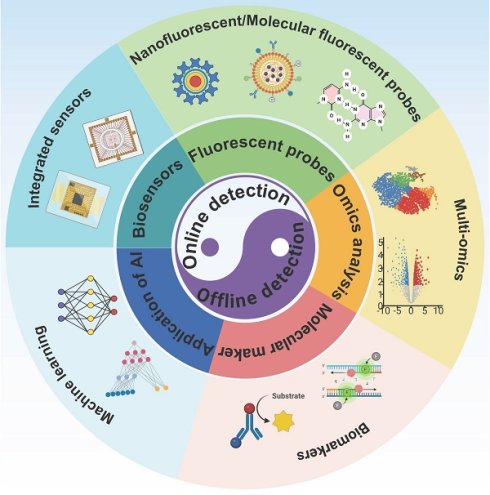
Organ-on-a-Chip (OoC) integrates advanced biomaterials, microfluidics, and cell biology to simulate organ structures and dynamic microenvironments, offering a vital platform for drug development and disease modeling. The miniature scale, structural precision, high biomimetic fidelity, and inherent dynamic complexity of OoCs pose challenges for conventional offline detection methods, including molecular-specific detection and omics analysis. Online detection technologies, particularly fluorescence probes and biosensors, address this limitation by enabling in situ, non-invasive, and real-time monitoring with high spatiotemporal resolution. As the core platform for microphysiological systems, the accuracy with which OoCs replicate human organ function and its capability for dynamic characterization are depend on breakthroughs in the performance of current probe and sensing materials. Now, comprehensive reviews specifically dedicated to fluorescence probe techniques and its application in real-time characterization of OoCs remain lacking. Herein, to address this gap, we establish an offline-online detection technologies multidimensional evaluation framework in OoCs characterization. Furthermore, we integrate the burgeoning application of image recognition technologies and artificial intelligence (AI) within the OoCs. Our aim is to provide methodological support for advancing OoCs standardization and industrial quality control, and to stimulate the development of OoCs into more reliable and effective tools for biomedical research and applications. The ongoing maturation and industrialization of OoC technology will solidify its role as a transformative tool, bridging foundational research and clinical applications with enhanced reliability and efficacy.
Keywords: functional material probes, organ-on-a-chip, biosensors, characterization techniques
1. Introduction
Organ-on-a-Chip (OoC) technology represents a revolutionary in vitro microphysiological systems (MPSs). Its core concept involves using microfluidic technology to construct 3D tissue structures incorporating human cells or organoids on a microfluidic chip, thereby mimicking key functions of human organs [1]. Unlike basic microfluidic chips that simply handle fluid flow, OoCs employ biomimetic designs, such as microchannels and functional membranes, to enable dynamic fluid perfusion. This allows them to simulate physiological microenvironments, including blood shear stress and mechanical tissue forces, while supporting co-culture of multiple cell types to reproduce organ-level interactions [2]. This approach fundamentally overcomes the limitations of traditional models. Compared to two-dimensional (2D) static cell cultures, which lack there-dimensional (3D) structure and physiological relevance, OoCs provide more biologically meaningful readouts of cell behavior and tissue function [3]. In contrast to animal models, which exhibit significant species-specific differences, OoCs utilize human cells, including those derived from primary or stem cell sources. They not only substantially reduce reliance on animal experiments but also align with the 3R (replacement, reduction, and refinement) principle of animal research ethics, while enabling more direct prediction of human-specific physiological and pathological responses. This capability is critical for addressing the high failure rate of drug candidates in human trials, where over 90% of preclinically successful compounds fail clinically [4]. Thus, engineering 3D human tissue models is essential for accurate assessment of drug metabolism, toxicity, and efficacy.
The high predictive power of OoCs underscores their translational value. Key applications include: precise assessment of organ-specific toxicity (e.g., cardiotoxicity, hepatotoxicity) in toxicology and safety pharmacology; functional integration into drug discovery pipelines to improve compound screening efficiency; the creation of multi-OoCs systems, also called “human-on-a-chip”, for studying systemic drug absorption, distribution, metabolism, excretion, and pharmacokinetics (ADME/PK), as well as biological barrier function; and disease modeling and therapeutic efficacy evaluation by reconstituting pathological conditions and testing personalized treatment strategies [5]. In 2025, U.S. regulatory and research agencies introduced landmark policies to advance more human-relevant alternative methods. In April, the Food and Drug Administration (FDA) announced plans to gradually phase out animal testing requirements for monoclonal antibodies and other drugs [6]. Subsequently, in July, the National Institutes of Health (NIH) stated that it would no longer fund new research projects relying solely on animal experiments [7]. This strategic shift creates a pivotal opportunity for advanced technologies such as OoCs. By enabling rapid toxicity screening and integrating AI for accurate drug response prediction, OoC technology is emerging as a key tool to bridge the translational gap in drug development.
The microenvironment within OoC systems is inherently complex and dynamic. These systems must not only replicate the structures of multiple cell types and tissues but also simulate their interactions and behaviors under physiological conditions [8]. Crucially, these interactions are highly time-dependent, requiring models where states evolve over time. Such dynamic complexity renders traditional offline detection methods, reliant on fixed-time-point sampling, insufficient for validation, thereby imposing an urgent need for real-time, continuous monitoring technologies. Furthermore, OoCs development faces technical bottlenecks, particularly in multi-organ functional integration and processing the massive, multi-dimensional data generated by high-precision, real-time sensing [9]. Addressing these challenges demands interdisciplinary collaboration to achieve key breakthroughs in high-precision characterization technologies for biomarker detection, advanced system integration, and complex data analysis [10]. These advances are essential to ensure the model's biological functions align with human organ physiology. In traditional characterization methods for OoCs, the chip output can be connected to analytical devices such as high-performance liquid chromatography (HPLC) or mass spectrometers (MS), or rely on biochemical detection means like DNA assays or reagent kits to achieve precise identification and quantitative analysis of biomarkers. While these traditional molecular-specific biomarker detection and omics analysis offer high sensitivity and molecular mechanism resolution, they exhibit significant material limitations: destructive sampling requiring fixation or lysis of OoCs, which precludes real-time monitoring of cellular dynamic behaviors; invasive probes or extraction interfaces that disrupt the homeostasis of physiological microenvironments; and operational complexities such as high sample consumption and increased labor costs due to multi-step processing [11].
The accuracy of OoCs in simulating human organ functions and its dynamic characterization capabilities fundamentally depend on breakthroughs in the performance of probe and sensing materials. Among various functional materials, fluorescent probes have become a key technology for realizing real-time tracking of molecular dynamics in microscale microenvironments, owing to their specific fluorescent labeling capabilities for intracellular ions, metabolites, and biomarkers. Such probes can capture transient biochemical signals in the microenvironment with nanoscale spatial resolution, such as monitoring the contraction activities of cardiac myocytes using calcium-sensitive fluorescent probes or tracking the dynamic activation of signaling pathways through FRET probes [12]. Integrated microfluidic sensor devices, leverage piezoelectric materials, nanoelectrodes, flexible bioelectronic materials, and optical sensing components to measure various physiological and environmental parameters within OoCs [13]. Compared with the limitations of traditional offline detection methods that require sample destruction, online detection technologies represented by fluorescent probes enable continuous monitoring of dynamic processes through non-invasive labeling. Notwithstanding their critical role in OoCs functionalization, sensors and fluorescent probes face limitations in application: physical sensors suffer from spatial constraints and vulnerability to biological contamination during miniaturized integration, and their difficulty in in situ calibration leads to poor long-term stability; fluorescent probes are deeply troubled by background autofluorescence interference and photobleaching effects, while their potential cytotoxicity and the uncertainty of concentration distribution in dynamic microenvironments also restrict quantitative reliability. Furthermore, both physical sensors and fluorescent probes may perturb the delicate microenvironment simulated by OoCs due to their invasiveness, and achieving high-sensitivity, wide dynamic range, and multi-parameter synchronous detection remains technically challenging. These factors collectively result in difficulties in data standardization and cross-platform comparability for OoCs detection, constituting bottlenecks for the technology's in-depth development and broad application. Thus, an ideal characterization strategy must integrate the advantages of online and offline technologies. This requires synergistically utilizing traditional offline methods to achieve comprehensive and in-depth biological mechanism analysis, while combining the continuous dynamic process information provided by real-time online technologies such as sensors and probes. Through data fusion and cross-validation, it is possible to achieve a truly comprehensive evaluation and optimization of OoCs.
Research on OoC platforms has witnessed steady growth in recent years, reflected in numerous reviews. While many of these focus on manufacturing materials and integration of OoCs [14-17], and others address the application of biosensors for OoCs optimization and validation [18, 19], comprehensive reviews specifically dedicated to fluorescence probe techniques and their application in real-time characterization of OoCs remain conspicuously lacking. To address this gap, this paper establishes a focused discussion framework centered on fluorescence probes and biosensors. Firstly, we provide a comparative analysis of real-time online detection technologies alongside traditional offline detection methods employed in OoCs characterization. Furthermore, we integrate the burgeoning application of image recognition technologies and AI within the OoCs. Finally, by investigating the principles and application scenarios of these mainstream characterization techniques, our aim is to provide methodological support for advancing OoCs standardization and industrial quality control, and to stimulate the development of OoCs into more reliable and effective tools for biomedical research and applications.
2. Online Detection Technologies in OoCs
Online detection technology, leveraging its real-time, dynamic, and continuous monitoring capabilities, has emerged as a pivotal tool for addressing the challenges of precisely characterizing and validating dynamic physiological processes within OoCs. Compared to traditional offline methods reliant on destructive sampling, its core advantages lie in its in situ, non-invasive nature and high spatiotemporal resolution, enabling the non-invasive capture of transient physiological activities of cells/tissues, the dynamic evolution of complex signaling networks, and the spatiotemporal response processes to drugs, thereby enhancing the biomimetic fidelity and reliability of OoCs. From the perspectives of technical principles and application dimensions, the core components of current online detection systems primarily include fluorescent probe technology utilizing functional dyes or nanoscale probe materials to achieve highly specific labeling and dynamic imaging of molecular targets; biosensors employing advanced transducer elements such as nanoelectrodes, piezoelectric materials, and flexible bioelectronics to convert biological signals into quantifiable outputs; image recognition systems combining computer vision algorithms for the automated analysis of cell morphology and behavior; and AI-driven analytics platforms integrating multi-dimensional data streams and leveraging AI algorithms for in-depth interpretation. Despite immense potential, existing technologies still face challenges in areas such as miniaturization and integration, long-term stability, resistance to environmental interference and the synchronous, precise detection of multiple parameters. The key to overcoming these bottlenecks and achieving a performance leap fundamentally lies in the innovative design and engineering application of novel functional materials, including probe materials with superior photostability, interface materials with high biocompatibility/anti-fouling properties, and nanocomposite materials integrating multi-sensing functions. These material-driven technological advancements are collectively building an increasingly sophisticated online detection framework, laying a solid technical foundation for the deeper development of OoCs research.
2.1 Biosensors in OoCs
Breakthroughs in functional materials have established diverse biosensors, including optical, electrochemical, and mechanical types, as core tools for achieving in situ, real-time monitoring of critical biomarkers and microenvironmental factors within OoCs. Optical biosensors rely on specific optical materials such as plasmonic metal nanostructures, fluorescent/Raman labels, photonic crystals, and fiber-optic coating materials. They achieve high sensitivity, strong selectivity, and real-time monitoring capabilities by precisely detecting light signal changes (e.g., intensity, wavelength, and refractive index) induced by interactions between light and biorecognition elements [20]. Electrochemical sensors utilize functionalized electrode materials, including nanostructured carbon materials, metal/metal oxide nanoparticles, and conductive polymers, to convert target recognition events into electrical signals. Benefiting from the excellent electrocatalytic activity, large specific surface area, and modifiability of these materials, they exhibit high sensitivity, low detection limits, rapid response times, and operational simplicity, leading to widespread application [21]. Electrophysiological sensors primarily employ microelectrode arrays (MEAs) or flexible/stretchable bioelectronic materials. These directly detect electrical activities (e.g., action potentials, field potentials) or impedance changes generated by cells or tissues, providing unique insights into neural activity, cardiac contraction, and intercellular electrical signaling crucial for understanding biological function and disease mechanisms [22]. Mechanical sensors operate on physical principles such as piezoresistive, piezoelectric, or capacitive effects to convert specific mechanical stimuli, including the contractile force of cardiac tissues, fluid shear stress on vessel walls, and hydrostatic pressure within lumens, into measurable electrical signals. This capability provides researchers with continuous, quantitative data on dynamic tissue function, thereby overcoming the limitations of conventional endpoint analysis [23]. In this discussion, we categorized electrophysiological sensors as a subset of electrochemical sensors. By integrating material platforms based on these distinct sensing principles, these sensors synergistically enable multi-dimensional, comprehensive monitoring of complex biological systems and environmental factors within OoCs. This provides powerful support for drug screening and disease model research.
2.1.1 Optical sensors in OoCs
As a vital component of the online detection technology system, optical sensors based on advanced optical materials play an indispensable role in OoCs due to their inherent high sensitivity, non-contact measurement capability, and real-time dynamic monitoring. The core principle of these sensors lies in the interaction of light with matter, particularly functional optical materials. By precisely detecting changes in parameters such as light intensity, wavelength, phase, or polarization state, they enable quantitative analysis of target biomarkers or environmental factors [24].
Optical oxygen-sensing technology demonstrates unique advantages in simulating and monitoring the critical microenvironmental oxygen gradients within OoCs. Its performance heavily depends on the phosphorescent oxygen-sensitive materials employed [25]. Currently, phosphorescent microparticles/films based on platinum porphyrin/platinum porphyrin derivatives (e.g., Pt (OEP), Pt-TPTBPF, and Pt-TFPP) represent the mainstream. These microparticles operate based on the principle of phosphorescence quenching: when oxygen molecules in the environment interact with the phosphorescent oxygen-sensitive microparticles, the paramagnetic properties of oxygen promote a non-radiative transition from the excited state to the ground state, leading to a decrease in phosphorescence intensity. Detecting this phosphorescence signal decay, emitted by the specific oxygen-sensitive material, allows for high-precision, rapid-response perception of oxygen concentration [26]. Benefiting from the excellent photophysical properties and processability of these materials (e.g., embeddable in polymer matrices like polydimethylsiloxane (PDMS)), phosphorescent oxygen-sensitive material-based technology offers core advantages including non-invasiveness, rapid response, and the provision of real-time dynamic feedback. Satomi et al. embedded Pt (OEP) oxygen-sensitive material within a glass mask coated with PDMS at the bottom of a liver-on-a-chip, successfully replicating a physiological liver lobule oxygen gradient in vitro using fluorescence intensity modulation (Figure 1A) [27]. Helene employed Pt-TPTBPF complexes as the sensing material to achieve time-resolved monitoring of oxygen partial pressure in 2D/3D OoCs. This allowed estimation of the oxygen consumption rate in cell monolayers under conditions of increased flow rate, higher cell numbers, varied cell types, and additional ECM coating (Figure 1B) [28]. Oliver's team utilized a Pt-TPTBPF/polystyrene optical sensing material for the heart-on-a-chip oxygen sensor. The material was pre-printed on a polyethylene terephthalate (PET) substrate via a micro-dispensing technique and integrated beneath the tissue chamber during chip fabrication. This configuration enabled non-invasive, in situ, real-time, stable, and scalable oxygen monitoring [29]. Wang et al. developed a non-invasive oxygen sensor for OoCs by fabricating a PtTFPP-doped PDMS film and integrating it via spin-coating and cutting, which eliminated the need for electrodes/wires, prevented environmental interference, and provided real-time local oxygen monitoring for enhanced data accuracy (Figure 1C) [30]. The oxygen-sensing nanoparticles (NPs) was drop-cast onto the PDMS surface to form sensor spots, followed by a second layer after drying, yielding a drift of less than 0.2 % over 72 h. These integrated probes enable truly in situ, zero-consumption, and zero-dead-volume monitoring, and for the first time, provide micron-scale absolute oxygen tension measurements under cyclic 10 % mechanical stimulation (Figure 1D) [31]; this strategy involved regulating the oxygen permeability of the chip material and utilizing cellular respiration to establish a hypoxic microenvironment (Figure 1E) [32].
Representative examples of optical sensors implementation in OoCs. (A) A novel hepatic culture device with an integrated oxygen sensor. Adapted with permission from [27], copyright 2018, Elsevier. (B) A gas-impermeable 3D cell culture chip with integrated oxygen sensor. Adapted with permission from [28], copyright 2018, Frontiersin.org. (C) A two-chamber PDMS microfluidic device with integrated oxygen sensor. Adapted with permission from [30], copyright 2021, Wiley. (D) A schematic of the oxygen sensing Intestine Chip with four oxygen sensors. Adapted with permission from [31], copyright 2022, Royal Society of Chemistry. (E) An oxygen-sensitive human intestinal chip microfluidic culture device with 6 oxygen-quenched fluorescent particles embedded. Adapted with permission from [32], copyright 2019, Springer Nature. (F) A photonic sensor-enabled tissue chip. Adapted with permission from [34], copyright 2024, Royal Society of Chemistry.
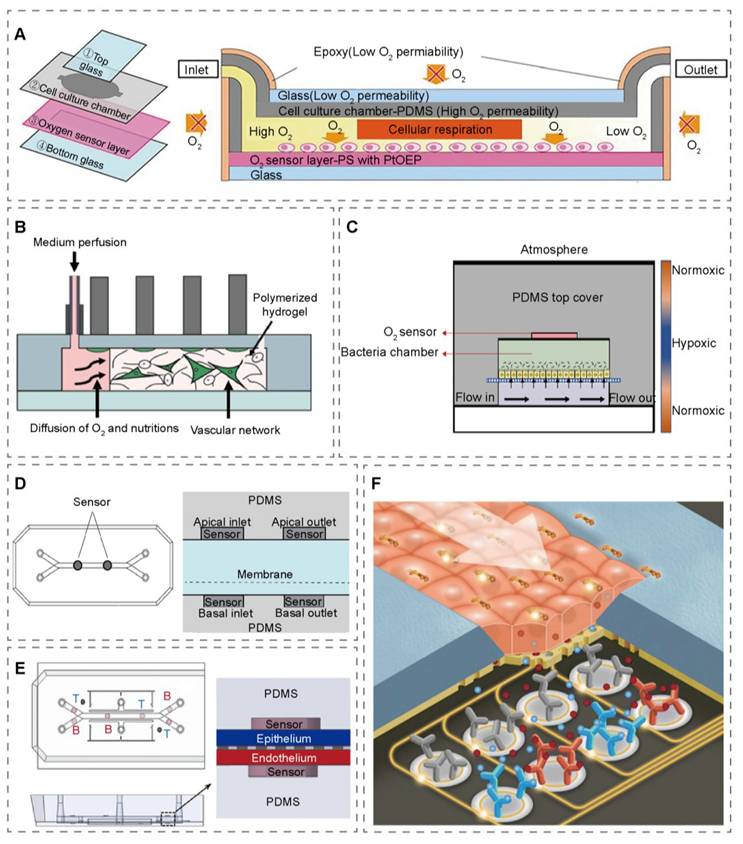
Photonic biosensors constitute another important class of optical sensing platforms. Their core relies on the synergistic action of specific optical structural materials (e.g., silicon-based photonic crystals, ring resonators) and biorecognition elements (antibodies, nucleic acid aptamers, etc.). When target biomolecules bind to the recognition elements on the sensor surface, they induce changes in optical properties such as the local refractive index. These changes are then detected by the highly sensitive optical material substrate as resonance wavelength shifts or intensity variations [33]. A complementary cetal oxide semiconductor (CMOS)-compatible silicon nitride micro-ring resonator was embedded beneath the pulmonary barrier. Using label-free refractive index sensing, it enabled real-time resolution of inflammatory protein secretion and barrier leakage every 19 seconds. The 28-channel parallel near-cell monitoring system quantitatively reported cytokine release from inflamed epithelium immediately after LPS stimulation (Figure 1F) [34]. This fully demonstrates the powerful capability of silicon-based optical material platforms for sensing at complex biological interfaces.
The future development of optical sensors in OoCs will increasingly rely on breakthroughs in novel optical materials. Potential advancements include developing phosphorescent materials with higher photostability and lower oxygen permeability interference; photonic crystal/resonator materials possessing ultra-high-quality factors and lower detection limits; and intelligent optical composite materials capable of integrating multimodal sensing functions. Innovation in these materials serves as the key driver for enhancing sensor performance and advancing OoC technology towards higher biomimicry and reliability.
2.1.2 Electrochemical sensors in OoCs
Electrochemical sensors enable in situ quantification of metabolic fluxes, ion concentrations, and transepithelial/transendothelial electrical resistance (TEER), thereby precisely resolving biochemical dynamics and barrier integrity [35]. Electrophysiological sensors, primarily microelectrode arrays, simultaneously capture functional phenotypes of excitable tissues, including cardiac field potentials, neuronal action potential sequences, and conduction velocities [36]. They also monitor cell adhesion, morphology, and viability via multi-frequency impedance measurements. These two modalities operate in a complementary manner, establishing an online, label-free, and multi-parameter characterization platform for OoCs.
For evaluating cellular barrier integrity, electrochemical impedance spectroscopy (EIS) and TEER measurements have become the preferred non-invasive, label-free methods [37, 38]. Real-time TEER monitoring effectively assesses the health status of cell layers, the formation and disruption of tight junctions, and the impact of drugs on barrier function. Traditionally, transwell systems and OoCs relied on permeability assays using fluorescent tracers to evaluate monolayer barrier function. However, these methods typically require cumbersome manual sampling, complex optical instrumentation, and offline sample processing [39, 40]. Jeremy et al. innovatively replaced traditional fluorescent tracers with electroactive tracers, assessing barrier function by monitoring their diffusion across the cellular monolayer [39]. They further demonstrated in a 3D hydrogel-based microfluidic vascular model that this electrochemical permeability assay maintained the robustness comparable to fluorescence methods while being easier to integrate with OoCs [41]. Kosuke et al. combined electrochemical tracers with patterned electrodes to develop a novel method for electrochemical imaging of endothelial permeability using a large-scale integrated device. This method eliminated the need for independent channels, allowing electrode arrays to acquire local information; its electrodes were typically fabricated using photolithography to create gold or platinum microelectrode arrays on glass or silicon substrates. However, current systems suffer from manual operation errors and insufficient precision, necessitating future improvements in culture systems and model configurations for enhanced reliability [42]. Jose employed micro-nanofabrication to construct a multi-chamber microfluidic device that integrates TEER electrodes for continuous monitoring. By simulating the blood-retinal barrier (BRB), they validated a method for placing electrodes on both sides of the cell monolayer substrate to enable real-time TEER measurement. This setup provides a more accurate assessment of cellular behavior than static models (Figure 2A) [43]. The emergence of spatial transepithelial electrical resistance (S-TEER) technology further expanded TEER applications, allowing local permeability measurements in specific regions of microfluidic chips. Noa developed an S-TEER OoC system incorporating two pairs of movable miniature stainless steel electrodes, enabling resistance measurements at arbitrary locations on the OoCs. This breakthrough overcame the limited spatial resolution of traditional TEER systems, allowed precise measurements before complete cell confluence, and effectively reduced time and cost [44].
Representative examples of electrochemical and mechanical sensors implementation in OoCs. (A) A blood-retinal barrier-on-a-chip with crisscross microgrooves and electrophysiological electrodes. Adapted with permission from [43], copyright 2017, Royal Society of Chemistry. (B) A human spinal organoid-on-a-chip device with plug-and-play MEA electrodes. Adapted with permission from [55], copyright 2021, American Chemical Society. (C) An OoC device incorporating a multi-modal FG-FET-based sensor. Adapted with permission from [62], copyright 2023, Springer Nature. (D) A human-on-a-chip system that integrates a silicon cantilever chip for measuring mechanical and electrical functional activity. Adapted with permission from [69], copyright 2018, Wiley. (E) A heart-on-a-chip platform integrating both an image processing system and a piezoelectric sensing system. Adapted with permission from [70], copyright 2020, Elsevier. (F) A fully 3D-printed heart-on-a-chip platform instrumented with multilayer cantilevers. Adapted with permission from [71], copyright 2017, Springer Nature.
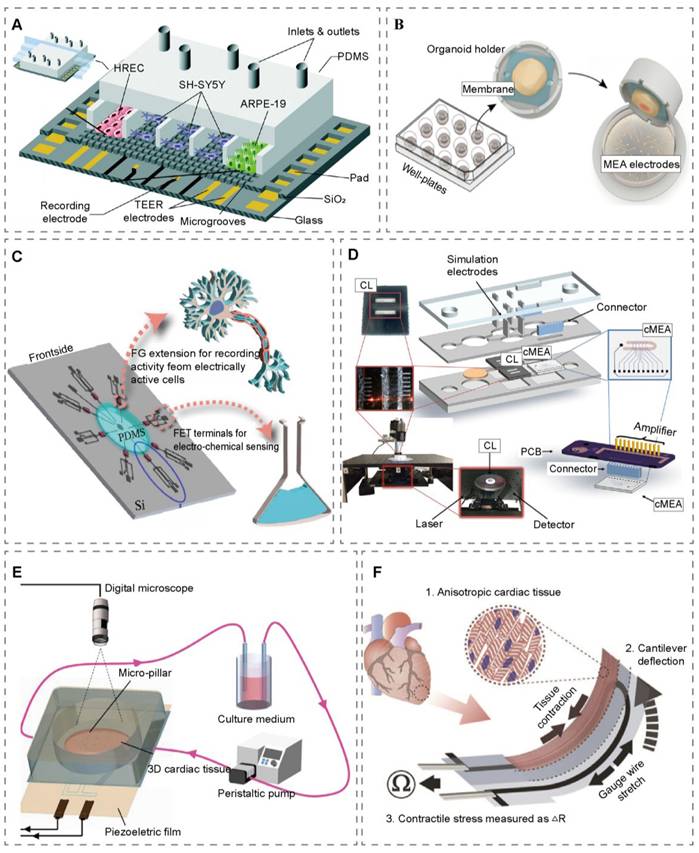
EIS reveals the electrical properties of cell layers by applying a small-amplitude AC signal to the system and analyzing its impedance response. This technique not only provides key electrical parameters such as cell layer capacitance alongside TEER measurements but also enables a more comprehensive assessment of cellular barrier integrity [45]. A developed an OoC system with an embedded porous membrane impedance biosensor array, enabling non-invasive monitoring of placental barrier integrity. Its results showed high correlation with standard offline activity assays and ROS measurements [46]. Mermoud integrated a micro-impedance tomography (MITO) system into a lung chip platform. This system monitored epithelial barrier integrity in real-time within 1 mm of the electrodes and successfully tracked changes in alveolar epithelial resistance during barrier permeabilization [47]. Nicolas leveraged impedance spectroscopy for electrical measurements in developing the OrganoTEER instrument, which allows TEER measurements within the OrganoPlate platform. This method enables high-throughput, real-time, and non-invasive monitoring of epithelial tubules in up to 40 independent microfluidic chips, eliminating interference from artificial membranes [48].
The ability to monitor key physical and functional parameters of cardiac tissues, specifically electrophysiology and contractility, in real time and in situ is therefore critical for heart-on-a-chip [49]. Zhang et al. fabricated a novel heart-on-a-chip platform integrated with soft conductive hydrogel columns. These columns are designed to concurrently monitor the contractile forces and electrical activity of 3D cardiac tissues. The acquired signals reveal a well-defined cardiac field potential profile, comprising a depolarization spike and subsequent repolarization phases, whoese characteristics are directly comparable to a clinical electrocardiogram (ECG) [50]. Visone et al. has developed the μHeart platform, which integrates microelectrode channel guidance technology. This system generates functional heart tissue under biomechanical conditions and allows precise localization and monitoring of electrophysiological signals without compromising cell viability [51]. Another study developed a heart-on-a-chip system integrating intracellular (Pt nanopillar arrays) and extracellular (planar electrodes) bioelectronic sensors. The extracellular devices recorded stable signals with high device yield, continuously monitoring heart rate and wavefront propagation, while the intracellular devices provided more accurate action potential recordings [52]. This system precisely monitored cardiac electrophysiological changes under acute hypoxia, revealing dynamic cellular responses to oxygen deprivation. Its multiplexing capability represented a significant advance in understanding hypoxic electrophysiological responses. Li et al. constructed “cyborg organoids”, an OoC system capable of migrating and growing with cells. This system achieved the 3D implantation and distribution of nano-electronic devices within organoids. Using a 14-channel recording system, they conducted long-term, multi-channel, and tissue-scale electrophysiological recordings. Their study systematically tracked the evolution, propagation, and synchronization of spontaneous dynamics in human cardiac organoids throughout organogenesis [53].
Multi-electrode arrays (MEAs) offer advantages in electrophysiological detection. Compared to traditional patch clamp techniques, MEAs can non-invasively record electrical activity from multiple cells simultaneously, cause minimal cell damage, are suitable for long-term stable monitoring, and capture more comprehensive electrophysiological information from cell populations, providing unique advantages in throughput [54]. In a study modeling the human nociceptive circuitry, an MEA system was incorporated into a spinal organoid-on-a-chip platform. This design facilitated plug-and-play electrophysiological recording by maintaining the organoids in a non-adherent state over the electrodes, which preserved electrode functionality and signal fidelity (Figure 2B) [55]. Wu et al. utilized the taste organoids-on-a-chip system to simulate biological taste perception in vitro. In this system, MEA functioned as taste axons, receiving taste information by recording extracellular potentials of the taste organoid-on-a-chip in real time [56]. Combined MEA and micro-MEA (m-MEA) to detect electrical activity in islet-on-a-chip. They also integrated a field-programmable gate array (FPGA) to enable real-time online analysis with microsecond-level latency. This approach precisely distinguished the electrophysiological activity of islet cells under different glucose concentrations, offering an innovative solution for type I diabetes research and insulin demand monitoring [57].
Field-effect transistor (FET) sensors operate based on the field-effect principle, where the conductivity of a semiconductor channel is modulated by external stimuli (e.g., biomolecules, chemical species, or light) perceived at the gate region. By transducing these interactions into measurable changes in channel conductance, FET sensors enable qualitative and quantitative detection of target analytes. They exhibit several inherent advantages, including low operating voltage, compatibility with aqueous microenvironments, and facile miniaturization, making them particularly suitable for integration into OoCs [58]. Among them, graphene-based field-effect transistors (GFETs) exhibit outstanding potential, benefiting from the high carrier mobility and excellent electrical properties inherent to their two-dimensional structure [59]. In 3D self-rolled biosensor arrays, GFETs utilize patterned SU-8 layers to achieve selective passivation of the sensing region, ensuring biocompatibility and enabling stable long-term monitoring. When integrated with continuous microfluidic perfusion, this configuration effectively minimizes biofouling and environmental interference. As a result, GFETs can reliably record field potentials from cardiac spheroids within complex 3D architectures [60]. Furthermore, in a 3D middle ear/cochlea-on-a-chip model of the round window membrane-cochlea interface, GFETs have been successfully applied for label-free, real-time monitoring of ototoxin-induced pro-inflammatory cytokines [61]. Floating-gate field-effect transistors (FG-FETs) demonstrate exceptional multi-functional integration. Effective passivation is achieved by coating the extended floating gate with a polyimide layer. This, combined with biocompatible PDMS membranes, provides a safe interface for neuronal cultures. The unique floating-gate design utilizes a capacitive coupling mechanism, which significantly suppresses signal drift caused by interfacial charge fluctuations. A notable innovation is their electrode design: a control gate functions as a pseudo-reference electrode. This simplifies the system by eliminating the need for bulky conventional reference electrodes. It allows simultaneous monitoring of pH and neuro-electrical activity, greatly enhancing system integration and reliability (Figure 2C) [62]. Organic electrochemical transistors (OECTs) offer advanced solutions for long-term monitoring in dynamic physiological settings. The OECT channel material, Poly (3,4-ethylene-dioxythiophene): poly (styrene sulfonic acid) (PEDOT: PSS), exhibits hydrogel-like properties. These properties promote cell adhesion and ensure efficient ion-to-electron coupling. An optimized AC driving mode minimizes signal drift by controlling doping depth. The gate can be functionalized for specific detection (e.g., glucose), or the source-drain electrodes can be shorted to create controlled electroporation wounds in cells. This enables the integration of sensing and manipulation capabilities within OoCs [63].
Despite these collaborative advances in materials, devices, and system integration, which are driving FET-OoCs toward greater reliability and functionality, several challenges remain for their mature application. The long-term stability of current passivation materials in complex biofluids needs improvement, necessitating novel biomimetic or nanocomposite coatings for chronic studies [64, 65]. Signal parsing is complicated by the coupling of multiple physiological parameters; decoupling these signals requires multimodal sensor arrays combined with machine learning (ML) [66]. Fabrication and integration face bottlenecks due to the custom nature of current designs, highlighting the need for standardized, “sensing-first”, wafer-scale processes. Furthermore, achieving conformal contact between sensors and 3D organoids, along with the lack of industry-wide standardized performance assessment protocols, hinders their application in physiologically relevant models. These systemic challenges represent critical hurdles that must be overcome to transition FET-sensing OoC technology from the laboratory to a standardized biological tool.
2.1.3 Mechanical sensors in OoCs
Mechanical sensors are key components in OoCs for monitoring tissue mechanical behavior, particularly for the real-time assessment of contractile function in parenchymal cells such as cardiomyocytes. Microcantilevers, as a common type of mechanical sensor, are integrated into OoCs via monolithic designs to enable non-invasive and highly sensitive mechanical monitoring. For instance, one study used integrated 3D stamping to form UV-crosslinked polyester elastomer microcantilevers (150 μm) directly onto the sidewalls of an AngioChip bioscaffold, making them an inseparable part of the structure. This design requires no additional electronic components and operates synergistically with the scaffold's 15 μm sidewall pores and a gravity-driven perfusion system (flow rate: 1.4 μL/min; shear stress: 1.05 dyne/cm²). When cardiomyocytes contract spontaneously or in response to pharmacological stimuli, the microcantilevers deflect. This displacement is quantified via fluorescence microscopy and ImageJ software to indirectly derive contractile force and beating patterns [67]. Other studies similarly demonstrate diverse implementations of microcantilevers: AFM silicon cantilevers (737 μm×150 μm×4 μm) fabricated from silicon-on-insulator wafers utilize laser deflection and a modified Stoney equation to accurately measure cardiomyocyte contractile stress[68]; a silicon cantilever chip integrating 32 cantilevers employs laser deflection for long-term monitoring of contractile forces in human induced pluripotent stem cell (iPSC)-derived cardiomyocytes and skeletal muscle cells in human multi-organ in vitro platforms (Figure 2D) [69].
Beyond microcantilevers, other mechanical sensors are widely used in OoCs. In a heart-on-a-chip, PDMS micropost arrays physically engage with cardiac tissues, converting contractile forces into bending deformations. Equivalent contractile forces are quantified using digital microscopy and matrix laboratory (MATLAB) code, enabling multi-site monitoring and analysis of contraction synchrony. Meanwhile, polyvinylidene fluoride (PVDF) piezoelectric films, attached to the bottom of micropost arrays, transform mechanical stress into voltage signals via the piezoelectric effect, providing millisecond-level response for monitoring overall contraction strength and frequency (Figure 2E) [70]. Johan et al. embedded strain sensors based on carbon black-thermoplastic polyurethane composite inks, which are integrated into cantilever structures within heart-on-a-chip via multi-material 3D printing. These sensors convert mechanical deflection into resistance signals, allowing for the in situ detection of cardiac tissue contractile stress (within the 1-15 kPa range) and supporting long-term drug testing (Figure 2F) [71]. Flexible polyether ether ketone (PEEK) probes are a type of functional probe device with flexibility, using PEEK as the core substrate. Their key advantages lie in the excellent biocompatibility of PEEK itself, which enables long-term in vivo implantation and effectively reduces the body's immune rejection. Meanwhile, the flexible design can adapt to the dynamic deformation of biological tissues, further reducing the risk of mechanical damage. Veniamin et al. used flexible PEEK probes to serve as mechanical sensors, combined with floating microelectrodes in the I-Wire heart-on-a-chip to simultaneously monitor the contractile force and electrophysiological function of 3D cardiac tissues. Force values are derived through image analysis and calibrated linear stiffness coefficients, making the system suitable for drug screening applications [72].
These mechanical sensors share common features such as structural compatibility, non-invasiveness, and functional integration, enabling synergistic operation with OoCs' perfusion systems for real-time, highly sensitive mechanical monitoring. Despite these advantages and their core role in assessing mechanical function, several technical defects hinder their standardized application. A significant limitation is the reliance of many high-sensitivity optical sensing strategies on sophisticated and costly readout systems, which restricts long-term, high-throughput use. While non-optical alternatives like embedded electronic sensors exist, they often require custom interfaces and suffer from challenges in long-term signal stability and hysteresis. Furthermore, the accurate conversion of raw sensor signals into absolute biomechanical parameters remains problematic, as the underlying analytical models are sensitive to uncertainties in material properties and cell-material interactions, potentially introducing significant quantification errors. Finally, achieving truly seamless integration often involves a trade-off, where monolithic designs may limit sensor replaceability, and the co-integration of multiple functionalities can lead to signal crosstalk or manufacturing complexities. Addressing these defects is crucial for advancing OoCs from proof-of-concept tools toward robust and standardized platforms for biomedical research.
2.1.4 Multi-sensors in OoCs
OoC technology derives its core advantage from its ability to simulate the complex microenvironment of human organs. Multi-sensor integration technology achieves real-time, in situ, and parallel monitoring of multiple critical parameters within the cellular microenvironment (such as barrier integrity, metabolite concentration, ion activity, electrophysiological signals, pH, oxygen tension, etc.) by synergistically integrating various physical, chemical, and biological sensors at the material level onto a single microfluidic platform, as summarized in Table 1 [73]. This multimodal sensing strategy, based on advanced functional materials, provides unprecedented comprehensive characterization for gaining deeper insights into tissue behavior, dynamic cell function, drug effects, and responses to environmental perturbations. It serves as the key enabling technology propelling OoCs from model construction towards precise prediction.
The summary of biosensors applied in OoCs.
| Sensor Classification | Organs | Cell types | Material & Technique | Target Parameter | Ref |
|---|---|---|---|---|---|
| Optical | Live | HepG2 | Pt (OEP) | Oxygen | [27] |
| Optical | Lung | A594, hASC, HUVEC | Pt-TPTBPF | Oxygen | [28] |
| Optical | Heart | hiPSC, phDF | Pt-TPTBPF | Oxygen | [29] |
| Optical | Intestine | Caco-2 | Pt-TFPP | Oxygen | [30] |
| Optical | Intestine | Intestine organoid, HIMEC | Oxygen-sensing nanoparticles | Oxygen | [31] |
| Optical | Intestine | Intestine organoid, HIMEC, Caco-2 | Oxygen sensitive and optical isolating particles | Oxygen | [32] |
| Optical | Lung | 16HBE | Silicon nitride photonic ring resonators | CRP, IL-1β, IL-6, IL-8 | [34] |
| Electrochemical | Endothelial | PAECs | Au/Cr electrodes | TEER | [39] |
| Electrochemical | Vascular | HUVEC | Au/Cr electrodes | TEER | [41] |
| Electrochemical | Endothelial | HUVEC | Pt electrode | Imaging of Endothelial Permeability | [42] |
| Electrochemical | Retina | HREC, SH-SY5Y, ARPE-19 | Ti/Pt/Ti electrodes | TEER | [43] |
| Electrochemical | Gut | Caco-2 | Gold-plated electrodes, stainless steel wires | TEER | [44] |
| Electrochemical | Placental | Bewo | Impedance electrodes | TEER | [46] |
| Electrochemical | Lung | 16HBE14 | Cu covered with Ni electrode, Au electrode | TEER | [47] |
| Electrochemical | Gut | Caco-2, RPTEC | Electrode board | TEER | [48] |
| Electrochemical | Heart | hiPSC | Au/hydrogel pillar electrodes | Cardiac tissues electrophysiology | [50] |
| Electrochemical | Heart | hiPSC-CM, Lonza | µECG | Cardiac tissues electrophysiology | [51] |
| Electrochemical | Heart | HL-1 | Au/Pt nanopillar | Cardiac tissues electrophysiology | [52] |
| Electrochemical | Heart | hiPSC | Pt (PEDOT) electrode, Au electrode | Electrophysiological mapping | [53] |
| Electrochemical | Spinal | Human stem cell-derived sensory-spinal cord organoids, human dorsal spinal cord interneurons, sensory neurons | Cytoview MEA 24 | Human nociceptive circuitry | [55] |
| Electrochemical | Tongue | Taste organoid | MEA 2100 system | Extracellular potential signals | [56] |
| Electrochemical | Islets | Islets | MEA, m-MEA | Islet ion fluxes | [57] |
| Electrochemical | Gut | HUVECs, HLECs | TEER electrode, O2 sensors, pH sensors | TEER, Oxygen, pH | [74] |
| Optical Electrochemical | Liver | HepG2/C3A | Polystyrene microbeads loaded with ruthenium-based phosphorescence dye (CPOx-50-RuP), Platinum electrodes | Oxygen, glucose, lactate | [75] |
| Optical | Lung | A549 | ptBS particle with Pt-TPTBPF, OHC12 dye/Egyptian blue | Oxygen, pH | [76] |
| Electrochemical | Gut | Caco-2 | Ag/Cl electrodes, three-electrode electrochemical sensors | TEER, Hg (II) | [77] |
| Electrochemical | Heart | HUVECs, hiPSC-CMs | Au electrode, MEA (platinum black) | TEER, Cardiac tissues electrophysiology | [78] |
| Optical Electrochemical Physical | Heart-liver | Cardiac/liver organoids | Au electrode, phenol red, [Ru(dpp)3]2+ Cl2-tris(4,7-diphenyl-1,10-phenanthroline) ruthenium (II) chloride, Type T thermocouple Probe | Albumin, pH, oxygen, temperature | [79] |
| Optical Electrochemical Electrophysiological | Neurons | Neuronal cell | TFT | Optical observation, impedance measurement, LFP, AP | [80] |
| Electrochemical | Liver-heart-lung | HSC, Kupffer, iPSC CM, TMSCS, HTBS | Au electrode (SAM-SPV), customized TEER electrode | ALB, GSTA, CK, TEER, Isc | [81] |
| Electrochemical | Liver | Primary hepatocytes | Au/Ag electrodes | Oxygen | [82] |
Real-time monitoring of cellular metabolic activity is central to evaluating OoCs' function. Multi-parameter sensing overcomes the limitations of single indicators, providing a more comprehensive picture of metabolic status and drug biological effects. Zohreh et al. developed siChip, a representative example of multi-sensor integration. By incorporating TEER sensors, oxygen sensors, pH sensors, and metabolic activity sensors, this platform enables real-time monitoring of key parameters such as barrier function, oxygen concentration, and metabolic activity. The design allows for the simulation of specific physiological conditions while analyzing dynamic cellular responses to chemical stimuli (Figure 3A) [74]. For the measurement of glucose, lactate, and oxygen in a liver-on-a-chip bioreactor under physiological conditions, an integrated phosphorescent microprobe and electrochemical sensor technology has been developed. This system detected metabolic changes and ATP redistribution following drug treatment, enabling the assessment of mitochondrial dysfunction at pharmacologically relevant concentrations (Figure 3B) [75]. Bernhard utilized PtTPTBPF-stained PtBS particles for oxygen sensing and a pH sensor consisting of OHC12 and silanized Egyptian blue microcrystalline powder. These sensors were embedded in hydromed D4 hydrogel matrices, allowing real-time monitoring of oxygen and pH levels in the cell culture environment through specific light excitation and detection (Figure 3C) [76].
Representative examples of multi-sensor implementation in OoCs. (A) A dual-channel chip with integrated TEER and oxygen sensors. Adapted with permission from [74], copyright 2024, Elsevier. (B) A liver-on-a-chip device with dual-frequency phase modulation of tissue-embedded phosphorescent microprobes and amperometric glucose and lactate sensors. Adapted with permission from [75], copyright 2016, National Academy of Sciences. (C) A thermoplastic microfluidic device integrating miniaturized optical pH and O2 sensors. Adapted with permission from [76], copyright 2021, Elsevier. (D) An optically TFT array biosensor chip for neuronal ensemble investigation. Adapted with permission from [80], copyright 2020, Elsevier. (E) An integrated OoC platform with optical, physical sensors, and electrochemical biosensors. Adapted with permission from [79], copyright 2017, National Academy of Sciences.
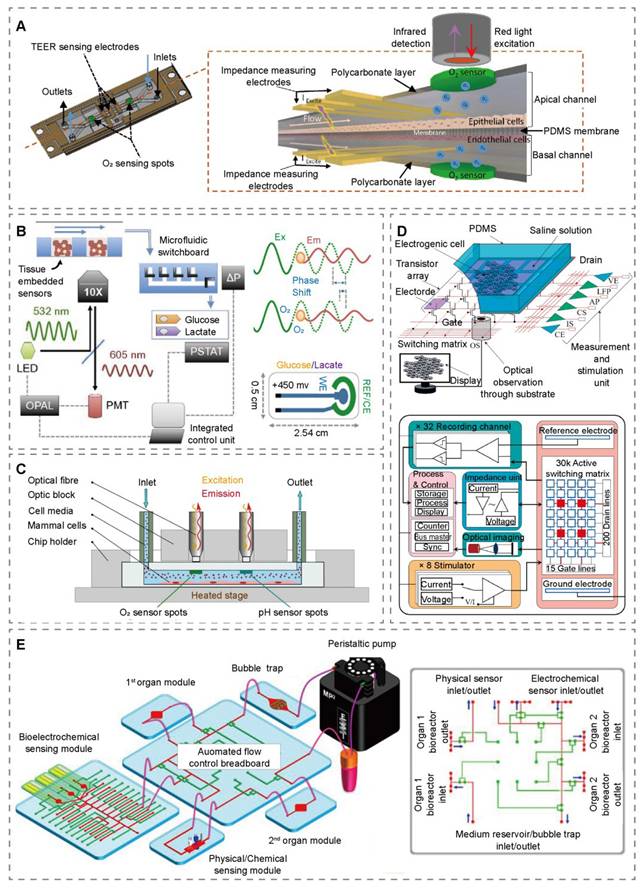
Continuous in situ measurement is crucial for accurately capturing microenvironment dynamics and long-term organ responses to drugs, relying on stable, biocompatible, and integrable sensing materials alongside microfabrication techniques. A gut-on-a-chip device integrating label-free sensors with MEMS has been developed for TEER measurement. This system not only enabled real-time, non-invasive monitoring of TEER changes but also quantitatively analyzed mercury ion absorption [77]. Maoz et al. was the first to integrate TEER and MEA into a heart-on-a-chip system. TEER measured tissue barrier integrity and permeability, while MEA evaluated the function of excitable cells. This system allowed simultaneous assessment of cellular electrical activity and barrier function [78]. Researchers have developed an automated modular design platform that integrates label-free electrochemical immunosensors for in situ continuous monitoring of soluble biomarkers secreted by organoids. By employing specific functionalization and regeneration processes, the platform enhances detection sensitivity and repeatability. Additionally, it integrates optical pH sensors, oxygen sensors, and temperature probes to monitor microenvironmental parameters. A miniature microscope is also incorporated for real-time observation of organoid morphological changes (Figure 3E) [79].
Moving beyond traditional sensors, novel electronic materials and bioprinting technologies open new pathways for OoCs sensing integration. Thin-film transistor (TFT) is expected to play an increasingly significant role in OoCs detection. Faruk developed a TFT-based array biosensor chip featuring six operational modes, including extracellular voltage recording, electrical and chemical stimulation, and optical imaging. This chip enables a multi-faceted approach to studying neuronal networks. The ability to monitor complex neuronal activity is greatly enhanced by its high electrode fill factor of 97.5%, high temporal resolution of 10ms, and optical transparency of over 90% (Figure 3D) [80]. Bioprinting enables the precise and reproducible integration of organoids into modular perfusion devices. Based on this, Aleksander has developed a triple tissue OoCs for liver, heart, and lung that integrates three electrochemical detection technologies: electrochemical impedance, TEER, and short-circuit current (Isc). The electrochemical impedance sensor enables the real-time, continuous, and multi-metric detection of various soluble biomarkers such as albumin, α-GST, and creatine kinase secreted by tissue constructs to assess tissue function and drug response. The TEER assay and Isc assay are mainly used in the lung microarray module to assess the integrity of lung organoids, monitor the activity of ion channels, and investigate the effects of drugs on lung tissue [81].
Through multimodal integration and material-driven innovation, biosensors enable real-time, in situ, and parallel monitoring of critical parameters within complex microenvironments. These parameters include barrier integrity, metabolite dynamics, electrophysiological signals, oxygen tension, and pH. Sensing technologies based on advanced functional materials, such as phosphorescent probes, flexible electrodes, smart hydrogels, and biocompatible nanocomposites, overcome the destructive nature and low spatiotemporal resolution limitations of traditional offline methods. This significantly enhances the biomimetic fidelity of OoCs. However, advancing sensor performance further still confronts critical challenges. Key among these are the need for novel micro/nano-fabrication materials and heterogeneous integration technologies to achieve miniaturization and integration; the reliance on biocompatible, anti-fouling interfacial materials and stable transducer materials to ensure long-term operational stability; and the demanding requirements for the mechanical properties of flexible/implantable materials coupled with precise fluid dynamics design to ensure compatibility within the OoCs microfluidic environment [18]. Overcoming these hurdles fundamentally requires innovation in advanced functional materials, such as multifunctional nanocomposites, bioinspired interfacial materials, and highly stable sensing materials.
2.2 Fluorescent probes in OoCs
In OoCs research, the real-time, in situ monitoring of the cellular microenvironment is essential. Fluorescent probes, which emit light across the ultraviolet to near-infrared spectrum, have emerged as a core analytical technology in this field. Their utility stems from the unique photophysical properties of their fluorophores and the highly designable nature of their molecular or nano-scale structures [83]. Compared to traditional methods requiring chip destruction or microfluidic interruption, non-invasive optical signal acquisition using fluorescent probes enables in situ target molecule capture. This maintains chip integrity while significantly reducing data distortion risks from sampling interference. Fluorescent probes, leveraging signal amplification via nanomaterials or molecular recognition mechanisms, can detect target molecules at concentrations as low as pM levels [84]. The deep tissue penetration and low biotoxicity of nanoprobes further ensure the feasibility of long-term live imaging in 3D organoids [85]. Additionally, multimodal integration of fluorescent probes with technologies such as electrophysiological recording and microfluidic pressure sensing enables the construction of multi-scale analysis platforms from molecular events to organ functions.
2.2.1 Molecular fluorescent probes in OoCs
Molecular fluorescent probes typically comprise three key components: a recognition group, a signaling fluorophore, and often a linker. This structure enables the conversion of target binding or chemical reactions into detectable fluorescence changes, such as intensity variation, spectral shift, or lifetime alteration. Small-molecular dyes are extensively utilized in fluorescence imaging due to their excellent biocompatibility and flexible chemical modifiability [86]. However, their utility in long-term imaging is often constrained by photobleaching and limited photostability [87]. Based on their activation mechanisms, these probes are classified into three categories: chemically responsive, biomolecular responsive, and physically responsive [88, 89].
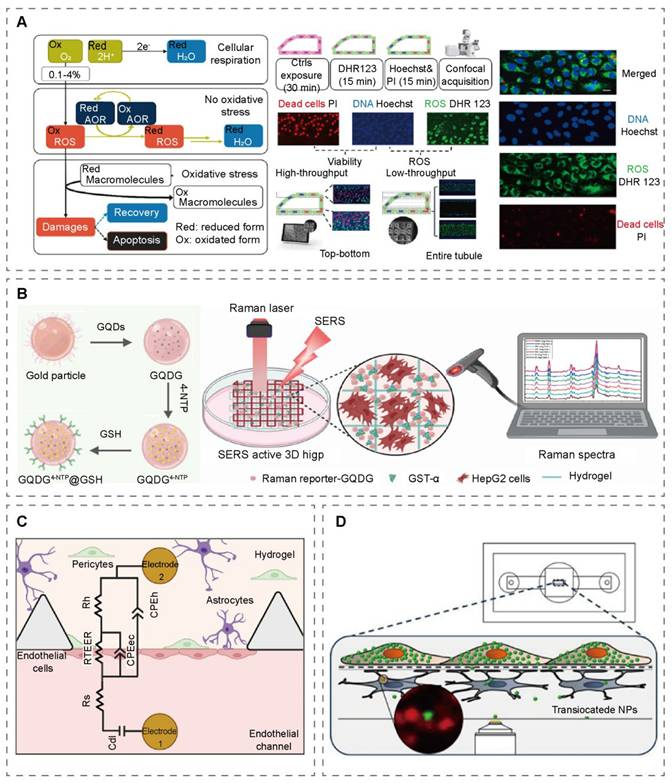
Chemically responsive probes undergo fluorescence changes via ion chelation or redox reactions. Fluo-4 acetoxymethyl ester (Fluo-4 AM), for example, enables real-time recording of calcium transients in single cells inside microfluidic chips with millisecond resolution [90, 91]. Probes such as 2',7'-dichlorofluorescin diacetate (DCFH-DA) and 4-amino-5-methylamino-2',7'-dichlorofluorescin diacetate (DAF-FM DA), widely used for reactive oxygen and nitrogen species (ROS/RNS) detection (Figure 4A), are now available as standardized commercial assay kits [92, 93]. Biomolecular-responsive probes are activated through interactions with biomacromolecules such as enzymes or nucleic acids. 5-chloromethylfluorescein diacetate (CMFDA), activated by intracellular esterases and glutathione, facilitates long-term tracking of multicellular dynamics in OoCs [94]. Calcein-AM/propidium iodide (PI) assays are routinely applied for viability/cytotoxicity testing [95], while cytochrome P450 probe substrates allow dynamic assessment of metabolic enzyme activity in liver-on-a-chip [96]. Physically responsive probes exhibit fluorescence changes in response to physical parameters. FRET-based sensors can monitor molecular distance changes in real time; for instance, a caspase-3 FRET sensor visualized apoptosis in endothelial cells under flow [97]. FITC-dextran, valued for its water solubility and stability, serves as a standard probe for assessing barrier permeability (e.g., in BBB, placental, and intestinal models) and has also been utilized in tumor-on-a-chip to quantify drug penetration and interstitial pressure [98, 99].
Representative examples of fluorescent probes implementation in OoCs. (A). A vasculature-on-a-chip for the quantification of intracellular ROS and cell viability. Adapted with permission from [93], copyright 2022, Elsevier. (B) A 3D-bioprinted liver-on-a-chip implanted in graphene-based plasmonic sensors Adapted with permission from [106], copyright 2024, American Chemical Society. (C) BBB-on-a-chip platform labeled with the GNR-PEG-Ang2/D1-A647 probe. Adapted with permission from [110], copyright 2023, Springer Nature. (D) BBB-on-a-chip labeled with ApoE-SiO₂ probes for live-cell imaging. Adapted with permission from [112], copyright 2020, American Chemical Society.
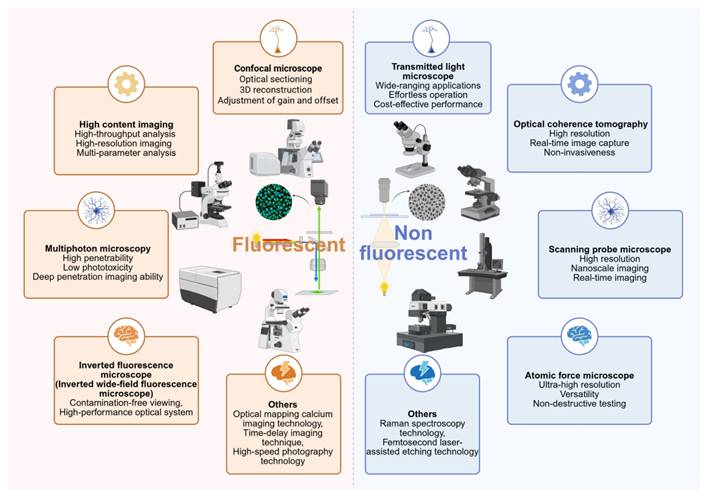
Recent morphological analysis used in visual recognition of OoCs. Advancements in microscopy have greatly facilitated research on cell-cell interactions, cellular behaviors, and dynamic changes within the microenvironment. (Created with BioRender.com).
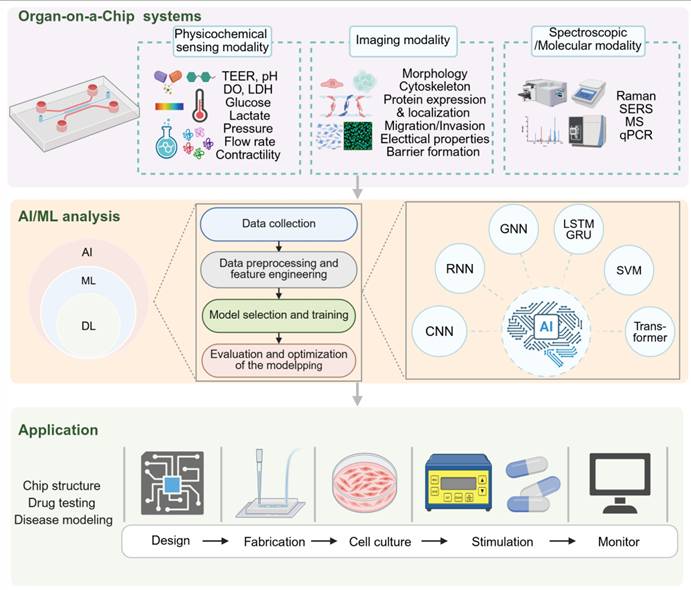
Workflow for integrating AI with OoCs data analysis. OoCs generate multimodal datasets, including images (e.g., cellular morphology), non-imaging sensor data (e.g., spectra), and multi-parametric functional readouts (e.g., cell viability). These data undergo preprocessing and feature extraction. Subsequently, they are fed into various AI/ML models to perform specific tasks, such as classification, prediction, and segmentation. Ultimately, the model outputs are translated into biological insights, which help validate hypotheses or guide further experimental design, establishing an iterative, closed-loop optimization process. (Created with BioRender.com).
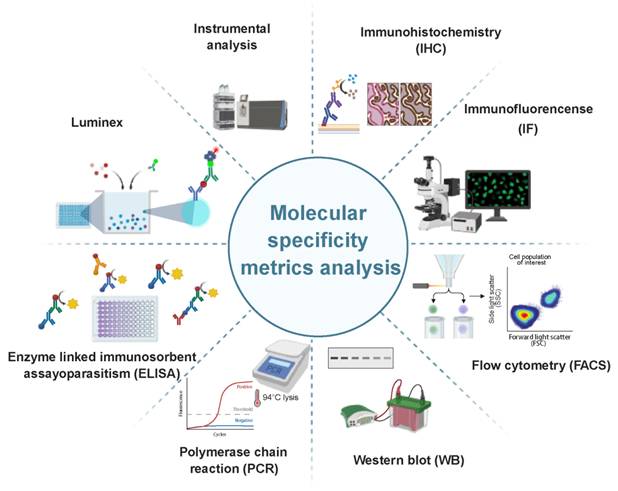
The applications of molecule-specific technologies in OoCs. Quantitative or qualitative detection of expression levels and dynamic changes of specific genes, proteins and metabolites to reveal biological functions and response characteristics in OoCs. (Created with BioRender.com).
The applications of omics analysis in OoCs. Metabolomics employs LC-MS, GC-MS, and NMR to holistically map metabolite dynamics and pathway regulation. Proteomics systematically deciphers protein expression profiles, post-translational modifications, and interaction networks. RNA-Seq-based transcriptomics enables genome-wide transcriptomic profiling, precisely identifying cell subpopulations and functional states. scRNA-seq transcends the resolution limits of conventional assays, deeply resolving cellular heterogeneity, gene expression dynamics, and disease-related molecular mechanisms within OoCs microenvironment. (Created with BioRender.com).
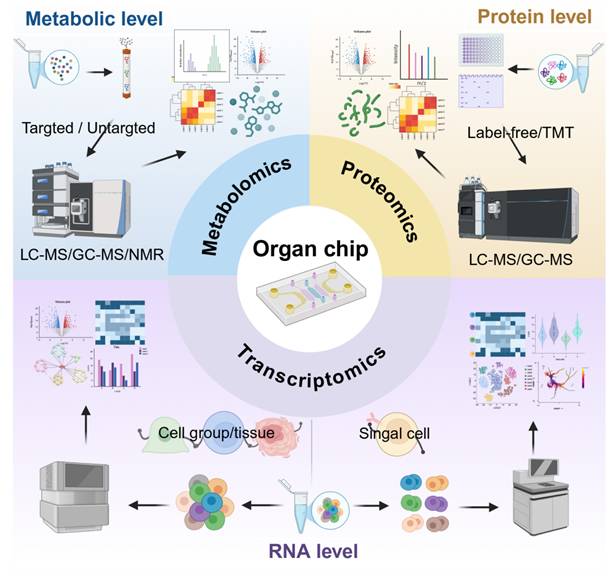
2.2.2 Nanoparticle fluorescent probes in OoCs
Nanoparticle fluorescent probes are multifunctional composite systems constructed based on nanomaterials. Their composition typically includes a nanocarrier core, a fluorescent unit, targeting modifications, and a functional coating. Due to their unique physicochemical properties, nanomaterials are highly suitable for biological monitoring and imaging [100]. In contrast to traditional organic dyes, nanoparticle fluorescent probes provide exceptionally tunable excitation and emission profiles, which can be engineered by adjusting their physical size and elemental makeup. This rational design capability underpins their outstanding optical performance, characterized by high signal intensity, robust photostability, extended lifetime, and favorable biocompatibility [101]. It can be classified based on its material composition into categories such as quantum dots (QDs), upconversion nanoparticles (UCNPs), gold nanorods (AuNRs), and silica nanoparticles (SiNPs) probes [102].
QDs are semiconductor nanocrystals (2-10 nm) whose fluorescence properties are dominated by quantum confinement effects. By tuning their size and composition, QDs can achieve tunable emission spectra ranging from ultraviolet to infrared. Due to their high brightness, photobleaching resistance, and multi-color labeling capability, QD-based fluorescent probes have become essential tools for OoCs characterization [103]. In a biomimetic alveolus-epithelium-on-a-chip study, ZnO-QDs were encapsulated in human serum albumin (HSA) NPs approximately 60 nm in diameter. The resulting HSA-ZnO NPs exhibited excellent biocompatibility, pH-responsive targeted release, and efficient cellular internalization [104]. Wu et al. incorporated cadmium selenide (CdSe) /ZnS core-shell quantum dots into thermoplastic elastomers (TPE) to fabricate TPE/QD nanocomposites. This material enables long-term electrical stimulation and simultaneous in situ assessment of cardiac contractility [105]. GQDs-AuNPs are composite nanomaterials formed by graphene quantum dots (GQDs) and AuNP svia chemical bonding or physical adsorption. This system integrates the fluorescent properties and surface modification flexibility of GQDs with the plasmonic resonance effect of AuNPs. Zhu et al. incorporated GQDs into a hydrogel matrix within a liver-on-a-chip bioprinted in 3D, achieving in situ quantification of glutathione S-transferase alpha (GST-α) secretion by liver cells. The detection system exhibited a dynamic linear range of 20-500 ng/mL with high specificity and anti-interference capability (Figure 4B) [106]. UCNPs are a class of inorganic nanomaterials doped with rare-earth elements that absorb Low-energy near-infrared (NIR) light and emit higher-energy visible or ultraviolet light, effectively reducing autofluorescence interference [107]. Wimalachandra et al. developed a novel UCNP probe for characterizing the tumor-vascular interface in OoCs. The probe features mesoporous silica-coated UCNPs co-functionalized with folic acid (FA) and the secondary lymphoid tissue chemokine (CCL21). Upon 980 nm excitation, these CCL21-FA-UCNPs exhibited distinct fluorescence emissions at 410, 543, and 658 nm. Furthermore, the probe demonstrated excellent biocompatibility, showing low cytotoxicity, a minimal hemolysis rate, and good blood compatibility [108].
AuNRs are anisotropic metallic nanomaterials with multimodal functions. Their longitudinal surface plasmon resonance (SPR) absorption peaks, typically in the near-infrared region (650-900 nm), can be precisely tuned by adjusting their aspect ratio. Since their optical signals are highly sensitive to the refractive index of the surrounding medium, AuNRs are frequently employed as surface plasmon resonance probes [109]. AuNRs were conjugated with the Alexa647 fluorophore to construct a traceable probe, designated as GNR-PEG-Ang2/D1-A647. This probe enabled real-time observation of AuNRs distribution between the cerebral endothelial channel and the central chamber in a BBB-on-a-chip model, thereby providing direct evidence for the quantitative assessment of the BBB-penetrating capacity of the AuNR-based nanomedicine (Figure 4C) [110].
SiNPs probes are composite nanoprobes that use SiO₂ as a carrier, incorporating fluorescent substances through physical encapsulation or chemical bonding. The SiO₂ shell isolates oxygen, free radicals, and biological enzymes, significantly extending the lifespan of fluorescent dyes while offering high stability, ease of functionalization, and modifiable surface properties [111]. Hudecz et al. developed an in vitro BBB model (μSiM-BBB) using fluorescent probes, including 40 nm PS-COOH and 100 nm PS-COOH polystyrene nanoparticles, as well as FITC-labeled apolipoprotein e-modified 100 nm SiO₂ (ApoE-SiO₂) nanoparticles. By employing high-resolution fluorescence imaging techniques, researchers investigated the interaction between these fluorescent nanoprobes and the BBB, focusing on subcellular localization of nanoparticles within endothelial cells, intracellular transport processes, and translocation events across the BBB into the astrocyte layer (Figure 4D) [112]. By implementing stepwise functionalization, nanoparticles can ensure independent yet synergistic functionality of different functional modules. Ag@SiO₂-FITC NPs are composite nanoprobes composed of a silver nanoparticle (AgNPs) core, a SiO₂ shell, and covalently bound FITC. This structure integrates the plasmonic effects of the silver core, the protective and functional capabilities of the silica shell, and the fluorescent properties of FITC, enabling microenvironmental pH monitoring through the pH sensitivity of FITC. Researchers immobilized these nanoprobes covalently onto the glass substrate of a microfluidic channel to form a sensing surface for real-time, ratiometric imaging of biofilms formed by the oral bacterium Streptococcus salivarius. This approach allowed the investigation of biofilm pH dynamics under various chemical (glucose concentration changes) and hydrodynamic (shear stress induced by different flow rates) stimuli [113].
Fluorescent probes, with their molecular-level spatial resolution, millisecond-level dynamic response capability, and multi-parameter synchronous monitoring characteristics, have become core tools for in situ analysis of the microenvironment in OoCs, advancing real-time cross-scale observation from ion fluctuations to tissue functions. The key to future breakthroughs lies in: developing probes with enhanced photostability to overcome long-term imaging bottlenecks; creating orthogonally multi-encoded probes to achieve decoupling of ultra-complex biological signals; deeply integrating AI algorithms to improve in situ quantification accuracy; and developing biomimetic micro-interface integration technologies to coordinate probe functions with the dynamic physiological microenvironment of OoCs, ultimately driving this technology from static observation to dynamic regulation.
2.3 Image visual recognition in OoCs
Advancements in microscopy have greatly facilitated research on cell-cell interactions, cellular behaviors, and dynamic changes within the microenvironment. Using confocal microscopy, high-content imaging systems, optical coherence tomography (OCT), wide-field fluorescence microscopy, and high-speed imaging, researchers can visualize cellular dynamics, intercellular interactions, and microenvironmental changes within OoCs in real time, providing high-resolution visualization tools for disease mechanism studies and drug screening.
Transmission light microscopy, one of the earliest developed microscopic techniques, utilizes contrast formed by light passing through a sample and is widely used for observing the microstructures of cells and materials. Despite the emergence of advanced microscopy techniques, transmission light microscopy remains valuable in fundamental research due to its simplicity and ease of sample preparation. For instance, Alexandra et al. used transmission light microscopy in combination with a fusion touch syringe pump to apply different flow rates to colon-on-a-chip, generating side-view images and dynamic videos to reveal the response of the colonic mucus layer to varying shear stresses [114]. OCT reconstructs 2D/3D images of samples by detecting optical interference signals, making it widely applicable in vascular and tissue structure studies. Yusuf et al. employed OCT imaging to assess hydrogel matrices and the 3D microvascular structures formed within an outer blood-retinal barrier model, enabling evaluation of vascular barrier integrity [115]. SPM allows direct surface scanning of samples to obtain spatial information on in situ chemical and biological processes. Nashimoto et al. utilized scanning probe microscopy (SPM) to overcome the challenges of high-resolution imaging and real-time analysis in a vasculature-on-a-chip posed by traditional optical tools. The nanoscale imaging capability of scanning ion conductance microscopy (SICM) surpasses the diffraction limit, while scanning electrochemical microscopy (SECM) and SICM measurements do not compromise cellular integrity, enabling real-time monitoring of cellular functions [116].
Furthermore, atomic force microscopy (AFM), a high-resolution scanning probe technology, also plays a crucial role in the characterization of OoCs. Guido et al. combined MEA with AFM technology to simultaneously record the electrical activity and mechanical contractility of cells in a cardiac-on-a-chip, providing an innovative approach for cardiac disease modeling and drug screening [117]. Similarly, Ignasi et al. developed a novel PDMS chip utilizing AFM to probe the nonlinear mechanical properties of tissue samples [118]. As a non-destructive analytical technique based on the interaction between light and matter, Raman spectroscopy can obtain molecular vibrational and chemical information by detecting changes in scattered light frequency [119]. Manjot et al. integrated Raman spectroscopy with a 3D-printed conformal microfluidic device to achieve non-invasive, real-time biomarker detection and isolation [120]. Calogiuri et al. used Raman spectroscopy, which provides a non-invasive, real-time, and label-free analysis modality, to monitor structural and biochemical changes in the tight junctions (TJs) of a Caco-2 intestinal epithelium-on-a-chip [121].
2.4 Application of AI in the detection technology of OoCs
AI, particularly ML and deep learning (DL), is revolutionizing the analysis of complex data by enabling the identification of patterns and predictive modeling beyond human capability. In the context of OoCs, which generate vast, multimodal datasets, AI serves as an indispensable analytical tool. Its applications span three primary domains: First, in imaging modalities processing, where AI algorithms automate the quantification of cellular structures, track dynamic behaviors, and classify phenotypes from high-content microscopy data. Second, AI extends to deciphering non-imaging modalities, such as interpreting spectroscopic signals (e.g., Raman) and other sensor data for label-free biochemical assessment. Finally, its most powerful application lies in integrative data analysis, where AI consolidates multi-parametric readouts, functional assays, and even external databases to uncover complex biological correlations and predict systemic outcomes [122, 123].
2.4.1 AI-powered analysis of image modalities in OoCs
OoC technology excels at modeling complex physiology by precisely controlling the cellular microenvironment. This capability, however, generates multidimensional and high-throughput data—encompassing parameters such as fluid shear stress, molecular gradients, and cellular dynamics—which poses significant challenges for conventional analytical methods. AI, particularly DL, addresses this bottleneck by automatically extracting features and recognizing patterns from high-dimensional datasets [124]. This approach not only enhances research productivity but also uncovers hidden biological insights with speed and accuracy.
Vascularization is becoming a critical physiological organ-level feature required for OoCs, yet there are no standard tools or morphological indicators to measure the performance or biological function of vascular networks in these models. James et al. were the first to apply ML to predict the biological function of vascular networks in a vascularized microphysiological system (vMPS). To predict the oxygen transport function in OoCs, they employed ML models including multiple linear regression (MLR), decision tree (DT), and random forest (RF) to analyze morphological image data of the vascular network. Among these, the random forest model demonstrated the best performance [125]. In another study, they analyzed 500 images of vMPS using AI to extract morphological and oxygen transport parameters. They introduced a vascular network quality index (VNQI) using a chain neural network. This index was validated in a vascularized islet-on-a-chip, where chips with higher VNQI values demonstrated superior insulin secretion function under hypoxic challenge [126]. Danial et al. used vMPS with an ultra-thin nanoporous silicon nitride membrane to simulate the human vascular microenvironment for studying leukocyte migration events. AI was employed with random forest semantic segmentation and LeNet-5-based convolutional neural network classification algorithms to analyze the spatiotemporal distribution, migration rate, and activity indicators (such as speed, persistence, and tortuosity index) of leukocytes in co-culture models. This automated analysis tool set was comparable to manual statistical data sets in terms of computational efficiency and could semi-automatically process large imaging datasets [127].
In tumor immunology research, the integration of OoCs with AI has enabled precise characterization and dynamic tracking of the immune microenvironment. For example, Zheng et al. employed a DL based on tumor-infiltrating lymphocytes (TILs) scoring, combined with a 3D tumor-stroma spheroid-on-a-chip, to efficiently screen an epigenetic modulator drug library and identify the synergistic effect of lysine-specific demethylase (1LSD1) inhibitors with immune checkpoint inhibitors [128]. Similarly, Stefania and Elena, using a microfluidic platform and the unsupervised learning algorithm “Cell Hunter”, achieved real-time tracking of dendritic cells and PBMCs within the tumor microenvironment [129, 130].
In studies analyzing cellular behavior in complex microenvironments, Chen et al. applied the visual geometry group (VGG)-19 to precisely characterize dynamic processes in a lung-on-a-chip. The VGG-19 model achieved a prediction accuracy of over 90% per single image after training. With an ensemble analysis of four images, an accuracy of 99.8% was achieved [131]. Similarly, Marc et al. used automated image analysis techniques to quantify vascular network features in a 3D vascular-on-a-chip, including vessel density, diameter, and branching point density [132]. These studies highlight the application of AI in OoCs, not only for characterizing microscopic biological processes but also for providing crucial references for disease modeling and drug development.
DL, such as convolutional neural networks (CNNs), have demonstrated outstanding performance in image recognition and analysis. CNNs can automatically learn features from images, enabling pixel-level classification, segmentation, and object detection while overcoming the limitations of manually designed features in traditional image analysis. This capability allows for more accurate identification and quantification of biological information in images [133]. Bhanu et al. utilized CNNs to achieve precise characterization and dynamic monitoring of skeletal muscle cells. By analyzing cellular images with CNNs, they identified changes at the nanometer level in cell images and inferred the functional performance of muscle cells. Furthermore, the team integrated recurrent neural networks (RNNs) and long short-term memory (LSTM) modules to predict time-series data from dynamic cellular mechanics image sequences. By combining supervised and unsupervised DL architectures, they effectively tracked dynamic changes in cellular markers concerning morphology, composition, and function [134]. Additionally, by employing CNNs for the automated analysis of β-catenin nuclear translocation images in a biomimetic bone-on-a-chip, researchers achieved 99.5% accuracy in the high-throughput, intelligent assessment of osteoporosis drug efficacy [135]. Chen et al. employed DL based on pre-trained CNNs, such as residual network (ResNet) and score-class activation map (CAM) feature visualization methods to analyze bright-field images of human small airway epithelial cells cultured for three days. By applying data augmentation and five-fold cross-validation for model training, they achieved a cell differentiation prediction accuracy of 89%. Moreover, the integration of an automated ciliary beating frequency calculation model improved efficiency by 90% compared to manual methods [136]. Sungho et al. developed a 3D microfluidic bladder cancer-on-a-chip for culturing bladder cancer cell lines with different levels of drug resistance alongside endothelial cells. The CNN analyzed 2674 cell images generated by the OoCs, covering different levels of gemcitabine resistance in bladder cancer cells. The system effectively predicted the anticancer drug resistance of bladder cancer, with CNN achieving a prediction accuracy of up to 95.2% when using data augmentation and a learning rate decay step (initial value 0.001) [137]. In the high-throughput biomimetic bone-on-a-chip built by Kyurim et al., CNN analyzed the large volume of image data obtained from bone-on-a-chip, including β-catenin, cell nuclei, and merged fluorescence images, to evaluate the effectiveness of anti-osteoporosis drugs. By assessing the intensity and nuclear translocation rates of β-catenin, the system improved the accuracy and reliability of drug efficacy evaluation, providing a new and powerful tool for bone-related disease research and drug development [138].
2.4.2 AI-powered analysis of non-image modalities in OoCs
Beyond microscopic imaging, spectroscopic data from OoCs present a rich source of information for AI-driven decoding. For instance, Raman spectroscopy, a label-free technique, can monitor biochemical changes in living cells within OoCs. In a study modeling the intestinal epithelial barrier using a Caco-2 cell monolayer-on-a-chip, Raman spectra were collected from cell junction regions under different treatment conditions. To manage the high-dimensional spectral data, Principal Component Analysis was first employed to reduce complexity and identify key features associated with tight junctions, such as peaks related to E-cadherin. Subsequently, a supervised ML model, specifically a quadratic Support Vector Machine, was trained on these selected features. Using only 7 features, this model achieved 91.9% accuracy in classifying different damage states of cellular tight junctions. This demonstrates the potential of combining label-free spectroscopy with AI for precise phenotypic assessment [121]. Furthermore, innovative sensing architectures can generate data formats highly amenable to AI-driven compression and reconstruction. One study employed a temporal-spatial compressed sensing (TS-CS) framework for acquiring optical signals from fibroblast micro-tissues. Although the signal source was optical, the data underwent compression in the analog domain before digitization. AI-inspired algorithms, specifically L₁-norm minimization based on DCT or DWT basis functions, were then used to reconstruct the original tissue dynamics. This approach achieved high fidelity and significantly improved data throughput and signal-to-noise distortion ratio compared to traditional methods. It highlights a synergy between advanced hardware design and computational algorithms to overcome data acquisition bottlenecks in OoCs [139].
The utility of AI in OoCs extends beyond analyzing single sensing signals. Its greater value lies in integrating multi-parametric readouts and even external databases for higher-level prediction and discovery. In a multicellular coculture array (MCA) designed for predicting drug-induced skin sensitization, each drug treatment generated five normalized quantitative cellular functional readouts. A Support Vector Machine model was used to integrate these multi-dimensional readouts, successfully correlating them with the sensitization potential of drugs. The model achieved 87.5% accuracy and 100% sensitivity, providing a powerful tool for systemic toxicity screening [140]. In a more forward-looking study, an ML liver-on-a-chip was developed for safer drug formulation. This research integrated experimental data from a porcine liver-on-a-chip with large external datasets. These included over 50,000 cytochrome P450 enzyme inhibition data points from ChEMBL24 and molecular fingerprints of candidate compounds. A Random Forest ML model was trained on this heterogeneous data to predict molecules that could mitigate acetaminophen hepatotoxicity. This AI-driven approach handled conflicting data annotations and successfully identified protective excipients, such as rutin and eugenol, from FDA-approved substances. It establishes a “predict-validate” closed-loop development model [141].
AI has emerged as a powerful tool for deciphering the multimodal data generated by OoCs. Its strengths lie in automating the extraction of key features from high-dimensional images, spectra, and functional readouts, enabling predictive modeling and significantly enhancing analysis throughput. However, challenges remain, including dependence on large, high-quality datasets, the “black-box” nature of complex models, and a lack of standardization. Future efforts will likely focus on developing explainable AI, creating closed-loop intelligent OoCs for adaptive experimentation, and integrating multi-omics data. By transitioning from a passive analytical tool to an active component in experimental design, AI holds the potential to vastly accelerate the application of OoCs in drug development and personalized medicine.
3. Offline Detection Technologies in OoCs
Offline detection plays a critical role in OoCs characterization by enabling systematic analysis of key biomolecules within cellular, tissue, and microenvironmental compartments. This approach typically involves endpoint sample collection, providing highly sensitive and specific quantitative or qualitative data to validate biological functions, establish disease models, and support drug screening. Based on analytical targets and resolution, offline detection can be categorized into molecule-specific analysis and omics-based approaches. The integration of these methods ensures comprehensive biological profiling of OoCs, delivering robust molecular insights for drug development, toxicological evaluation, and mechanistic studies of disease pathways.
3.1 Molecule-specific detection technologies in OoCs
Molecule-specific detection technologies serve as a core methodological framework for functional validation and dynamic profiling in OoCs. These approaches systematically quantify or semi-quantify gene expression, protein interactions, and metabolite dynamics across cellular, tissue, and microenvironmental compartments, delivering essential data to advance disease modeling and drug discovery. The framework integrates multidimensional analytical strategies: foundational molecular biology techniques enable targeted biomarker validation; high-throughput platforms facilitate parallel multi-parameter analysis; spatial localization methods combined with microscopic imaging resolve molecular distribution patterns; and instrumental analytical techniques comprehensively monitor metabolomic fluctuations. Coordinated application of these methodologies achieves multi-scale functional characterization, bridging genetic regulation to metabolic network dynamics.
Western blot (WB), quantitative PCR (qPCR), and Enzyme-linked immunosorbent assay (ELISA) are key techniques for characterizing molecular biomarkers in OoCs. WB allows precise detection of target proteins, aiding in cell type identification and signaling pathway analysis, particularly in monitoring protein expression changes induced by drug treatments or toxins [142-144]. qPCR, using fluorescence signal quantification, offers sensitive gene expression detection, useful for evaluating barrier integrity in BBB-on-a-chip and osteoblast maturation in 3D bone-on-a-chip [145, 146]. ELISA, which quantitatively analyzes secreted biomarkers, complements both WB and qPCR. It quantitatively analyzes secreted biomarkers, with applications including urea metabolism assessment in liver-on-a-chip [147, 148], detection of toxicity markers (KIM-1, IL-6) in renal hypoxic reperfusion injury-on-a-chip [149], and dynamic monitoring of glucose-responsive insulin secretion in Organ-on-vascularNet [150]. These complementary methodologies establish a multi-level validation framework, supporting the functional characterization and mechanistic analysis of OoCs.
Luminex technology offers the ability to simultaneously detect multiple indicators, making it valuable for dynamic profiling of inflammatory mediators and cytokines [151]. It has been used to detect GM-CSF and interleukins (IL-6, IL-8, and IL-10) in the supernatants of vagina-cervix-decidua-OoCs and feto-maternal-interface-OoCs, helping investigate the effects of infection and inflammation [152]. In fetal neuroinflammation models, it enables real-time monitoring of IL-8 and IL-1β gradients [153]. While it combines high sensitivity with high throughput, its high cost and the need for rigorous standardization remain challenges. Flow cytometry (FACS), using multi-color fluorescence labeling, allows single-cell phenotypic analysis. It has been applied in lung-on-a-chip to assess nanoparticle uptake [154], in lymphoid-on-a-chip for B/T cell activation profiling [155], and in bone marrow-on-a-chip to track hematopoietic stem cell differentiation [156]. Large-particle flow cytometry extends its use to viability assessments in liver microtissues and drug toxicity screening [157]. Together, Luminex and FACS provide a multidimensional framework for analyzing soluble factors and cellular behaviors in OoCs.
Immunohistochemistry (IHC) and immunofluorescence (IF) are essential techniques for spatial characterization in OoCs. IHC provides stable colorimetric signals for qualitative and semi-quantitative detection of protein distribution at the tissue level, such as analyzing spatial interactions in breast cancer bone-tropic metastasis models and studying neurodevelopmental disorders in BBB-on-a-chip [158, 159]. IF, on the other hand, enables subcellular-resolution, multi-target dynamic tracking through fluorescence labeling, as seen in 3D placenta-on-a-chip and liver-gut-on-a-chip models to evaluate cell interactions and metabolism [160, 161]. While IHC offers low cost and stable signals, IF excels in sensitivity and multiplexing capability. Together, these methods provide a comprehensive approach for analyzing target protein expression, supporting disease modeling and drug screening in OoCs applications.
In the characterization of OoCs, various instrumental analysis techniques play a crucial role. Attenuated total reflectance fourier-transform infrared spectroscopy (ATR-FTIR) is used to analyze surface functional group changes following chemical modifications. For example, in studying the interaction between PDMS and type I collagen [162], ATR-FTIR effectively reveals newly formed amine and carboxyl functional groups along with their characteristic absorption peaks. This technique provides direct insights into surface chemical structures, aiding in confirming protein immobilization and other chemical modifications. However, its limited penetration depth and sample preparation requirements constrain its broader application. GFAAS enables the precise quantification of metal ions within OoCs, such as nickel ion concentrations in circulating culture media [163], which is critical for assessing system toxicity and immune cell activation. Graphite furnace atomic absorption spectrophotometry (GFAAS) is highly sensitive for metal ion detection but poses challenges due to complex sample preparation and its restriction to specific metal elements. High-performance liquid chromatography with ultraviolet detection (HPLC-UV) allows for quantitative analysis of drug concentration variations in OoCs, facilitating pharmacokinetic studies and tracking drug metabolism in simulated environments [164]. However, this method may have limited accuracy in mimicking human physiological processes. Headspace solid-phase microextraction gas chromatography mass spectrometry (HS-SPME-GC-MS) detects volatile organic compounds (VOCs) within OoCs, which can serve as potential tumor biomarkers, reflecting metabolic changes in tumor cells [165]. Yet, its application is challenged by stringent sample collection and analysis conditions, as well as the complexity of VOC identification. In summary, these analytical techniques offer unique advantages in OoCs, and characterization, yet each has its own limitations. Selecting and optimizing the appropriate technique based on research objectives and sample characteristics is crucial for enhancing experimental accuracy and reliability.
Molecular-specific detection technologies provide multi-level analyses from genes to metabolites, significantly improving the reliability of OoCs and advancing their applications in precision medicine and drug development. Future research should focus on developing highly compatible, cost-effective detection strategies that accommodate the complex microenvironments and real-time monitoring demands of OoCs.
3.2 Omics technologies in OoCs
3.2.1 Application of multi-omics in OoCs
Multi-omics technologies encompass genomics, transcriptomics, proteomics, and metabolomics. They provide systematic quantification of molecules across different biological layers, including RNA, proteins, and metabolites, to unbiasedly reveal complex biological processes. In OoCs' research, integrated multi-omics analysis has become the gold standard for deeply characterizing model fidelity, deciphering functional mechanisms, and evaluating perturbation responses.
Transcriptomics effectively verifies model authenticity in OoCs. In liver-on-a-chip, it confirms correct cell type differentiation by detecting hepatocyte-specific genes, including drug-metabolizing enzymes such as CYP3A4 and transporters like SLCO1B3 [166]. Similarly, Hart et al. applied transcriptomics in a glomerulus-on-a-chip to precisely reveal molecular interactions between endothelial cells and podocytes. These findings validate the biofidelity of multicellular systems [167]. Single-cell transcriptomics further supports the high similarity of intestinal-on-a-chip to human tissues in mimicking intestinal function and pathology [168]. For mechanistic insights, proteomics and metabolomics exhibit strong capabilities: analysis of culture medium can directly confirm key liver functions such as drug metabolism and plasma protein secretion. For instance, integrated transcriptomics and metabolomics can elucidate the role of microbial metabolites in mediating host-pathogen interactions [169], while combining proteomics and phosphor-proteomics reveals how food emulsifiers disrupt the intestinal barrier via activation of the PI3K-AKT/MAPK signaling pathways [170]. In assessing perturbation responses, multi-omics provides a systemic perspective—transcriptomics accurately identifies drug-induced alterations in lipid metabolism and steatosis in liver-on-a-chip [171] as well as pollutant-triggered inflammatory gene expression changes [172]; metabolomics sensitively captures toxicity-related metabolic biomarkers after drug treatment [173, 174] and PM2.5-induced disruptions in cholesterol and bile acid metabolism [160]; while integrated metabolomics, proteomics, and transcriptomics comprehensively decode immune-metabolic pathway reprogramming in COVID-19 infection [175]or reveal key mechanisms such as cell proliferation, inflammatory responses, and anti-fibrotic signaling during liver regeneration [176]. Moreover, multi-omics technologies enable exploration of multi-organ interactions: proteomics in a neurovascular unit-on-a-chip uncovers the importance of metabolic coupling between endothelial cells and neurons in maintaining brain function [177], and linking pancreatic and liver-on-a-chip combined with transcriptomic and proteomic analysis successfully models diabetes-related metabolic disorders [178].
3.2.2 Integrating multi-omics to address low-volume challenges in OoCs
The microfluidic environment of OoCs typically features microliter-scale culture volumes, yielding limited cell numbers. Consequently, the effluents or cell lysates available for analysis are minute in volume, with total protein content often at the nanogram level. This creates a significant gap compared to the microliter-scale samples and microgram-level protein inputs typically required by conventional omics technologies. The challenge is most acute in proteomics, where the inability to amplify proteins, unlike nucleic acids, presents a major bottleneck [179].
In proteomics, the inability to amplify proteins or peptides necessitates meticulous optimization across the entire workflow, including collection, enrichment, processing, and acquisition, to maximize the recovery and detection of informative molecules. During sample collection and preprocessing, the priority is to minimize adsorptive losses and evaporation. In practice, the use of low-binding microtubes and immediate sample freezing is recommended. Furthermore, pooling samples from multiple chip units or extending collection periods effectively increases the total protein amount. For instance, in an open microfluidic vessel-on-a-chip, pooling cells from six arrayed units or collecting 24-hour secretions accumulated sufficient protein for subsequent analysis [180]. Similarly, in an adipose micro-tissue-on-a-chip, non-destructive retrieval and pooling of 12 micro-tissues elevated peptide concentrations to a range detectable by the Q-Exactive HF-X mass spectrometer [181]. Techniques like vacuum centrifugation concentrate microliter-scale liquids, while optimized chip designs (e.g., open reservoirs and retrievable hydrogels) help reduce sample retention [182].
For enrichment and processing, proteomics relies on highly efficient concentration and purification schemes. The SP3 magnetic bead method is widely adopted for its efficient capture and purification of trace proteins, demonstrating excellent performance in both spinal cord and cardiovascular OoCs [180, 183]. Micro-solid-phase extraction tips, such as stop and go extraction tips (StageTips), are routinely used for peptide desalting and cleanup. To minimize transfer losses, on-chip digestion strategies can be employed, exemplified by the micro suspension trapping column approach used in a human cervix-on-a-chip [184]. Standardized kits facilitate uniform digestion and purification from nanogram-level inputs, ensuring reproducible peptide generation. EvoTip, a specialized StageTip, features low-adsorption PTFE material and an automation-friendly design [185]. For future development, it could be directly integrated into the open reservoir module at the outlet of OoCs. This integration would enable in situ capture of secreted proteins or lysates, thereby minimizing sample loss from transfer steps. Furthermore, for OoCs incorporating 3D hydrogel scaffolds, an adapted “in situ digestion-capture” workflow could be developed. This approach would effectively reduce matrix-induced interference and enhance protein identification.
Finally, for data acquisition, state-of-the-art high-resolution mass spectrometry platforms (e.g., Orbitrap Q Exactive HF/X series) are coupled with nano-reversed-phase liquid chromatography (nano-RSLC). These systems are operated in highly sensitive modes, such as data-dependent acquisition (DDA) or data-independent acquisition (DIA), with optimized settings for low-abundance peptide detection, enabling the identification of hundreds to thousands of proteins [186]. Wang et al. employed nano-LC-MS/MS for proteomic profiling of the minimal samples derived from OoCs. This platform, with its high resolution and DDA, achieved extensive proteome coverage from limited material. The analysis successfully identified key differentially expressed proteins, including MFAP2 and LTBP-1. These findings validated the molecular authenticity of the Angiotensin II-induced cardiomyopathy model. Furthermore, the study delineated, for the first time on OoCs, the multi-target anti-fibrotic mechanisms of relaxin [187]. Looking forward, the next frontier for OoCs proteomics lies in integrating spatial and single-cell resolutions. Spatial proteomics techniques, while still in early stages of adaptation to OoCs, could map protein expression and post-translational modifications to specific regions within a miniature tissue construct, such as distinguishing the proteome of a vascular channel from an adjacent parenchymal chamber [188]. Similarly, advances in single-cell proteomics by mass spectrometry (SCoPE-MS) and its derivatives promise to deconstruct the cellular heterogeneity within OoCs, identifying rare cell types or stochastic cellular responses to perturbations that are masked in bulk analyses [189].
In contrast, genomics and transcriptomics benefit from powerful amplification techniques. These methods can generate sufficient sequencing material from even a few cells, effectively circumventing the low-input challenge inherent to OoCs [190]. Metabolomics also faces low-concentration challenges, but sample pretreatment is often simpler (e.g., protein precipitation), and modern MS-based detection offers sufficient sensitivity for microliter-scale samples. In summary, overcoming the low-input bottleneck in OoCs' multi-omics, particularly for proteomics, is being achieved through integrated miniaturized sample handling, efficient enrichment strategies, and advanced detection platforms.
In the research of OoCs, material innovations for molecular-specific detection and omics analysis are breaking through along multi-dimensional paths. Through the development of implantable micro-capture devices, anti-fouling microfluidic interface chips, and intelligent stimulus-responsive enrichment media, combined with biomimetic recognition materials to solve the specificity bottleneck of molecular detection, and by leveraging nano-confined separation materials to achieve omics-scale panoramic analysis of micro-samples, an exclusive offline detection material toolkit for OoCs is ultimately constructed. These advancements will drive offline detection to evolve from endpoint analysis toward quasi-dynamic monitoring, forming a synergistic closed loop with fluorescent probe/sensor technologies to provide OoCs with cross-scale verification capabilities from molecular events to organ functions.
4. Conclusion
As an innovative in vitro simulation platform, OoCs characterization has matured into two complementary paradigms: offline and online detection systems. Together, these approaches propel advances in disease modeling and drug development. Offline detection focuses on molecular-specific biomarker analysis and multi-omics profiling, employing high-resolution analytical instruments like mass spectrometry and sequencing to deeply interrogate biological signatures and unravel systems-level disease mechanisms. Integrated metabolomic and proteomic strategies exemplify this approach, constructing molecular fingerprints while enabling precision medicine applications. However, these techniques face inherent limitations, including complex sample processing, operational delays, and environmental perturbations, making real-time monitoring of dynamic biological processes challenging. Conversely, online detection integrates biosensing and fluorescent probe technologies to enable continuous, real-time monitoring of OoCs. Biosensors offer high sensitivity and specificity for tracking biomarker fluctuations, facilitating rapid assessment of drug responses and biological functions, while fluorescent probes provide high-resolution, non-invasive visualization of microenvironmental dynamics and cellular behaviors. The integration of AI further augments this framework through its ability to leverage ML or DL algorithms for complex data analysis. This reveals hidden patterns within intricate datasets, generating novel insights for OoCs optimization and experimental design.
While the integration of multiple real-time monitoring probes, as reviewed herein, undoubtedly enriches the data output from OoCs, it is crucial to acknowledge the inherent trade-offs and limitations. Firstly, the physical incorporation of probes and sensors can disrupt delicate 3D tissue architectures, while the use of non-biological materials may compromise native cell-cell and cell-matrix interactions fundamental to organ function [23, 191, 192]. Consequently, a critical balance must be struck between data density and biological fidelity. Secondly, the platform-specific nature of these technologies presents a significant challenge. Many advanced analytical techniques are uniquely tailored to particular chip architectures. For instance, in the BBB-on-a-chip developed by Sujey et al., the micro-TEER measurements are highly dependent on the precise placement and design of the electrodes, a feature that varies substantially across different platforms [110]. Similarly, the efficacy of optical imaging modalities can be limited by a chip's material opacity and internal geometry [193]. Therefore, a probe or assay optimized for one platform is seldom directly transferable to another due to profound differences in materials, dimensions, and fluidic principles. Ultimately, the metrics generated from any OoCs are contextualized by these design choices and technological constraints. Acknowledging these challenges is a necessary step for the field's maturation.
Looking forward, the consensus is that OoCs' characterization is evolving towards sophisticated, non-invasive, real-time monitoring, yet its widespread implementation faces systemic challenges. Key priorities include developing high-sensitivity probes and nanoscale sensors for the in situ tracking of metabolites and ion concentrations. Simultaneously, multi-parameter sensing platforms must overcome the limitations of single-parameter detection to provide a holistic functional analysis. For real-time monitoring, integrating miniaturized biosensors with intelligent microfluidics will enhance spatiotemporal resolution. AI-driven microelectrode arrays, for example, could decode neuro-electrophysiological networks, while dynamic fluorescence imaging combined with ML feedback systems could shift OoCs from static simulation towards adaptive control. Nevertheless, two major obstacles persist: optimizing the long-term stability and biocompatibility of probes/sensors, and developing interpretable AI models for the real-time fusion and analysis of multi-source heterogeneous data. Most crucially, the absence of standardized frameworks severely impedes technological adoption. An urgent priority is establishing cross-laboratory standards for hardware interfaces, sensor calibration, and spatiotemporal metadata architectures, alongside promoting data sharing and algorithm validation through open-source platforms. Ultimately, all technological progress must be anchored in clinical relevance. This goal requires demonstrating strong correlations between the dynamic data from OoCs and human pathological mechanisms, potentially through multi-center studies, and quantifying how accurately OoCs can predict drug toxicity. It is believed that through ongoing technological refinement, OoCs will mature into robust and dependable tools for scientific research, facilitating advances in disease understanding and therapeutic development, all directed toward improving human health.
Acknowledgements
Funding
This research was supported by the National Natural Science Foundation of China (82574737), and the technological innovation project of China Academy of Chinese Medical Sciences (CI2024D001, CI2024E003).
Author contributions
Yanan Wang, Xiao Chang and Shiwen Deng wrote and revised the manuscript. Shihuan Tang and Peng Chen critically evaluated the manuscript and provided substantial input. All authors reviewed and approved the final version.
Competing Interests
The authors have declared that no competing interest exists.
References
1. Youhanna S, Kemas AM, Preiss L, Zhou Y, Shen JX, Cakal SD. et al. Organotypic and Microphysiological Human Tissue Models for Drug Discovery and Development-Current State-of-the-Art and Future Perspectives. Pharmacol Rev. 2022;74:141-206
2. Khalil AS, Jaenisch R, Mooney DJ. Engineered tissues and strategies to overcome challenges in drug development. Adv Drug Deliv Rev. 2020;158:116-39
3. Ingber DE. Human organs-on-chips for disease modelling, drug development and personalized medicine. Nat Rev Genet. 2022;23:467-91
4. Ma C, Peng Y, Li H, Chen W. Organ-on-a-Chip: A New Paradigm for Drug Development. Trends Pharmacol Sci. 2021;42:119-33
5. Wang Y, Gao Y, Pan Y, Zhou D, Liu Y, Yin Y. et al. Emerging trends in organ-on-a-chip systems for drug screening. Acta Pharm Sin B. 2023;13:2483-509
6. FDA. FDA Announces Plan to Phase Out Animal Testing Requirement for Monoclonal Antibodies and Other Drugs. April 10, 2025. https://www.fda.gov/news-events/press-announcements/fda-announces-plan-phase-out-animal-testing-requirement-monoclonal-antibodies-and-other-drugs
7. NIH. NIH Funding Announcements to Align with NIH Initiative to Prioritize Human-based. July 10, 2025. https://grants.nih.gov/news-events/nih-extramural-nexus-news/2025/07/nih-funding-announcements-to-align-with-nih-initiative-to-prioritize-human-based-research
8. Low LA, Mummery C, Berridge BR, Austin CP, Tagle DA. Organs-on-chips: into the next decade. Nat Rev Drug Discov. 2021;20:345-61
9. Haddrick M, Simpson PB. Organ-on-a-chip technology: turning its potential for clinical benefit into reality. Drug Discov Today. 2019;24:1217-23
10. Malik M, Yang Y, Fathi P, Mahler GJ, Esch MB. Critical Considerations for the Design of Multi-Organ Microphysiological Systems (MPS). Front Cell Dev Biol. 2021;9:721338
11. Chen S, Li Z, Zhang S, Zhou Y, Xiao X, Cui P. et al. Emerging biotechnology applications in natural product and synthetic pharmaceutical analyses. Acta Pharm Sin B. 2022;12:4075-97
12. Dou WT, Han HH, Sedgwick AC, Zhu GB, Zang Y, Yang XR. et al. Fluorescent probes for the detection of disease-associated biomarkers. Sci Bull (Beijing). 2022;67:853-78
13. Liu S, Kumari S, He H, Mishra P, Singh BN, Singh D. et al. Biosensors integrated 3D organoid/organ-on-a-chip system: A real-time biomechanical, biophysical, and biochemical monitoring and characterization. Biosens Bioelectron. 2023;231:115285
14. Li X, Zhu H, Gu B, Yao C, Gu Y, Xu W. et al. Advancing Intelligent Organ-on-a-Chip Systems with Comprehensive In Situ Bioanalysis. Adv Mater. 2024;36:e2305268
15. Moradi E, Jalili-Firoozinezhad S, Solati-Hashjin M. Microfluidic organ-on-a-chip models of human liver tissue. Acta Biomater. 2020;116:67-83
16. Young RE, Huh DD. Organ-on-a-chip technology for the study of the female reproductive system. Adv Drug Deliv Rev. 2021;173:461-78
17. Kavand H, Nasiri R, Herland A. Advanced Materials and Sensors for Microphysiological Systems: Focus on Electronic and Electrooptical Interfaces. Adv Mater. 2022;34:e2107876
18. Chen H, Luo Z, Lin X, Zhu Y, Zhao Y. Sensors-integrated organ-on-a-chip for biomedical applications. Nano Res. 2023:1-28
19. Kim J, Kim J, Jin Y, Cho SW. In situbiosensing technologies for an organ-on-a-chip. Biofabrication. 2023 15
20. Liao Z, Zhang Y, Li Y, Miao Y, Gao S, Lin F. et al. Microfluidic chip coupled with optical biosensors for simultaneous detection of multiple analytes: A review. Biosens Bioelectron. 2019;126:697-706
21. Kieninger J, Weltin A, Flamm H, Urban GA. Microsensor systems for cell metabolism - from 2D culture to organ-on-chip. Lab Chip. 2018;18:1274-91
22. Park J, Wu Z, Steiner PR, Zhu B, Zhang JXJ. Heart-on-Chip for Combined Cellular Dynamics Measurements and Computational Modeling Towards Clinical Applications. Ann Biomed Eng. 2022;50:111-37
23. Morales IA, Boghdady CM, Campbell BE, Moraes C. Integrating mechanical sensor readouts into organ-on-a-chip platforms. Front Bioeng Biotechnol. 2022;10:1060895
24. Tawade P, Mastrangeli M. Integrated Electrochemical and Optical Biosensing in Organs-on-Chip. Chembiochem. 2024;25:e202300560
25. Papkovsky DB, Dmitriev RI. Biological detection by optical oxygen sensing. Chem Soc Rev. 2013;42:8700-32
26. Roussakis E, Li Z, Nichols AJ, Evans CL. Oxygen-Sensing Methods in Biomedicine from the Macroscale to the Microscale. Angew Chem Int Ed Engl. 2015;54:8340-62
27. Matsumoto S, Leclerc E, Maekawa T, Kinoshita H, Shinohara M, Komori K. et al. Integration of an oxygen sensor into a polydymethylsiloxane hepatic culture device for two-dimensional gradient characterization. Sens Actuators B Chem. 2018;273:1062-9
28. Zirath H, Rothbauer M, Spitz S, Bachmann B, Jordan C, Müller B. et al. Every Breath You Take: Non-invasive Real-Time Oxygen Biosensing in Two- and Three-Dimensional Microfluidic Cell Models. Front Physiol. 2018;9:815
29. Schneider O, Moruzzi A, Fuchs S, Grobel A, Schulze HS, Mayr T. et al. Fusing spheroids to aligned μ-tissues in a heart-on-chip featuring oxygen sensing and electrical pacing capabilities. Mater Today Bio. 2022;15:100280
30. Wang C, Dang T, Baste J, Anil Joshi A, Bhushan A. A novel standalone microfluidic device for local control of oxygen tension for intestinal-bacteria interactions. FASEB J. 2021;35:e21291
31. Grant J, Lee E, Almeida M, Kim S, LoGrande N, Goyal G. et al. Establishment of physiologically relevant oxygen gradients in microfluidic organ chips. Lab Chip. 2022;22:1584-93
32. Jalili-Firoozinezhad S, Gazzaniga FS, Calamari EL, Camacho DM, Fadel CW, Bein A. et al. A complex human gut microbiome cultured in an anaerobic intestine-on-a-chip. Nat Biomed Eng. 2019;3:520-31
33. Steglich P, Hülsemann M, Dietzel B, Mai A. Optical Biosensors Based on Silicon-On-Insulator Ring Resonators: A Review. Molecules. 2019 24
34. Cognetti JS, Moen MT, Brewer MG, Bryan MR, Tice JD, McGrath JL. et al. A photonic biosensor-integrated tissue chip platform for real-time sensing of lung epithelial inflammatory markers. Lab Chip. 2023;23:239-50
35. Abouhagger A, Celiešiūtė-Germanienė R, Bakute N, Stirke A, Melo W. Electrochemical biosensors on microfluidic chips as promising tools to study microbial biofilms: a review. Front Cell Infect Microbiol. 2024;14:1419570
36. Naresh V, Lee N. A Review on Biosensors and Recent Development of Nanostructured Materials-Enabled Biosensors. Sensors (Basel). 2021 21
37. Nazari H, Shrestha J, Naei VY, Bazaz SR, Sabbagh M, Thiery JP. et al. Advances in TEER measurements of biological barriers in microphysiological systems. Biosens Bioelectron. 2023;234:115355
38. Lazar J, Rosencrantz RR, Elling L, Schnakenberg U. Simultaneous Electrochemical Impedance Spectroscopy and Localized Surface Plasmon Resonance in a Microfluidic Chip: New Insights into the Spatial Origin of the Signal. Anal Chem. 2016;88:9590-6
39. Wong JF, Simmons CA. Microfluidic assay for the on-chip electrochemical measurement of cell monolayer permeability. Lab Chip. 2019;19:1060-70
40. Richter JF, Hildner M, Mrowka R, Schmauder R. Probing the leak pathway: Live-cell imaging of macromolecule passage through epithelia. Ann N Y Acad Sci. 2022;1516:151-61
41. Wong JF, Mohan MD, Young EWK, Simmons CA. Integrated electrochemical measurement of endothelial permeability in a 3D hydrogel-based microfluidic vascular model. Biosens Bioelectron. 2020;147:111757
42. Ino K, Pai HJ, Hiramoto K, Utagawa Y, Nashimoto Y, Shiku H. Electrochemical Imaging of Endothelial Permeability Using a Large-Scale Integration-Based Device. ACS omega. 2021;6:35476-83
43. Yeste J, García-Ramírez M, Illa X, Guimerà A, Hernández C, Simó R. et al. A compartmentalized microfluidic chip with crisscross microgrooves and electrophysiological electrodes for modeling the blood-retinal barrier. Lab Chip. 2017;18:95-105
44. Renous N, Kiri MD, Barnea RA, Rauti R, Leichtmann-Bardoogo Y, Maoz BM. Spatial trans-epithelial electrical resistance (S-TEER) integrated in organs-on-chips. Lab Chip. 2021;22:71-9
45. Galla HJ. Monocultures of primary porcine brain capillary endothelial cells: Still a functional in vitro model for the blood-brain-barrier. J Control Release. 2018;285:172-7
46. Schuller P, Rothbauer M, Kratz SRA, Höll G, Taus P, Schinnerl M. et al. A lab-on-a-chip system with an embedded porous membrane-based impedance biosensor array for nanoparticle risk assessment on placental Bewo trophoblast cells. Sens Actuators B Chem. 2020;312:127946
47. Mermoud Y, Felder M, Stucki JD, Stucki AO, Guenat OT. Microimpedance tomography system to monitor cell activity and membrane movements in a breathing lung-on-chip. Sens Actuators B Chem. 2018;255:3647-53
48. Nicolas A, Schavemaker F, Kosim K, Kurek D, Haarmans M, Bulst M. et al. High throughput transepithelial electrical resistance (TEER) measurements on perfused membrane-free epithelia. Lab Chip. 2021;21:1676-85
49. Zhang F, Qu KY, Zhou B, Luo Y, Zhu Z, Pan DJ. et al. Design and fabrication of an integrated heart-on-a-chip platform for construction of cardiac tissue from human iPSC-derived cardiomyocytes and in situ evaluation of physiological function. Biosens Bioelectron. 2021;179:113080
50. Zhang F, Cheng H, Qu K, Qian X, Lin Y, Zhang Y. et al. Continuous contractile force and electrical signal recordings of 3D cardiac tissue utilizing conductive hydrogel pillars on a chip. Mater Today Bio. 2023;20:100626
51. Visone R, Ugolini GS, Cruz-Moreira D, Marzorati S, Piazza S, Pesenti E. et al. Micro-electrode channel guide (µECG) technology: an online method for continuous electrical recording in a human beating heart-on-chip. Biofabrication. 2021 13
52. Liu H, Bolonduro OA, Hu N, Ju J, Rao AA, Duffy BM. et al. Heart-on-a-Chip Model with Integrated Extra- and Intracellular Bioelectronics for Monitoring Cardiac Electrophysiology under Acute Hypoxia. Nano Lett. 2020;20:2585-93
53. Li Q, Nan K, Le Floch P, Lin Z, Sheng H, Blum TS. et al. Cyborg Organoids: Implantation of Nanoelectronics via Organogenesis for Tissue-Wide Electrophysiology. Nano Lett. 2019;19:5781-9
54. Kussauer S, David R, Lemcke H. hiPSCs Derived Cardiac Cells for Drug and Toxicity Screening and Disease Modeling: What Micro- Electrode-Array Analyses Can Tell Us. Cells. 2019 8
55. Ao Z, Cai H, Wu Z, Krzesniak J, Tian C, Lai YY. et al. Human Spinal Organoid-on-a-Chip to Model Nociceptive Circuitry for Pain Therapeutics Discovery. Anal Chem. 2022;94:1365-72
56. Wu J, Chen C, Qin C, Li Y, Jiang N, Yuan Q. et al. Mimicking the Biological Sense of Taste In Vitro Using a Taste Organoids-on-a-Chip System. Adv Sci (Weinh). 2023;10:e2206101
57. Perrier R, Pirog A, Jaffredo M, Gaitan J, Catargi B, Renaud S. et al. Bioelectronic organ-based sensor for microfluidic real-time analysis of the demand in insulin. Biosens Bioelectron. 2018;117:253-9
58. Sadighbayan D, Hasanzadeh M, Ghafar-Zadeh E. Biosensing based on field-effect transistors (FET): Recent progress and challenges. Trends Analyt Chem. 2020;133:116067
59. Krishnan SK, Nataraj N, Meyyappan M, Pal U. Graphene-Based Field-Effect Transistors in Biosensing and Neural Interfacing Applications: Recent Advances and Prospects. Anal Chem. 2023;95:2590-622
60. Kalmykov A, Huang C, Bliley J, Shiwarski D, Tashman J, Abdullah A. et al. Organ-on-e-chip: Three-dimensional self-rolled biosensor array for electrical interrogations of human electrogenic spheroids. Sci Adv. 2019;5:eaax0729
61. Bai J, Bolonduro O, Gordiichuk P, Green RM, Chung HH, Mahmud K. et al. An integrative round window membrane/cochlear microphysiological system with sensing components for the study of real-time drug response. Lab Chip. 2025;25:2744-56
62. Aydogmus H, Hu M, Ivancevic L, Frimat JP, van den Maagdenberg A, Sarro PM. et al. An organ-on-chip device with integrated charge sensors and recording microelectrodes. Sci Rep. 2023;13:8062
63. Curto VF, Marchiori B, Hama A, Pappa AM, Ferro MP, Braendlein M. et al. Organic transistor platform with integrated microfluidics for in-line multi-parametric in vitro cell monitoring. Microsyst Nanoeng. 2017;3:17028
64. Szunerits S, Rodrigues T, Bagale R, Happy H, Boukherroub R, Knoll W. Graphene-based field-effect transistors for biosensing: where is the field heading to? Anal Bioanal Chem. 2024;416:2137-50
65. Manimekala T, Sivasubramanian R, Dharmalingam G. Nanomaterial-Based Biosensors using Field-Effect Transistors: A Review. J Electron Mater. 2022;51:1950-73
66. Lu HW, Kane AA, Parkinson J, Gao Y, Hajian R, Heltzen M. et al. The promise of graphene-based transistors for democratizing multiomics studies. Biosens Bioelectron. 2022;195:113605
67. Lai BFL, Lu RXZ, Davenport Huyer L, Kakinoki S, Yazbeck J, Wang EY. et al. A well plate-based multiplexed platform for incorporation of organoids into an organ-on-a-chip system with a perfusable vasculature. Nat Protoc. 2021;16:2158-89
68. Stancescu M, Molnar P, McAleer CW, McLamb W, Long CJ, Oleaga C. et al. A phenotypic in vitro model for the main determinants of human whole heart function. Biomaterials. 2015;60:20-30
69. Oleaga C, Lavado A, Riu A, Rothemund S, Carmona-Moran CA, Persaud K. et al. Long-Term Electrical and Mechanical Function Monitoring of a Human-on-a-Chip System. Adv Funct Mater. 2019 29
70. Sakamiya M, Fang Y, Mo X, Shen J, Zhang T. A heart-on-a-chip platform for online monitoring of contractile behavior via digital image processing and piezoelectric sensing technique. Med Eng Phys. 2020;75:36-44
71. Lind JU, Busbee TA, Valentine AD, Pasqualini FS, Yuan H, Yadid M. et al. Instrumented cardiac microphysiological devices via multimaterial three-dimensional printing. Nat Mater. 2017;16:303-8
72. Sidorov VY, Samson PC, Sidorova TN, Davidson JM, Lim CC, Wikswo JP. I-Wire Heart-on-a-Chip I: Three-dimensional cardiac tissue constructs for physiology and pharmacology. Acta Biomater. 2017;48:68-78
73. Fuchs S, Johansson S, Tjell A, Werr G, Mayr T, Tenje M. In-Line Analysis of Organ-on-Chip Systems with Sensors: Integration, Fabrication, Challenges, and Potential. ACS Biomater Sci Eng. 2021;7:2926-48
74. Izadifar Z, Charrez B, Almeida M, Robben S, Pilobello K, van der Graaf-Mas J. et al. Organ chips with integrated multifunctional sensors enable continuous metabolic monitoring at controlled oxygen levels. Biosens Bioelectron. 2024;265:116683
75. Bavli D, Prill S, Ezra E, Levy G, Cohen M, Vinken M. et al. Real-time monitoring of metabolic function in liver-on-chip microdevices tracks the dynamics of mitochondrial dysfunction. Proc Natl Acad Sci U S A. 2016;113:E2231-40
76. Müller B, Sulzer P, Walch M, Zirath H, Buryška T, Rothbauer M. et al. Measurement of respiration and acidification rates of mammalian cells in thermoplastic microfluidic devices. Sens Actuators B Chem. 2021;334:129664
77. Wang L, Han J, Su W, Li A, Zhang W, Li H. et al. Gut-on-a-chip for exploring the transport mechanism of Hg(II). Microsyst Nanoeng. 2023;9:2
78. Maoz BM, Herland A, Henry OYF, Leineweber WD, Yadid M, Doyle J. et al. Organs-on-Chips with combined multi-electrode array and transepithelial electrical resistance measurement capabilities. Lab Chip. 2017;17:2294-302
79. Zhang YS, Aleman J, Shin SR, Kilic T, Kim D, Mousavi Shaegh SA. et al. Multisensor-integrated organs-on-chips platform for automated and continual in situ monitoring of organoid behaviors. Proc Natl Acad Sci U S A. 2017;114:E2293-e302
80. Shaik FA, Ihida S, Ikeuchi Y, Tixier-Mita A, Toshiyoshi H. TFT sensor array for real-time cellular characterization, stimulation, impedance measurement and optical imaging of in-vitro neural cells. Biosens Bioelectron. 2020;169:112546
81. Skardal A, Murphy SV, Devarasetty M, Mead I, Kang HW, Seol YJ. et al. Multi-tissue interactions in an integrated three-tissue organ-on-a-chip platform. Sci Rep. 2017;7:8837
82. Moya A, Ortega-Ribera M, Guimerà X, Sowade E, Zea M, Illa X. et al. Online oxygen monitoring using integrated inkjet-printed sensors in a liver-on-a-chip system. Lab Chip. 2018;18:2023-35
83. Wang S, Ren WX, Hou JT, Won M, An J, Chen X. et al. Fluorescence imaging of pathophysiological microenvironments. Chem Soc Rev. 2021;50:8887-902
84. Minoshima M, Reja SI, Hashimoto R, Iijima K, Kikuchi K. Hybrid Small-Molecule/Protein Fluorescent Probes. Crit Rev. 2024;124:6198-270
85. Liu G, Wei J, Li X, Tian M, Wang Z, Shen C. et al. Near-Infrared-Responded High Sensitivity Nanoprobe for Steady and Visualized Detection of Albumin in Hepatic Organoids and Mouse Liver. Adv Sci (Weinh). 2022;9:e2202505
86. Han HH, Tian H, Zang Y, Sedgwick AC, Li J, Sessler JL. et al. Small-molecule fluorescence-based probes for interrogating major organ diseases. Chem Soc Rev. 2021;50:9391-429
87. Kim Y, Gonzales J, Zheng Y. Sensitivity-Enhancing Strategies in Optical Biosensing. Small. 2021;17:e2004988
88. Tang F, Wang K, Liu X, Zhang X, Zhou W, Mu Z. et al. Small Molecular Fluorescent Probes for Alzheimer's Disease Associated Active Species. Chemistry. 2023;29:e202300592
89. Yuan M, Wu Y, Zhao C, Chen Z, Su L, Yang H. et al. Activated molecular probes for enzyme recognition and detection. Theranostics. 2022;12:1459-85
90. Li XJ, Li PC. Contraction study of a single cardiac muscle cell in a microfluidic chip. Methods Mol Biol. 2006;321:199-225
91. Zhang X, Yin H, Cooper JM, Haswell SJ. A microfluidic-based system for analysis of single cells based on Ca2+ flux. Electrophoresis. 2006;27:5093-100
92. Soragni C, Rabussier G, Lanz HL, Bircsak KM, de Windt LJ, Trietsch SJ. et al. A versatile multiplexed assay to quantify intracellular ROS and cell viability in 3D on-a-chip models. Redox Biol. 2022;57:102488
93. D'Amico Oblak T, Root P, Spence DM. Fluorescence monitoring of ATP-stimulated, endothelium-derived nitric oxide production in channels of a poly(dimethylsiloxane)-based microfluidic device. Anal Chem. 2006;78:3193-7
94. Foster AJ, Chouhan B, Regan SL, Rollison H, Amberntsson S, Andersson LC. et al. Integrated in vitro models for hepatic safety and metabolism: evaluation of a human Liver-Chip and liver spheroid. Arch Toxicol. 2019;93:1021-37
95. Rajan SAP, Aleman J, Wan M, Pourhabibi Zarandi N, Nzou G, Murphy S. et al. Probing prodrug metabolism and reciprocal toxicity with an integrated and humanized multi-tissue organ-on-a-chip platform. Acta Biomater. 2020;106:124-35
96. Deng L, Huang X, Ren J. In Situ Study of the Drug-Target Protein Interaction in Single Living Cells by Combining Fluorescence Correlation Spectroscopy with Affinity Probes. Anal Chem. 2020;92:7020-7
97. Liu XF, Yu JQ, Dalan R, Liu AQ, Luo KQ. Biological factors in plasma from diabetes mellitus patients enhance hyperglycaemia and pulsatile shear stress-induced endothelial cell apoptosis. Integr Biol (Camb). 2014;6:511-22
98. Brown TD, Nowak M, Bayles AV, Prabhakarpandian B, Karande P, Lahann J. et al. A microfluidic model of human brain (μHuB) for assessment of blood brain barrier. Bioeng Transl Med. 2019;4:e10126
99. Yue T, Zhao D, Phan DTT, Wang X, Park JJ, Biviji Z. et al. A modular microfluidic system based on a multilayered configuration to generate large-scale perfusable microvascular networks. Microsyst Nanoeng. 2021;7:4
100. Chinen AB, Guan CM, Ferrer JR, Barnaby SN, Merkel TJ, Mirkin CA. Nanoparticle Probes for the Detection of Cancer Biomarkers, Cells, and Tissues by Fluorescence. Crit Rev. 2015;115:10530-74
101. Ong SY, Zhang C, Dong X, Yao SQ. Recent Advances in Polymeric Nanoparticles for Enhanced Fluorescence and Photoacoustic Imaging. Angew Chem Int Ed Engl. 2021;60:17797-809
102. Xiong J, Ma C, Qu H, Zhang H, He Q, Zhao Z. et al. Recent Advances in Fluorescent Detection of Pesticides in Environmental and Food Matrices: From Molecular Probes to Nanoparticle-Based Sensors. J Agric Food Chem. 2025;73:23783-808
103. Le N, Zhang M, Kim K. Quantum Dots and Their Interaction with Biological Systems. Int J Mol Sci. 2022;23:10763-15
104. Meghani N, Kim KH, Kim SH, Lee SH, Choi KH. Evaluation and live monitoring of pH-responsive HSA-ZnO nanoparticles using a lung-on-a-chip model. Arch Pharm Res. 2020;43:503-13
105. Wu Q, Xue R, Zhao Y, Ramsay K, Wang EY, Savoji H. et al. Automated fabrication of a scalable heart-on-a-chip device by 3D printing of thermoplastic elastomer nanocomposite and hot embossing. Bioact Mater. 2024;33:46-60
106. Wang Y, Ma D, Zhang Q, Qian W, Liang D, Shen J. et al. 3D-Bioprinted Hepar-on-a-Chip Implanted in Graphene-Based Plasmonic Sensors. ACS Sens. 2024;9:3423-32
107. Wu J, Wu J, Wei W, Zhang Y, Chen Q. Upconversion Nanoparticles Based Sensing: From Design to Point-of-Care Testing. Small. 2024;20:e2311729
108. Wimalachandra DC, Li Y, Liu J, Shikha S, Zhang J, Lim YC. et al. Microfluidic-Based Immunomodulation of Immune Cells Using Upconversion Nanoparticles in Simulated Blood Vessel-Tumor System. ACS Appl Mater Interfaces. 2019;11:37513-23
109. Gong B, Shen Y, Li H, Li X, Huan X, Zhou J. et al. Thermo-responsive polymer encapsulated gold nanorods for single continuous wave laser-induced photodynamic/photothermal tumour therapy. J Nanobiotechnology. 2021;19:41
110. Palma-Florez S, López-Canosa A, Moralez-Zavala F, Castaño O, Kogan MJ, Samitier J. et al. BBB-on-a-chip with integrated micro-TEER for permeability evaluation of multi-functionalized gold nanorods against Alzheimer's disease. J Nanobiotechnology. 2023;21:115
111. Huang Y, Li P, Zhao R, Zhao L, Liu J, Peng S. et al. Silica nanoparticles: Biomedical applications and toxicity. Biomed Pharmacother. 2022;151:113053
112. Hudecz D, Khire T, Chung HL, Adumeau L, Glavin D, Luke E. et al. Ultrathin Silicon Membranes for in Situ Optical Analysis of Nanoparticle Translocation across a Human Blood-Brain Barrier Model. ACS nano. 2020;14:1111-22
113. Gashti MP, Asselin J, Barbeau J, Boudreau D, Greener J. A microfluidic platform with pH imaging for chemical and hydrodynamic stimulation of intact oral biofilms. Lab Chip. 2016;16:1412-9
114. Sontheimer-Phelps A, Chou DB, Tovaglieri A, Ferrante TC, Duckworth T, Fadel C. et al. Human Colon-on-a-Chip Enables Continuous In Vitro Analysis of Colon Mucus Layer Accumulation and Physiology. Cell Mol Gastroenterol Hepatol. 2020;9:507-26
115. Arık YB, Buijsman W, Loessberg-Zahl J, Cuartas-Vélez C, Veenstra C, Logtenberg S. et al. Microfluidic organ-on-a-chip model of the outer blood-retinal barrier with clinically relevant read-outs for tissue permeability and vascular structure. Lab Chip. 2021;21:272-83
116. Nashimoto Y, Abe M, Fujii R, Taira N, Ida H, Takahashi Y. et al. Topography and Permeability Analyses of Vasculature-on-a-Chip Using Scanning Probe Microscopies. Adv Healthc Mater. 2021;10:e2101186
117. Caluori G, Pribyl J, Pesl M, Jelinkova S, Rotrekl V, Skladal P. et al. Non-invasive electromechanical cell-based biosensors for improved investigation of 3D cardiac models. Biosens Bioelectron. 2019;124-125:129-35
118. Jorba I, Beltrán G, Falcones B, Suki B, Farré R, García-Aznar JM. et al. Nonlinear elasticity of the lung extracellular microenvironment is regulated by macroscale tissue strain. Acta Biomater. 2019;92:265-76
119. Dodo K, Fujita K, Sodeoka M. Raman Spectroscopy for Chemical Biology Research. J Am Chem Soc. 2022;144:19651-67
120. Singh M, Tong Y, Webster K, Cesewski E, Haring AP, Laheri S. et al. 3D printed conformal microfluidics for isolation and profiling of biomarkers from whole organs. Lab Chip. 2017;17:2561-71
121. Calogiuri A, Bellisario D, Sciurti E, Blasi L, Esposito V, Casino F. et al. Non-invasive real-time investigation of colorectal cells tight junctions by Raman microspectroscopy analysis combined with machine learning algorithms for organ-on-chip applications. Front Bioeng Biotechnol. 2024;12:1458404
122. Deng S, Li C, Cao J, Cui Z, Du J, Fu Z. et al. Organ-on-a-chip meets artificial intelligence in drug evaluation. Theranostics. 2023;13:4526-58
123. Fetah KL, DiPardo BJ, Kongadzem EM, Tomlinson JS, Elzagheid A, Elmusrati M. et al. Cancer Modeling-on-a-Chip with Future Artificial Intelligence Integration. Small. 2019;15:e1901985
124. Gangwal A, Lavecchia A. Artificial intelligence in preclinical research: enhancing digital twins and organ-on-chip to reduce animal testing. Drug Discov Today. 2025;30:104360
125. Tronolone JJ, Mathur T, Chaftari CP, Jain A. Evaluation of the Morphological and Biological Functions of Vascularized Microphysiological Systems with Supervised Machine Learning. Ann Biomed Eng. 2023;51:1723-37
126. Tronolone JJ, Mathur T, Chaftari CP, Sun Y, Jain A. Machine learning chained neural network analysis of oxygen transport amplifies the physiological relevance of vascularized microphysiological systems. Bioeng Transl Med. 2023;8:e10582
127. Ahmad SD, Cetin M, Waugh RE, McGrath JL. A computer vision approach for analyzing label free leukocyte trafficking dynamics on a microvascular mimetic. Front Immunol. 2023;14:1140395
128. Ao Z, Cai H, Wu Z, Hu L, Nunez A, Zhou Z. et al. Microfluidics guided by deep learning for cancer immunotherapy screening. Proc Natl Acad Sci U S A. 2022;119:e2214569119
129. Parlato S, De Ninno A, Molfetta R, Toschi E, Salerno D, Mencattini A. et al. 3D Microfluidic model for evaluating immunotherapy efficacy by tracking dendritic cell behaviour toward tumor cells. Sci Rep. 2017;7:1093
130. Biselli E, Agliari E, Barra A, Bertani FR, Gerardino A, De Ninno A. et al. Organs on chip approach: a tool to evaluate cancer -immune cells interactions. Sci Rep. 2017;7:12737
131. Chen Z, Huang J, Zhang J, Xu Z, Li Q, Ouyang J. et al. A storm in a teacup - A biomimetic lung microphysiological system in conjunction with a deep-learning algorithm to monitor lung pathological and inflammatory reactions. Biosens Bioelectron. 2023;219:114772
132. Vila Cuenca M, Cochrane A, van den Hil FE, de Vries AAF, Lesnik Oberstein SAJ, Mummery CL. et al. Engineered 3D vessel-on-chip using hiPSC-derived endothelial- and vascular smooth muscle cells. Stem Cell Reports. 2021;16:2159-68
133. Lyu Y, Huang X, Zhang Z. Revisiting 2D Convolutional Neural Networks for Graph-Based Applications. IEEE Trans Pattern Anal Mach Intell. 2023;45:6909-22
134. Jena BP, Gatti DL, Arslanturk S, Pernal S, Taatjes DJ. Human skeletal muscle cell atlas: Unraveling cellular secrets utilizing 'muscle-on-a-chip', differential expansion microscopy, mass spectrometry, nanothermometry and machine learning. Micron. 2019;117:55-9
135. Mencattini A, Di Giuseppe D, Comes MC, Casti P, Corsi F, Bertani FR. et al. Discovering the hidden messages within cell trajectories using a deep learning approach for in vitro evaluation of cancer drug treatments. Sci Rep. 2020;10:7653
136. Chen SL, Xie RH, Chen CY, Yang JW, Hsieh KY, Liu XY. et al. Revolutionizing Epithelial Differentiability Analysis in Small Airway-on-a-Chip Models Using Label-Free Imaging and Computational Techniques. Biosensors. 2024 14
137. Tak S, Han G, Leem SH, Lee SY, Paek K, Kim JA. Prediction of anticancer drug resistance using a 3D microfluidic bladder cancer model combined with convolutional neural network-based image analysis. Front Bioeng Biotechnol. 2023;11:1302983
138. Paek K, Kim S, Tak S, Kim MK, Park J, Chung S. et al. A high-throughput biomimetic bone-on-a-chip platform with artificial intelligence-assisted image analysis for osteoporosis drug testing. Bioeng Transl Med. 2023;8:e10313
139. Song C, Wang A, Lin F, Asmani M, Zhao R, Jin Z. et al. Tempo-Spatial Compressed Sensing of Organ-on-a-Chip for Pervasive Health. IEEE J Biomed Health Inform. 2018;22:325-34
140. Chong LH, Ching T, Farm HJ, Grenci G, Chiam KH, Toh YC. Integration of a microfluidic multicellular coculture array with machine learning analysis to predict adverse cutaneous drug reactions. Lab Chip. 2022;22:1890-904
141. Shi Y, Lin C-H, Reker D, Steiger C, Hess K, Collins J. et al. A machine learning liver-on-a-chip system for safer drug formulation. bioRxiv. 2022
142. Zhu S, Abudupataer M, Yan S, Wang C, Wang L, Zhu K. Construction of a high-throughput aorta smooth muscle-on-a-chip for thoracic aortic aneurysm drug screening. Biosens Bioelectron. 2022;218:114747
143. Mou X, Shah J, Roye Y, Du C, Musah S. An ultrathin membrane mediates tissue-specific morphogenesis and barrier function in a human kidney chip. Sci Adv. 2024;10:eadn2689
144. Liu G, Li J, Ming Y, Xiang B, Zhou X, Chen Y. et al. A hiPSC-derived lineage-specific vascular smooth muscle cell-on-a-chip identifies aortic heterogeneity across segments. Lab Chip. 2023;23:1835-51
145. Kuttenberger J, Polska E, Schaefer BM. A novel three-dimensional bone chip organ culture. Clin Oral Investig. 2013;17:1547-55
146. Li M, Zhong Y, Zhu M, Pang C, Xiao L, Bu Y. et al. Identification of new AAV vectors with enhanced blood-brain barrier penetration efficiency via organ-on-a-chip. Analyst. 2024;149:3980-8
147. Banaeiyan AA, Theobald J, Paukštyte J, Wölfl S, Adiels CB, Goksör M. Design and fabrication of a scalable liver-lobule-on-a-chip microphysiological platform. Biofabrication. 2017;9:015014
148. Yu Y, Sun B, Ye X, Wang Y, Zhao M, Song J. et al. Hepatotoxic assessment in a microphysiological system: Simulation of the drug absorption and toxic process after an overdosed acetaminophen on intestinal-liver-on-chip. Food Chem Toxicol. 2024;193:115016
149. Chethikkattuveli Salih AR, Asif A, Samantasinghar A, Umer Farooqi HM, Kim S, Choi KH. Renal Hypoxic Reperfusion Injury-on-Chip Model for Studying Combinational Vitamin Therapy. ACS Biomater Sci Eng. 2022;8:3733-40
150. Palikuqi B, Nguyen DT, Li G, Schreiner R, Pellegata AF, Liu Y. et al. Adaptable haemodynamic endothelial cells for organogenesis and tumorigenesis. Nature. 2020;585:426-32
151. Rogers MT, Gard AL, Gaibler R, Mulhern TJ, Strelnikov R, Azizgolshani H. et al. A high-throughput microfluidic bilayer co-culture platform to study endothelial-pericyte interactions. Sci Rep. 2021;11:12225
152. Tantengco OAG, Richardson LS, Radnaa E, Kammala AK, Kim S, Medina PMB. et al. Exosomes from Ureaplasma parvum-infected ectocervical epithelial cells promote feto-maternal interface inflammation but are insufficient to cause preterm delivery. Front Cell Dev Biol. 2022;10:931609
153. Richardson LS, Emezienna N, Burd I, Taylor BD, Peltier MR, Han A. et al. Adapting an organ-on-chip device to study the effect of fetal sex and maternal race/ethnicity on preterm birth related intraamniotic inflammation leading to fetal neuroinflammation. Am J Reprod Immunol. 2022;88:e13638
154. Yang S, Zhang T, Ge Y, Cheng Y, Yin L, Pu Y. et al. Sentinel supervised lung-on-a-chip: A new environmental toxicology platform for nanoplastic-induced lung injury. J Hazard Mater. 2023;458:131962
155. Jeger-Madiot R, Planas D, Staropoli I, Debarnot H, Kervevan J, Mary H. et al. Modeling memory B cell responses in a lymphoid organ-chip to evaluate mRNA vaccine boosting. J Exp Med. 2024 221
156. Cairns J, Leonard E, Khan K, Parks C, Maglennon G, Zhang B. et al. Optimal experimental design for efficient toxicity testing in microphysiological systems: A bone marrow application. Front Pharmacol. 2023;14:1142581
157. Li CY, Stevens KR, Schwartz RE, Alejandro BS, Huang JH, Bhatia SN. Micropatterned cell-cell interactions enable functional encapsulation of primary hepatocytes in hydrogel microtissues. Tissue Eng Part A. 2014;20:2200-12
158. Cui K, Chen W, Cao R, Xie Y, Wang P, Wu Y. et al. Brain organoid-on-chip system to study the effects of breast cancer derived exosomes on the neurodevelopment of brain. Cell Regen. 2022;11:7
159. Conceição F, Sousa DM, Loessberg-Zahl J, Vollertsen AR, Neto E, Søe K. et al. A metastasis-on-a-chip approach to explore the sympathetic modulation of breast cancer bone metastasis. Mater Today Bio. 2022;13:100219
160. Duan X, Zheng L, Zhang X, Wang B, Xiao M, Zhao W. et al. A Membrane-free Liver-Gut-on-Chip Platform for the Assessment on Dysregulated Mechanisms of Cholesterol and Bile Acid Metabolism Induced by PM(2.5). ACS Sens. 2020;5:3483-92
161. Pu Y, Gingrich J, Veiga-Lopez A. A 3-dimensional microfluidic platform for modeling human extravillous trophoblast invasion and toxicological screening. Lab Chip. 2021;21:546-57
162. Priyadarshani J, Roy T, Das S, Chakraborty S. Frugal Approach toward Developing a Biomimetic, Microfluidic Network-on-a-Chip for In Vitro Analysis of Microvascular Physiology. ACS Biomater Sci Eng. 2021;7:1263-77
163. Koning JJ, Rodrigues Neves CT, Schimek K, Thon M, Spiekstra SW, Waaijman T. et al. A Multi-Organ-on-Chip Approach to Investigate How Oral Exposure to Metals Can Cause Systemic Toxicity Leading to Langerhans Cell Activation in Skin. Front Toxicol. 2021;3:824825
164. Marin TM, de Carvalho Indolfo N, Rocco SA, Basei FL, de Carvalho M, de Almeida Gonçalves K. et al. Acetaminophen absorption and metabolism in an intestine/liver microphysiological system. Chem Biol Interact. 2019;299:59-76
165. Harrell AG, Thom SR, Shields CWt. Dissolved gases from pressure changes in the lungs elicit an immune response in human peripheral blood. Bioeng Transl Med. 2024;9:e10657
166. Myszczyszyn A, Muench A, Lehmann V, Sinnige T, van Steenbeek FG, Bouwmeester M. et al. A hollow fiber membrane-based liver organoid-on-a-chip model for examining drug metabolism and transport. Biofabrication. 2025 17
167. t Hart DC, Yildiz D, Palacio-Castañeda V, Li L, Gumuscu B, Brock R. et al. Co-Culture of Glomerular Endothelial Cells and Podocytes in a Custom-Designed Glomerulus-on-a-Chip Model Improves the Filtration Barrier Integrity and Affects the Glomerular Cell Phenotype. Biosensors. 2023 13
168. Moerkens R, Mooiweer J, Ramírez-Sánchez AD, Oelen R, Franke L, Wijmenga C. et al. An iPSC-derived small intestine-on-chip with self-organizing epithelial, mesenchymal, and neural cells. Cell Rep. 2024;43:114247
169. Tovaglieri A, Sontheimer-Phelps A, Geirnaert A, Prantil-Baun R, Camacho DM, Chou DB. et al. Species-specific enhancement of enterohemorrhagic E. coli pathogenesis mediated by microbiome metabolites. Microbiome. 2019;7:43
170. Ogulur I, Yazici D, Pat Y, Bingöl EN, Babayev H, Ardicli S. et al. Mechanisms of gut epithelial barrier impairment caused by food emulsifiers polysorbate 20 and polysorbate 80. Allergy. 2023;78:2441-55
171. Jellali R, Jacques S, Essaouiba A, Gilard F, Letourneur F, Gakière B. et al. Investigation of steatosis profiles induced by pesticides using liver organ-on-chip model and omics analysis. Food Chem Toxicol. 2021;152:112155
172. Byun J, Song B, Lee K, Kim B, Hwang HW, Ok MR. et al. Identification of urban particulate matter-induced disruption of human respiratory mucosa integrity using whole transcriptome analysis and organ-on-a chip. J Biol Eng. 2019;13:88
173. Choucha Snouber L, Bunescu A, Naudot M, Legallais C, Brochot C, Dumas ME. et al. Metabolomics-on-a-chip of hepatotoxicity induced by anticancer drug flutamide and Its active metabolite hydroxyflutamide using HepG2/C3a microfluidic biochips. Toxicol Sci. 2013;132:8-20
174. Messelmani T, Le Goff A, Soncin F, Gilard F, Souguir Z, Maubon N. et al. Investigation of the metabolomic crosstalk between liver sinusoidal endothelial cells and hepatocytes exposed to paracetamol using organ-on-chip technology. Toxicology. 2023;492:153550
175. Druzak S, Iffrig E, Roberts BR, Zhang T, Fibben KS, Sakurai Y. et al. Multiplatform analyses reveal distinct drivers of systemic pathogenesis in adult versus pediatric severe acute COVID-19. Nat Commun. 2023;14:1638
176. Danoy M, Tauran Y, Poulain S, Jellali R, Bruce J, Leduc M. et al. Multi-omics analysis of hiPSCs-derived HLCs matured on-chip revealed patterns typical of liver regeneration. Biotechnol Bioeng. 2021;118:3716-32
177. Maoz BM, Herland A, FitzGerald EA, Grevesse T, Vidoudez C, Pacheco AR. et al. A linked organ-on-chip model of the human neurovascular unit reveals the metabolic coupling of endothelial and neuronal cells. Nat Biotechnol. 2018;36:865-74
178. Rigal S, Casas B, Kanebratt KP, Wennberg Huldt C, Magnusson LU, Müllers E. et al. Normoglycemia and physiological cortisone level maintain glucose homeostasis in a pancreas-liver microphysiological system. Commun Biol. 2024;7:877
179. Lazar IM, Gulakowski NS, Lazar AC. Protein and Proteome Measurements with Microfluidic Chips. Anal Chem. 2020;92:169-82
180. Marder M, Remmert C, Perschel JA, Otgonbayar M, von Toerne C, Hauck S. et al. Stem cell-derived vessels-on-chip for cardiovascular disease modeling. Cell Rep. 2024;43:114008
181. Compera N, Atwell S, Wirth J, von Törne C, Hauck SM, Meier M. Adipose microtissue-on-chip: a 3D cell culture platform for differentiation, stimulation, and proteomic analysis of human adipocytes. Lab Chip. 2022;22:3172-86
182. Ronaldson-Bouchard K, Teles D, Yeager K, Tavakol DN, Zhao Y, Chramiec A. et al. A multi-organ chip with matured tissue niches linked by vascular flow. Nat Biomed Eng. 2022;6:351-71
183. Lall D, Workman MJ, Sances S, Ondatje BN, Bell S, Lawless G. et al. An organ-chip model of sporadic ALS using iPSC-derived spinal cord motor neurons and an integrated blood-brain-like barrier. Cell stem cell. 2025;32:1139-53.e7
184. Izadifar Z, Cotton J, Chen S, Horvath V, Stejskalova A, Gulati A. et al. Mucus production, host-microbiome interactions, hormone sensitivity, and innate immune responses modeled in human cervix chips. Nat Commun. 2024;15:4578
185. Kverneland AH, Harking F, Vej-Nielsen JM, Huusfeldt M, Bekker-Jensen DB, Svane IM. et al. Fully Automated Workflow for Integrated Sample Digestion and Evotip Loading Enabling High-Throughput Clinical Proteomics. Mol Cell Proteomics. 2024;23:100790
186. Bennett HM, Stephenson W, Rose CM, Darmanis S. Single-cell proteomics enabled by next-generation sequencing or mass spectrometry. Nat Methods. 2023;20:363-74
187. Wang EY, Kuzmanov U, Smith JB, Dou W, Rafatian N, Lai BFL. et al. An organ-on-a-chip model for pre-clinical drug evaluation in progressive non-genetic cardiomyopathy. J Mol Cell Cardiol. 2021;160:97-110
188. Lundberg E, Borner GHH. Spatial proteomics: a powerful discovery tool for cell biology. Nat Rev Mol Cell Biol. 2019;20:285-302
189. Specht H, Emmott E, Petelski AA, Huffman RG, Perlman DH, Serra M. et al. Single-cell proteomic and transcriptomic analysis of macrophage heterogeneity using SCoPE2. Genome Biol. 2021;22:50
190. Azizgolshani H, Coppeta JR, Vedula EM, Marr EE, Cain BP, Luu RJ. et al. High-throughput organ-on-chip platform with integrated programmable fluid flow and real-time sensing for complex tissue models in drug development workflows. Lab Chip. 2021;21:1454-74
191. Samantasinghar A, Sunildutt N, Ahmed F, Memon FH, Kang C, Choi KH. Revolutionizing Biomedical Research: Unveiling the Power of Microphysiological Systems with Advanced Assays, Integrated Sensor Technologies, and Real-Time Monitoring. ACS omega. 2025;10:9869-89
192. Marrero D, Pujol-Vila F, Vera D, Gabriel G, Illa X, Elizalde-Torrent A. et al. Gut-on-a-chip: Mimicking and monitoring the human intestine. Biosens Bioelectron. 2021;181:113156
193. Buchanan BC, Yoon JY. Microscopic Imaging Methods for Organ-on-a-Chip Platforms. Micromachines. 2022 13
Author contact
Corresponding authors: Shihuan Tang (tshuan800com), Institute of Chinese Materia Medica, China Academy of Chinese Medical Sciences, Beijing 100700, China. Peng Chen (sdzpchenpengcom), Experimental Research Center, China Academy of Chinese Medical Sciences, Beijing 100700, China.