Impact Factor

 Global reach, higher impact


Theranostics 2024; 14(8):3193-3212. doi:10.7150/thno.95034 This issue Cite
Review
Recent progress of nano-drugs in neutron capture therapy
1. Britton Chance Center for Biomedical Photonics at Wuhan National Laboratory for Optoelectronics - Hubei Bioinformatics & Molecular Imaging Key Laboratory, Department of Biomedical Engineering, College of Life Science and Technology, Huazhong University of Science and Technology, Wuhan 430074, Hubei, P. R. China
2. NMPA Research Base of Regulatory Science for Medical Devices & Institute of Regulatory Science for Medical Devices, Huazhong University of Science and Technology, Wuhan 430074, Hubei, P. R. China
3. Cancer Center, the 10th Affiliated Hospital of Southern Medical University (Dongguan People's Hospital), Southern Medical University, Guangzhou 510280, China
4. Dongguan Key Laboratory of Precision Diagnosis and Treatment for Tumors, Dongguan Engineering Research Center for Innovative Boron Drugs and Novel Radioimmune Drugs, the 10th Affiliated Hospital of Southern Medical University, Guangzhou 510280, China
5. State Key Laboratory of Advanced Electromagnetic Engineering and Technology, Huazhong University of Science and Technology, Wuhan, Hubei 430074, P. R. China
Abstract
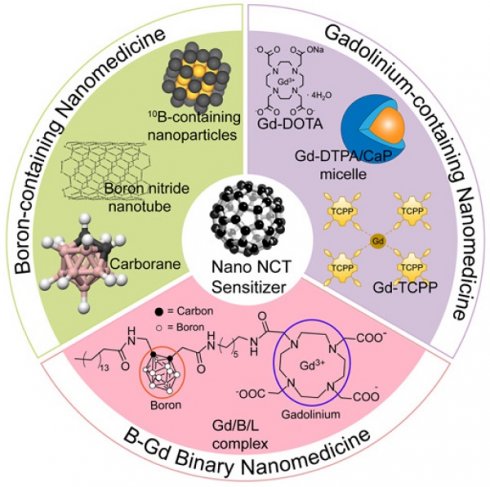
As a developing radiation treatment for tumors, neutron capture therapy (NCT) has less side effects and a higher efficacy than conventional radiation therapy. Drugs with specific isotopes are indispensable counterparts of NCT, as they are the indespensable part of the neutron capture reaction. Since the creation of the first and second generations of boron-containing reagents, NCT has significantly advanced. Notwithstanding, the extant NCT medications, predominantly comprised of small molecule boron medicines, have encountered challenges such monofunctionality, inadequate targeting of tumors, and hypermetabolism. There is an urgent need to promote the research and development of new types of NCT drugs. Bio-nanomaterials can be introduced into the realm of NCT, and nanotechnology can give conventional medications richer functionality and significant adaptability. This can complement the advantages of each other and is expected to develop more new drugs with less toxicity, low side effects, better tumor targeting, and high biocompatibility. In this review, we summarized the research progress of nano-drugs in NCT based on the different types and sources of isotopes used, and introduced the attempts and efforts made by relevant researchers in combining nanomaterials with NCT, hoping to provide pivotal references for promoting the development of the field of tumor radiotherapy.
Keywords: neutron capture therapy, nano-drugs, multi-functional compound boron drug, gadolinium-based drugs, anti-tumor therapy